USAID DEC
Vermicompost – Care and Maintenance for your worm bin
The agricultural initiative in Kenya focuses on promoting the growth of leafy crops, specifically spinach and cabbage, as part of the Horticulture Competitiveness Project (KHCP) funded by USAID.
2012 · 9 pages
Sign in to readA free account is required to download.
Abstract
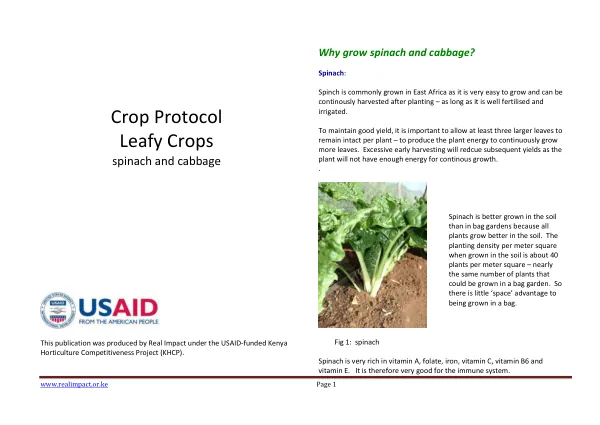
Spinach is a widely cultivated crop in East Africa due to its ease of growth and continuous harvest potential. To maintain good yield, it is essential to allow at least three larger leaves to remain intact per plant, as excessive early harvesting can reduce subsequent yields. Spinach is a nutrient-rich crop, providing high levels of vitamin A, folate, iron, vitamin C, vitamin B6, and vitamin E. Compared to cow's milk, 100 grams of cooked spinach produce contains more calcium and is more nutritious, making it a cost-effective and efficient crop for farmers. The crop is better grown in soil than in bag gardens, with a planting density of approximately 40 plants per meter square. Cabbage, another leafy crop, is widely grown in East Africa and is rich in vitamin C and vitamin A. The crop belongs to the Cruciferous family and should not be continuously planted in the same place or directly after other crops in the same family. Cabbage crops require a lot of nitrogen to stimulate vegetative growth and give higher yields, making them suitable for rotation with legume crops that can fix atmospheric nitrogen. The planting program for spinach and cabbage involves two rotation groups, one for crops that are in the ground for about 12 weeks and another for crops that are in the ground for about 20 weeks. The rotation plan includes planting leafy crops after legume crops and before root crops. A general guide for a small Nutrition Garden with 20 beds is to plant the areas in the table above at the weekly intervals stated. For cabbage, the crop rotation involves planting after legume crops, which will have fixed atmospheric nitrogen into the legume leaves and roots. Leafy crops need a lot of nitrogen to stimulate their vegetative growth and give higher yields. Suitable crops that could have been planted as previous crops in that piece of land include runner beans, common beans, French beans, peas, cowpeas, and peanuts. Bed preparation for cabbage involves cultivating the ground to a depth of 30 cm and laying 3 drip lines equally spaced. The fertiliser programme for cabbage includes a base dressing of 40g of DAP per m2 and vermi-fertiliser at 1 kg/m2. Foliar sprays involve vermi-liquid fertiliser at a 1:10 dilution every week, and topdressing involves side dressing with 40g/m2 of CAN 3 weeks after transplanting. Seed priming and making transplants for cabbage involve soaking the seeds in water for 14 hours before planting and sowing 2 seeds per cell at 1.0 cm depth in tray plugs. The planting pattern for cabbage aims for 5 plants per meter square, by planting two plants on each the outside drip lines on the edge of the bed and only one on the middle drip line. The yield for cabbage is approximately 15 kilos per meter square, assuming a cabbage head has an average weight of 3 kilos and a planting density of five plants per meter square. Harvesting cabbage starts 12-16 weeks from planting by cutting heads with a knife, and the crop can store for 8 weeks without cold storage. The main cabbage pests include the diamond back moth, cabbage aphid, whitefly, and thrips, while the main cabbage diseases include downy mildew and Alternaria. Pest control measures involve picking off caterpillars by hand, using high-pressure water jets, and applying sprays made with diluted Teepol detergent.
Related documents