IREX
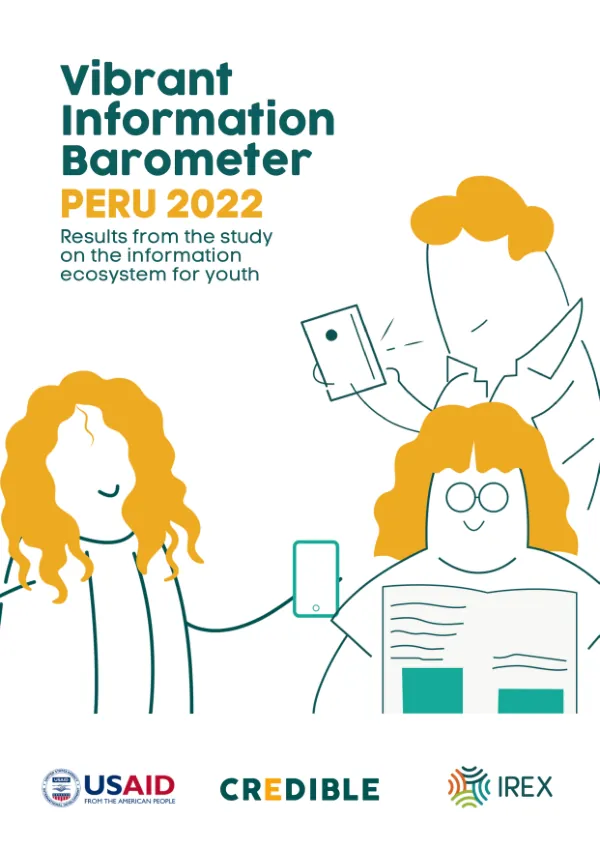
Vibrant Information Barometer 2022: Peru
The Vibrant Information Barometer (VIBE) is an annual study that tracks how information is produced, spread, consumed, and used.
2022 · 25 pages
Sign in to readA free account is required to download.
Abstract
The study aims to account for the reality that many people are simultaneously producers, transmitters, consumers, and users of information. VIBE includes four principles of information vibrancy: Information Quality, Multiple Channels, Information Consumption and Engagement, and Transformative Action. The VIBE study assesses the information system in a country based on a set of indicators and scores each principle out of a possible 40 points. The scores are then averaged to determine the Overall score, which can range from Not Vibrant (0-10) to Quite Vibrant (31-40). In the case of Peru, the Overall score is 16, which falls under the category of Slightly Vibrant (scores 11-20), indicating a weak information system. Peru's information system is characterized by a lack of quality information on some topics and geographies, with misinformation, harmful information, and hate speech having a significant influence on public discourse. The body of content is not very inclusive and diverse, and many groups are not well represented. Content production is under-resourced, and many content producers struggle to maintain the necessary resources to survive. In terms of Principle 2, many people in Peru have limited rights to information or inadequate access to information channels, and government information channels are limited. There are only a few channels with a free flow of information, and many of these channels are not editorially independent of their owners or sponsors. Principle 3 highlights the lack of media literacy and digital privacy and security skills among the population. Relatively few people engage productively with the information that is available to them, either because the information itself is limited, they do not have the capacity to participate, or because they are concerned about the repercussions. Media and information producers rarely engage with the needs of their audience or work to build trust. Finally, Principle 4 notes that information producers and distribution channels do not allow for the exchange of information across ideological lines, but they do not actively prevent it either. People and civil society occasionally use quality information to inform their actions and to improve communities, but this is not the norm. The VIBE study is designed to inform people in academia and policy, the education sector, civil society organizations, and the general public about the vitality of information systems in countries. It is also useful for designing media or information-related interventions, but it is not a tool for monitoring or evaluating the results of individual projects or programs. The study incorporates perspectives from local specialists gathered by IREX to serve as panelists, providing a comprehensive understanding of the information system in Peru.