USAID DEC
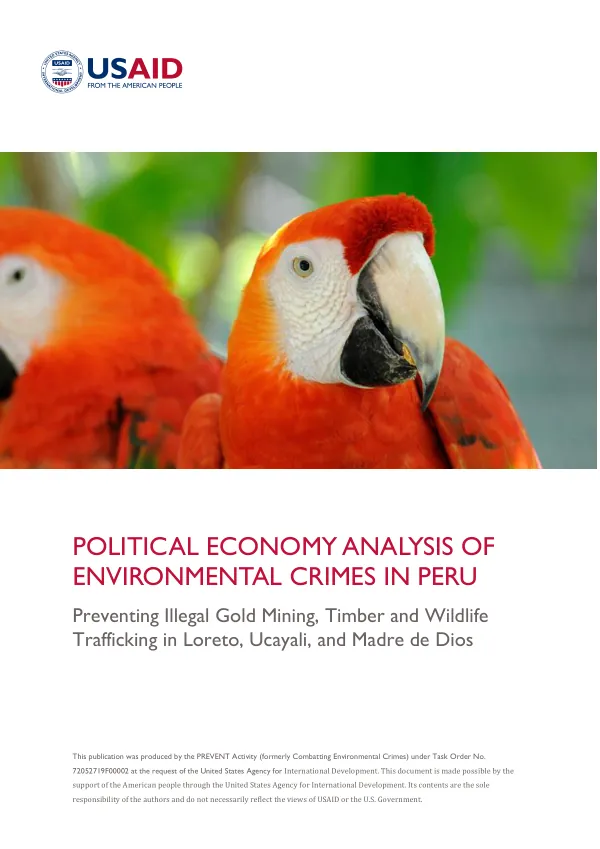
Political Economy Analysis of Environmental Crimes in Peru: Preventing Illegal Gold Mining, Timber and Wildlife Trafficking in Loreto, Ucayali, and Madre de Dios
Sign inDAI GLOBAL, LLC
Political Economy Analysis of Environmental Crimes in Peru: Preventing Illegal Gold Mining, Timber and Wildlife Trafficking in Loreto, Ucayali, and Madre de Dios
Prevention of environmental crimes in the Peruvian Amazon has entered a new era of crisis and opportunity in the post-pandemic world.
2020 · 69 pages
Sign in to readA free account is required to download.
Abstract
Illegal activity threatens the rich biodiversity of the Amazon region and has created underlying social conflict that threatens the cultural diversity of one of the most unique places in the world. The global reach of the coronavirus pandemic has exposed pressure points in Peru's commitment to eradicating these crimes. Measures of governance capacity indicate a significant gap between national level institutions established to identify and prosecute perpetrators and the regional level administration and execution of these efforts. Central government officials blame the systemic weakness on regional government officials, who in turn decry the national level reluctance to entrust regional authorities with the resources they need to prevent and control environmental crimes. Behind the finger-pointing are the perceived ties of some of the regional authorities to organized crime networks and the coziness of the private sector with evidently corrupt political elites with stakes in the status quo. Public perceptions of the problem and the role of civil society in this context are critical to improving the prevention of environmental crimes. Interviews with almost 100 respondents reveal a pattern of fractionalized authority that accompanies ineffective coordination and response. At both the national and the regional levels, the emergence of champions who see the environmental damage perpetuated by the corruption of the political actors with links to national level authorities and institutions is tempered by powerful interests in the profits of environmental crimes. Emblematic of this problem is the Yacu Kallpa case in Loreto, where the ex-governor appeared to have clear interests in obstructing prosecution of environmental crimes. Illegality is a function of the complex legal requirements and administrative procedures that foster illegality by making compliance too burdensome. Criminality is a narrower slice of illegality and organized crime is constituted in many nebulously articulated forms. Illegal timber extraction, illegal gold mining and exportation, and wildlife trafficking activities overlap with narco-trafficking, land trafficking, money laundering, and trafficking in persons. The lines among these activities can be blurry but results from illegal territorial occupation to extract and traffic resources. Fraudulent paperwork enables laundering, and the governing systems have little to no incentives or motivation to respond to environmental crimes. Such incapacity and inefficiency are linked with larger patterns of political abuse and corruption. The recent implementation of prosecutors specialized in environmental matters (FEMA) has made some progress in uncovering and prosecuting environmental crimes, including illegal gold mining, illegal timber extraction, and trafficking in wildlife species. However, these offices are understaffed and under-resourced, particularly regarding logistics support for their operations. Moreover, complex and even contradictory existing laws and regulations, the segmented structure of the government, incomplete and inadequately resourced decentralization, and a lack of inter-institutional coordination and transparency of records make their work excessively difficult. There is a need for greater focus on preventing environmental crimes than in prosecuting them after the fact. Central to the issue of fragmented authority is the failure of coordinated and integrated land-use planning and governance. Transparency around the superimposition of competing land use authorizations issued at both the regional and national level would help expose the nefarious relationships driving the dominant narrative of exasperation over the failures of inter-institutional articulation that make it impossible to implement the law.