USAID DEC
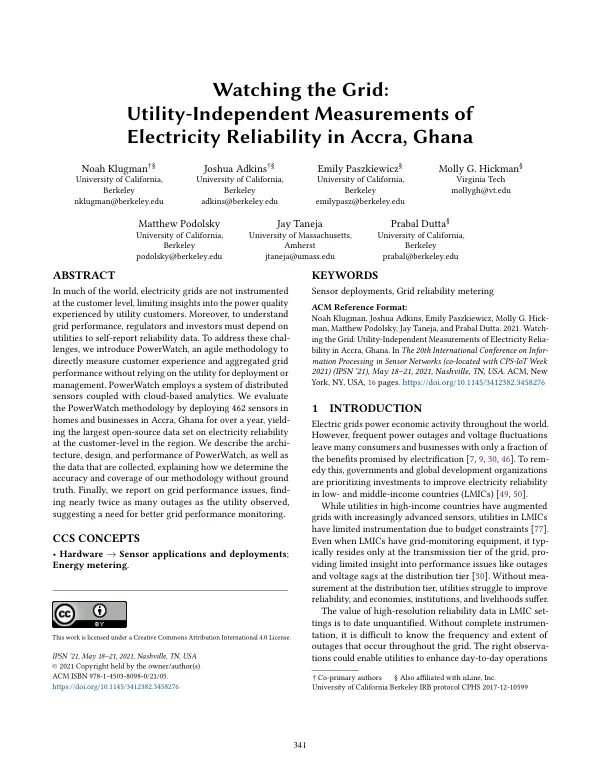
Watching the Grid: Utility-Independent Measurements of Electricity Reliability in Accra, Ghana
Sign inUS MILLENNIUM CHALLENGE CORPORATION
Watching the Grid: Utility-Independent Measurements of Electricity Reliability in Accra, Ghana
The PowerWatch system is designed to measure electricity grid reliability in real-time, providing high-resolution data on power outages and voltage fluctuations.
2021 · 16 pages
Sign in to readA free account is required to download.
Abstract
The system consists of plug-in sensors that transmit data about power quality and location to a central server for analysis. PowerWatch can detect power outages and restorations at each level of the grid, including distribution and transmission tiers. The system's architecture is based on a plug-in sensor that plugs into an electrical outlet in a home or business. The sensor periodically reports whether it has power, the local voltage and frequency, and other metadata. Multiple sensors are deployed in a site, typically under the same grid infrastructure, such as a transformer. The sensors detect clusters of power events, indicating outages or restorations. PowerWatch was deployed in Accra, Ghana, for 14 months, collecting data on grid performance. The system detected nearly twice as many outages than the utility observed, suggesting a need for better grid performance. The data collected by PowerWatch can inform utility operations and planning, enabling regulators to hold utilities accountable for system performance. The PowerWatch system has several key features, including: * High-resolution data collection: PowerWatch can detect power outages and restorations at each level of the grid, providing detailed information on grid performance. * Utility-independence: PowerWatch operates independently of the utility, allowing for unbiased data collection and analysis. * Real-time analysis: PowerWatch transmits data to a central server for real-time analysis, enabling utilities to respond quickly to power outages and voltage fluctuations. The PowerWatch system has the potential to improve grid reliability and efficiency in low-income countries, where limited instrumentation and self-reported data can hinder utility operations. By providing high-resolution data on power outages and voltage fluctuations, PowerWatch can help utilities identify areas for improvement and optimize their operations. The PowerWatch system has several benefits, including: * Improved grid reliability: PowerWatch can detect power outages and restorations, enabling utilities to respond quickly and minimize downtime. * Enhanced utility operations: PowerWatch provides high-resolution data on grid performance, enabling utilities to optimize their operations and optimize their operations. * Increased transparency: PowerWatch operates independently of the utility, providing unbiased data collection and analysis. The PowerWatch system has several applications, including: * Grid monitoring: PowerWatch can be used to monitor grid performance in real-time, enabling utilities to respond quickly to power outages and voltage fluctuations. * Utility operations: PowerWatch can be used to optimize utility operations, enabling utilities to improve grid reliability and efficiency. * Research and development: PowerWatch can be used to study grid performance and identify areas for improvement. The PowerWatch system has several advantages, including: The PowerWatch system has several limitations, including: * Limited deployment: PowerWatch is designed for deployment in low-income countries, where limited instrumentation and self-reported data can hinder utility operations. * Limited scalability: PowerWatch is designed for deployment in small-scale deployments, where limited resources are available. The PowerWatch system has several future directions, including: * Large-scale deployment: PowerWatch can be deployed in large-scale deployments, enabling utilities to monitor grid performance in real-time. * Advanced analytics: PowerWatch can be integrated with advanced analytics, enabling utilities to optimize their operations and optimize their operations. * International collaboration: PowerWatch can be used to study grid performance and identify areas for improvement in low-income countries, enabling international collaboration and knowledge sharing.