USAID DEC
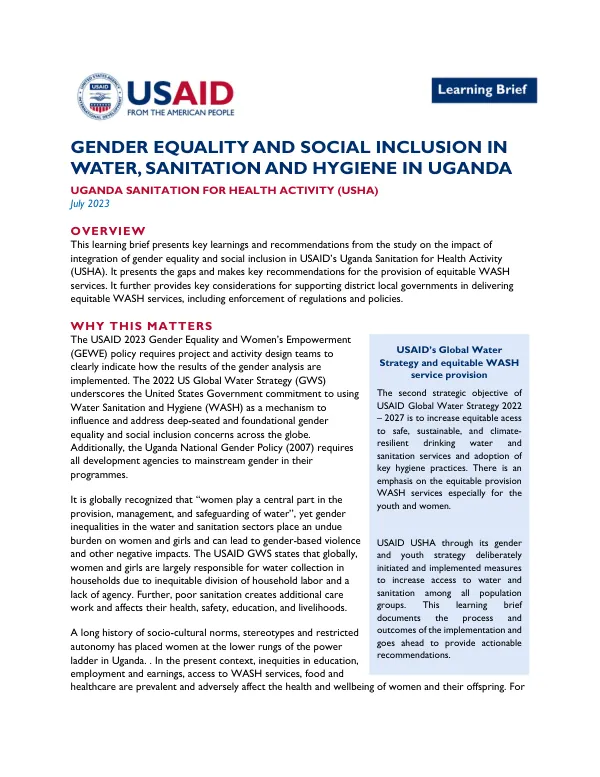
Water Resources Integration Development Initiative (WARIDI) UPWARD Gendered Social Norms Change Intervention: An Evaluation Brief
Sign inCARE
Water Resources Integration Development Initiative (WARIDI) UPWARD Gendered Social Norms Change Intervention: An Evaluation Brief
The USAID Tanzania Water Resources Integration Development Initiative (WARIDI) is working to improve the management of water resources and supply services in Tanzania.
2019 · 2 pages
Sign in to readA free account is required to download.
Abstract
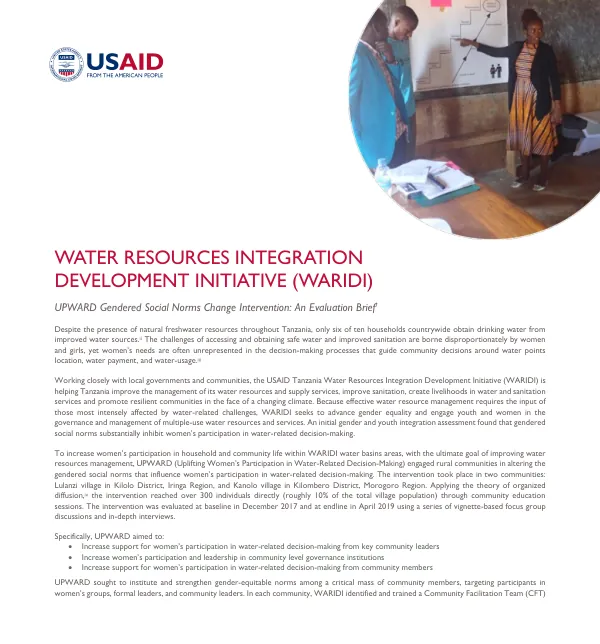
Despite the presence of natural freshwater resources throughout the country, only six of ten households obtain drinking water from improved water sources. Women and girls bear a disproportionate burden of accessing and obtaining safe water and improved sanitation, yet their needs are often unrepresented in decision-making processes. WARIDI is collaborating with local governments and communities to address these challenges. The initiative aims to advance gender equality and engage youth and women in the governance and management of multiple-use water resources and services. An initial gender and youth integration assessment found that gendered social norms substantially inhibit women's participation in water-related decision-making. To address this issue, WARIDI launched the UPWARD (Uplifting Women's Participation in Water-Related Decision-Making) intervention. The UPWARD intervention took place in two communities: Lulanzi village in Kilolo District, Iringa Region, and Kanolo village in Kilombero District, Morogoro Region. The intervention aimed to increase support for women's participation in water-related decision-making from key community leaders, increase women's participation and leadership in community-level governance institutions, and increase support for women's participation in water-related decision-making from community members. The intervention was evaluated at baseline in December 2017 and at endline in April 2019 using a series of vignette-based focus group discussions and in-depth interviews. The evaluation found that the UPWARD intervention had a significant impact on women's participation in water-related decision-making. At baseline, women's involvement in water-related decision-making was restricted to household aspects, but did not extend to broader community issues of access and availability. However, at endline, women reported feeling a stronger sense of solidarity with other women, and there were fewer reports of ridicule and discouragement from women and men. Men also reported that more respect was given to men whose wives contributed at the community level. The UPWARD intervention provides evidence that gender social norms change programs can have identifiable impacts on women's participation in water-related decision-making over a short period of time. The evaluation offers promising evidence that integrating activities to shift gender norms can effectively advance gender equality while strengthening governance and sustainability of water resource management. The findings of the UPWARD evaluation have implications for other WASH projects, highlighting the importance of addressing gendered social norms to promote women's participation in water-related decision-making. The evaluation also found that the UPWARD intervention had a positive impact on men's behavior, with men reporting that they were more likely to give respect to women who took an active role in village life. The intervention also led to increased women's participation in community meetings, with one woman stating that "men now expect women to stand up and speak their views." The UPWARD intervention demonstrates that targeted community mobilization can promote changes in social norms, even with relatively limited resources.