AECOM INTERNATIONAL
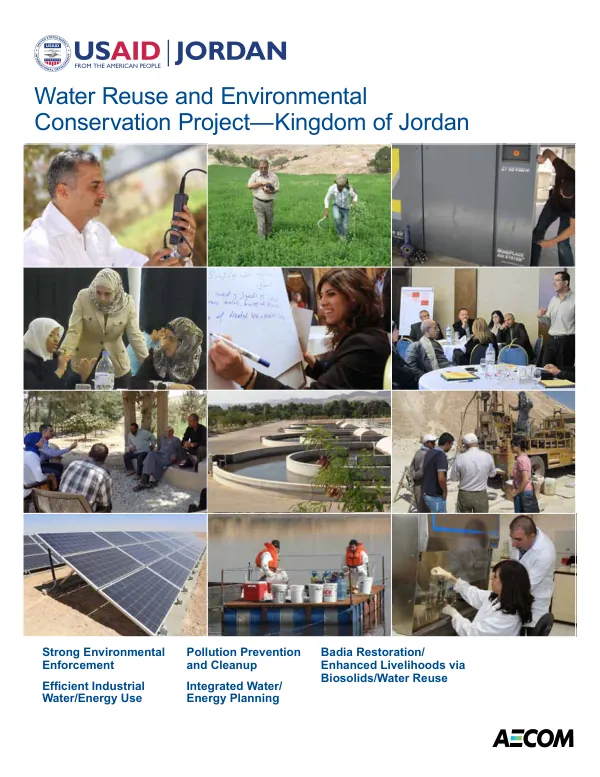
Water Reuse and Environmental Conservation Project—Kingdom of Jordan
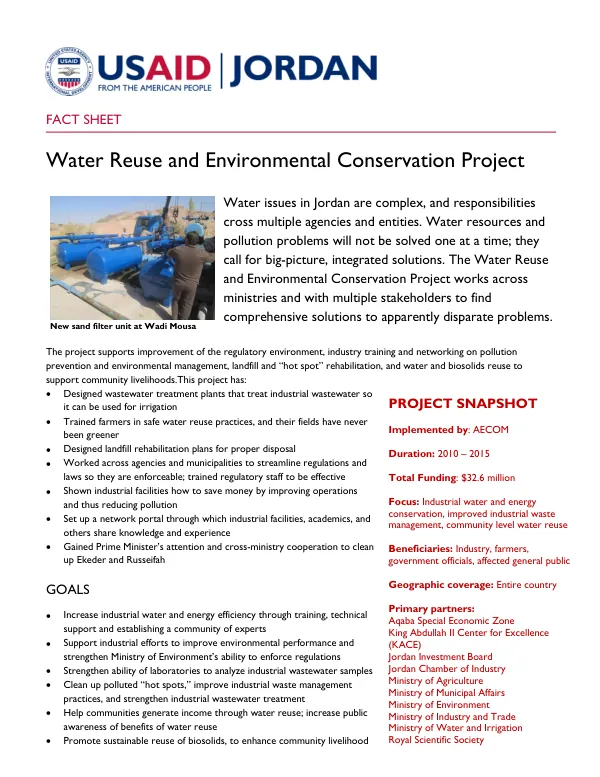
The Water Reuse and Environmental Conservation Project in the Kingdom of Jordan was a collaborative effort between the USAID and the Government of Jordan to protect and conserve the country's scarce water resources.
2010 · 13 pages
Sign in to readA free account is required to download.
Abstract
The project, implemented by AECOM from 2010 to 2015, focused on industrial water and energy conservation, industrial waste management, and community-level water reuse. With a total funding of $32.6 million, the project aimed to promote sustainable management of water resources and reduce pollution. The project's key interventions included training and technical support for industrial facilities to improve their water and energy efficiency, as well as pollution prevention and control measures. A total of 31 industrial partners were engaged in developing and implementing pollution prevention (P2) plans, resulting in significant savings of 1.38 million JOD in the first year. Additionally, 2,665 people were trained in environmental protection, and 790,000 cubic meters of water were reused annually. The project also worked with communities, ministries, and partner organizations to find comprehensive solutions to the water challenge. The Ministry of Environment, Aqaba Special Economic Zone Authority, King Abdullah II Center for Excellence, and other key stakeholders were involved in the project. The project's results included improved environmental performance in industrial factories, increased public awareness of the benefits of water reuse, and strengthened ability of laboratories to analyze industrial wastewater samples. One of the project's success stories was the rehabilitation of the irrigation network in Wadi Mousa, which resulted in enhanced water pressure, increased crop yield, and expanded planted areas with forages. The project also worked with the Lajjoun Water User Association to replicate successful elements from the Wadi Mousa plot, training farmers in reuse best practices and installing solar energy units to run irrigation pumps. The project's impact was also seen in the establishment of water reuse plans and options for refugee camps, including the Za'atari camp, where 50 farmers reused 1,000 cubic meters of reclaimed water to grow forage crops. The project also established a marketing center for storage of produced fodder, allowing farmers to hang onto fodder until prices went up. In addition to its focus on industrial water and energy conservation, the project also worked on biosolids management, beneficial reuse options for the As-Samra wastewater treatment plant, and land application of biosolids for agriculture and Badia restoration. The project's results included improved environmental performance, increased public awareness, and strengthened ability of laboratories to analyze industrial wastewater samples. The project's geographic coverage was kingdom-wide, with a focus on industrial water and energy conservation, industrial waste management, and community-level water reuse. The project's results demonstrate the potential for collaborative efforts between governments, industries, and communities to promote sustainable management of water resources and reduce pollution.