USAID DEC
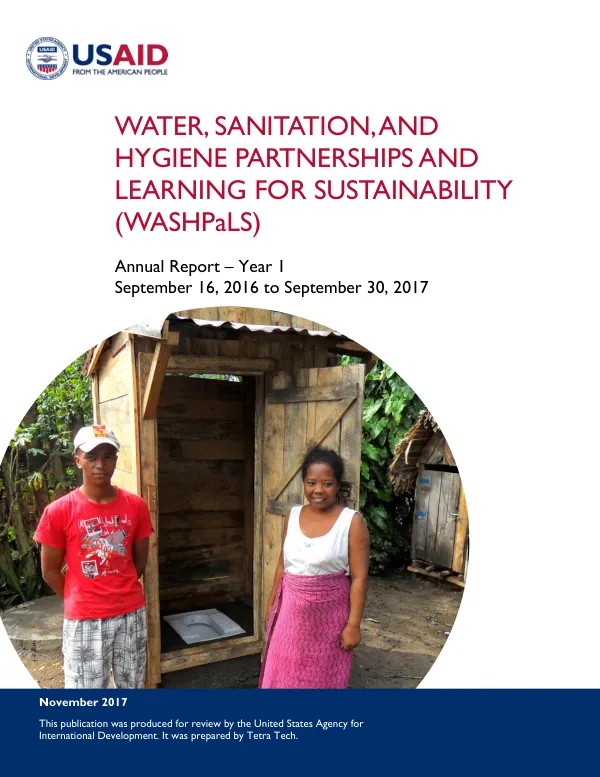
WATER, SANITATION, AND HYGIENE PARTNERSHIPS AND LEARNING FOR SUSTAINABILITY (WASHPaLS) Annual Report – Year 1
Sign inFAMILY HEALTH INTERNATIONAL
WATER, SANITATION, AND HYGIENE PARTNERSHIPS AND LEARNING FOR SUSTAINABILITY (WASHPaLS) Annual Report – Year 1
The Water, Sanitation, and Hygiene Partnerships and Learning for Sustainability (WASHPaLS) project is a 5-year task order awarded to Tetra Tech on September 16, 2016, under USAID's Water and Development Indefinite Delivery Indefinite Quantity Contract (WADI).
2017 · 36 pages
Sign in to readA free account is required to download.
Abstract
The project aims to reduce morbidity and mortality in children under five by ensuring USAID programming employs high-impact, evidence-based environmental health and WASH interventions. WASHPaLS supports the Agency's goal of reducing preventable child and maternal deaths by generating evidence to support the reduction of open defecation and movement of communities up the sanitation ladder. The project has four main components: Short-Term Technical Assistance to USAID, Implementation Research, Small Grants Program on Hygiene Behavior Change, and Participation in Strategic Partnerships. Component 1 provides USAID missions and technical bureaus with access to thought leaders and analytical expertise across a wide range of WASH themes in response to their needs. Component 2 generates evidence through implementation research to increase the sector's understanding of and approaches to sustainable WASH services, the effectiveness of behavioral and market-oriented approaches to sanitation, and measures to disrupt pathways of fecal exposure to infants and young children. Component 3 administers a small grants program on hygiene behavior change, while Component 4 engages and partners with national and global stakeholders to promote the use and application of WASHPaLS-generated evidence and global best practices by practitioners and policy makers. The project also has a strong focus on gender equality and social inclusion (GESI) across project activities. During Year 1, WASHPaLS achieved several notable milestones, including the rapid start-up of the project following the post-award meeting in October 2016. The project team on-boarded or recruited key personnel, established internal procedures, and held a team-wide planning session to develop the Year 1 Work Plan. WASHPaLS also submitted initial Year 1 project deliverables on schedule, including the Monitoring and Evaluation (M&E) Plan, Quality Assurance/Quality Control (QA/QC) Plan, and Branding Implementation Plan and Marking Plan. The project constituted the WASHPaLS Advisory Board, developed Terms of Reference for the Board, and held three official meetings. WASHPaLS also established a collaborative working relationship with the USAID technical leads through bi-weekly project meetings and periodic technical meetings to discuss direction of Component 2 and 3 activities. The project prepared a draft Engagement Strategy to define a knowledge generation and dissemination process for how the project will interact with and ultimately influence national and global stakeholders. Component 1 achieved several notable milestones, including the preparation of a Component 1 response protocol and financial reporting template. The project also provided technical assistance to USAID missions and technical bureaus, including the development of a WASH sector analysis for the Democratic Republic of Congo. Component 2 generated evidence through implementation research, including the completion of a baseline survey in Kenya and the development of a research agenda for the project. Component 3 administered a small grants program on hygiene behavior change, awarding grants to several organizations to support research and implementation of hygiene behavior change interventions. Component 4 engaged and partnered with national and global stakeholders to promote the use and application of WASHPaLS-generated evidence and global best practices. The project also made significant progress in incorporating aspects of gender equality and social inclusion (GESI) across project activities. Overall, WASHPaLS made significant progress in Year 1, achieving several notable milestones and laying the foundation for future success. The project's focus on evidence-based programming, gender equality and social inclusion, and strategic partnerships positions it well to achieve its goals and make a meaningful impact in the WASH sector.
Related documents