USAID DEC
West Africa Biodiversity and Low Emissions Development (WABiLED) - Issues Brief: Women in the Illegal Wildlife Trade and Wildlife Enforcement in West Africa
Sign inTETRA TECH ARD, INC.
West Africa Biodiversity and Low Emissions Development (WABiLED) - Issues Brief: Women in the Illegal Wildlife Trade and Wildlife Enforcement in West Africa
The Illegal Wildlife Trade (IWT) in West Africa is a significant problem, with an estimated value of up to $23 billion USD annually.
2024 · 10 pages
Sign in to readA free account is required to download.
Abstract
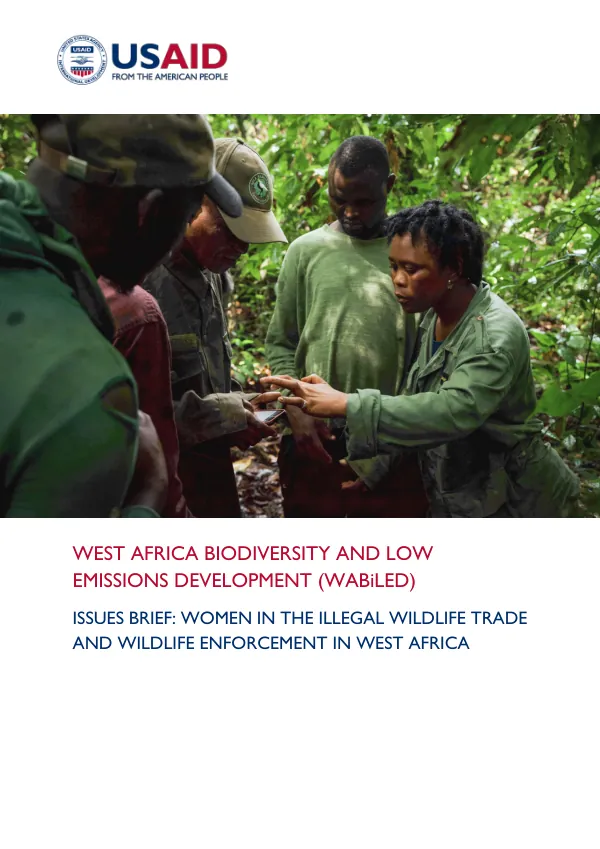
Wildlife trafficking involves the illegal trade, smuggling, poaching, capture, or collection of endangered species, protected wildlife, and their derivatives or products. The trade is driven by the potential for high revenue, with traffickers, including local community members, being attracted to the lucrative business. Women play a crucial role in the IWT in West Africa, with some involved in the legal and illegal wildlife trade as local dealers, retailers, and consumers. They buy from poachers, process bushmeat, and market and consume wildlife products. In some cases, women are involved in the capture and trade of live wildlife, such as parrots, while men accumulate the specimens before trafficking them in bulk. Women also play a significant role in shaping attitudes towards wildlife crime and conservation, with some influencing men to engage in the IWT due to its high income and food security potential. In the context of wildlife law enforcement in West Africa, men dominate the sector, with enforcement actors within customs, police, ranger units, and transnational crime-fighting entities being predominantly male. However, some countries, such as Mali, have explicit policies in favor of recruiting and appointing women to positions of responsibility. A more detailed analysis of gender dynamics shows that while there are more men in government agencies than women, the gender gap is closing for management and junior-level roles in many wildlife organizations due to the integration of gender into conservation approaches. The roles within law enforcement agencies are not gendered, but rather depend on an individual's rank or position. However, men are often assigned to field enforcement positions, while women are often assigned administrative roles or intelligence/evidence gathering for advocacy campaigns and prosecution. This is due to the cultural perception that law enforcement is a masculine job requiring physical strength and bravery, which women are culturally perceived not to have. Despite this, some civil society institutions, such as the Wildlife Conservation Society (WCS) in Liberia, are empowering and engaging women as forest rangers. The participation of women in the wildlife trade or law enforcement sectors is determined by various factors, including traditional and cultural gender norms, limited access to information, national policies, insecurity and violence, economic factors, and lack of law enforcement. Some gender norms drive IWT along the entire value chain, while others constrain it or could be amplified to curb it. Community norms impact whether the act of endangering wildlife is seen as a crime and whether the community responds with tolerance, sanctions, or a combination thereof.