USAID DEC
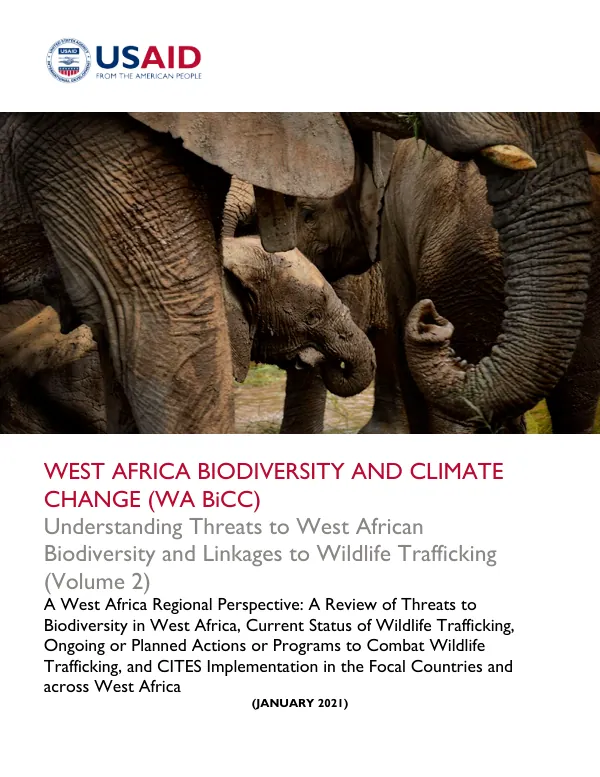
West Africa Biodiversity and Climate Change (WA BiCC): Understanding Threats to West African Biodiversity and Linkages to Wildlife Trafficking (Volume 2): A West Africa Regional Perspective
Sign inTETRA TECH ARD, INC.
West Africa Biodiversity and Climate Change (WA BiCC): Understanding Threats to West African Biodiversity and Linkages to Wildlife Trafficking (Volume 2): A West Africa Regional Perspective
Main threats to biodiversity in West Africa include habitat loss and fragmentation, overhunting, and climate change.
2021 · 141 pages
Sign in to readA free account is required to download.
Abstract
The region is home to a diverse range of species, including terrestrial fauna, terrestrial flora, marine and freshwater fauna. The Convention on International Trade in Endangered Species of Wild Fauna and Flora (CITES) has made several decisions concerning West Africa, including the listing of several species under Appendix I and II. Existing wildlife policies and legislation in West Africa are varied and often inadequate to combat wildlife crime. A robust legal landscape is required to effectively enforce CITES, including designation and assignment of authority, prohibition of trade in violation of the Convention, and penalization of illegal trade and confiscation of illegally traded specimens. Regional assessment of gaps in legal frameworks has identified several areas for improvement, including national legal frameworks and regional enforcement considerations. National structures set up to implement CITES vary across West Africa, with some countries having well-established management authorities, scientific authorities, and wildlife crime strategies and task forces. However, effectiveness of CITES implementation is often hindered by factors such as political commitment and prioritization, staffing, collaboration with national institutions, regional and international institutions, civil society, training, and availability of resources. Processes to strengthen CITES implementation include national and regional processes, which aim to improve collaboration, coordination, and capacity building. Recommendations for strengthening wildlife enforcement and combating wildlife trafficking in the region include general recommendations, such as strengthening national legal frameworks, improving regional enforcement, and enhancing collaboration and coordination. Species-specific recommendations include protecting key species, such as elephants, hippopotamuses, and marine turtles, and addressing the root causes of wildlife crime, including poverty and lack of economic opportunities. A roadmap for developing a strategy to strengthen wildlife enforcement and combating wildlife trafficking includes several key steps, including conducting a regional assessment of wildlife crime, developing a regional action plan, and establishing a regional wildlife enforcement network. West African elephant population figures are declining, with estimates suggesting a population of around 350,000 individuals. The region is also home to several MIKE sites, which are critical for monitoring and conserving wildlife populations. National Ivory Action Plans (NIAP) have been developed for several countries in the region, which aim to address the root causes of ivory trafficking and improve enforcement. Elephant ivory seizures in ECOWAS member states have been reported, with several seizures made in 2016 and 2017. The region is also home to several species of sharks and rays, which are listed under CITES. Distribution of these species in the West African region has been mapped, with several species found in the region. Marine turtles are also found in the region, with several species listed under CITES. Distribution of marine turtles in West Africa has been mapped, with several species found in the region. African Ministerial Conference on the Environment (AMCEN) has played a key role in promoting regional cooperation on environmental issues, including biodiversity conservation and wildlife trafficking. The Conference of the Parties (COP) to CITES has also made several decisions concerning West Africa, including the listing of several species under Appendix I and II. The United Nations Environment Programme (UNEP) has also played a key role in promoting regional cooperation on environmental issues, including biodiversity conservation and wildlife trafficking.
Related documents