USAID
West Africa Seed Alliance (WASA) in Action
The West Africa Seed Alliance (WASA) was established in 2007 with the goal of developing a commercial seed industry in West Africa.
2011 · 1 pages
Sign in to readA free account is required to download.
Abstract
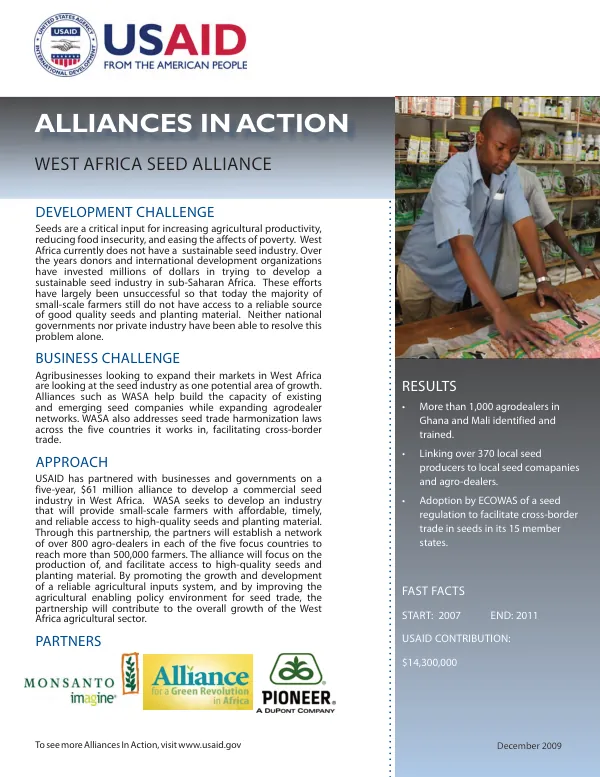
The alliance aimed to provide small-scale farmers with affordable, timely, and reliable access to high-quality seeds and planting material. WASA was a five-year partnership between USAID and various businesses and governments, with a total budget of $61 million. The partnership focused on establishing a network of over 800 agro-dealers in each of the five focus countries, including Ghana and Mali, to reach more than 500,000 farmers. The alliance sought to promote the growth and development of a reliable agricultural inputs system, and improve the agricultural enabling policy environment for seed trade. By facilitating cross-border trade in seeds, WASA aimed to contribute to the overall growth of the West Africa agricultural sector. Key activities undertaken by WASA included identifying and training over 1,000 agrodealers in Ghana and Mali, linking local seed producers to local seed companies and agro-dealers, and advocating for the adoption of a seed regulation by the Economic Community of West African States (ECOWAS). This regulation facilitated cross-border trade in seeds among the 15 member states of ECOWAS. The development of a sustainable seed industry in West Africa was critical to increasing agricultural productivity, reducing food insecurity, and easing the effects of poverty. However, previous efforts by donors and international development organizations had largely been unsuccessful in achieving this goal. National governments and private industry had been unable to resolve the problem of small-scale farmers lacking access to reliable sources of good quality seeds and planting material. The business challenge facing agribusinesses looking to expand their markets in West Africa was the need to develop a commercial seed industry that could provide high-quality seeds and planting material to small-scale farmers. Alliances such as WASA helped build the capacity of existing and emerging seed companies while expanding agrodealer networks, and addressed seed trade harmonization laws across the five countries it worked in, facilitating cross-border trade.