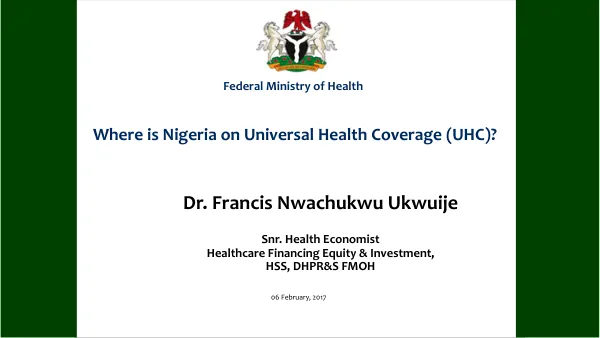
FEDERAL MINISTRY OF HEALTH
Where is Nigeria on Universal Health Coverage (UHC)?
Nigeria's progress towards Universal Health Coverage (UHC) is assessed against several key indicators.
2017 · 46 pages
Sign in to readA free account is required to download.
Abstract
The World Health Assembly Resolution of 2005 urged countries to develop their health financing systems to ensure all people have access to needed health services without financial hardship. Nigeria's health financing system is characterized by a high level of out-of-pocket spending, with out-of-pocket spending exceeding 60% of total health expenditure in 2014. The country's total health expenditure was 6.7% of GDP in 2009, below the recommended benchmark of 4-5% of GDP. Additionally, less than 2% of the population is covered by social assistance and safety-net programs, falling short of the 100% benchmark. The country's out-of-pocket spending is among the highest among low-income countries, with 89% of total health expenditure attributed to out-of-pocket spending in 2015. Nigeria's health system is also characterized by a high reliance on tertiary care, with the federal government allocating over 80% of its health budget to tertiary care. This allocation is contrary to the recommended allocation of resources to primary health care, which is essential for addressing the majority of health ailments that contribute to the country's high burden of disease. By increasing allocative efficiencies, Nigeria could increase the coverage of health care services. The country's health system also faces challenges in terms of cost efficiency, with a low cost efficiency of 10.8% in 2013. This low cost efficiency contributes to poor health outcomes, with a high burden of disease and a low level of health service utilization. The country's health system also faces challenges in terms of access to health services, with a low level of health service utilization, particularly in rural areas. Nigeria's progress towards UHC is also assessed against several key indicators, including modern contraceptive prevalence rates, antenatal care coverage, skilled birth attendance, and measles coverage. The country's performance on these indicators is below the recommended benchmarks, with a modern contraceptive prevalence rate of 10.8% in 2013, antenatal care coverage of 58% in 2013, skilled birth attendance of 35% in 2013, and measles coverage of 41.8% in 2013. In conclusion, Nigeria's progress towards UHC is slow, with several key indicators falling short of the recommended benchmarks. The country's health financing system is characterized by a high level of out-of-pocket spending, a low level of health service utilization, and a high burden of disease. To achieve UHC, Nigeria needs to increase allocative efficiencies, improve cost efficiency, and increase access to health services, particularly in rural areas.
Related documents