USAID DEC
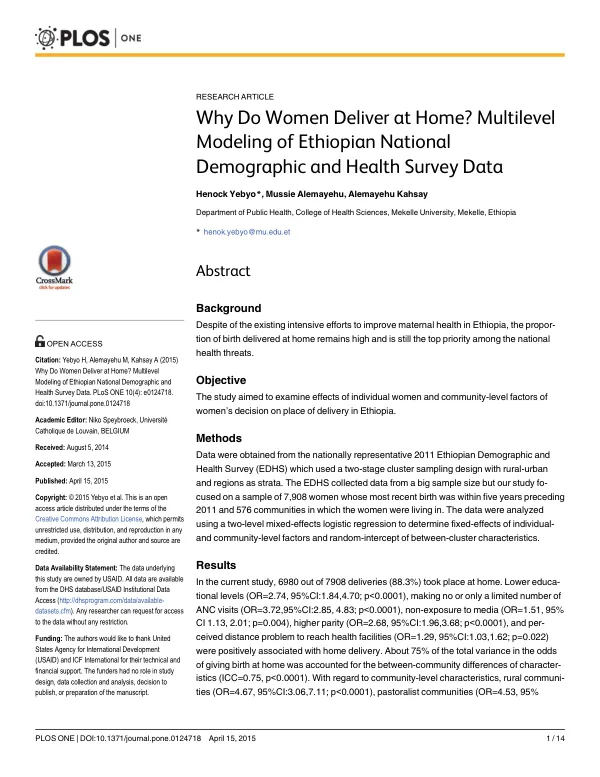
Why Do Women Deliver at Home? Multilevel Modeling of Ethiopian National Demographic and Health Survey Data
Sign inICF
Why Do Women Deliver at Home? Multilevel Modeling of Ethiopian National Demographic and Health Survey Data
Lower educational levels, making no or only a limited number of antenatal care (ANC) visits, non-exposure to media, higher parity, and perceived distance problems to reach health facilities were positively associated with home delivery in Ethiopia.
2015 · 14 pages
Sign in to readA free account is required to download.
Abstract
About 75% of the total variance in the odds of giving birth at home was accounted for by between-community differences of characteristics. Rural communities, pastoralist communities, communities with higher poverty levels, lower levels of ANC utilization, and problem of distance to a health facility had a positive influence on women to give birth at home. The Ethiopian Demographic and Health Survey (EDHS) 2011 collected data from a sample of 7,908 women whose most recent birth was within five years preceding 2011 and 576 communities in which the women were living in. The data were analyzed using a two-level mixed-effects logistic regression to determine fixed-effects of individual- and community-level factors and random-intercept of between-cluster characteristics. The study found that not only individual characteristics of women, but also community-level factors determine women's decision to deliver at home. The EDHS 2011 data showed that 90% of all deliveries in Ethiopia took place at home, regardless of expansion of strategies to increase service utilization and to improve maternal and child health. The most frequent reasons for high rates of home delivery were distance to health facility, problems in transportation, lack of decision-making power among women, low levels of antenatal care (ANC), and poor educational attainment. The study aimed to examine the effects of individual and community-level characteristics and between-community differences on women's decision to deliver at home using multilevel modeling based on the EDHS 2011 data.
Related documents
Documents in this collection
 2021
2021USAID DEC
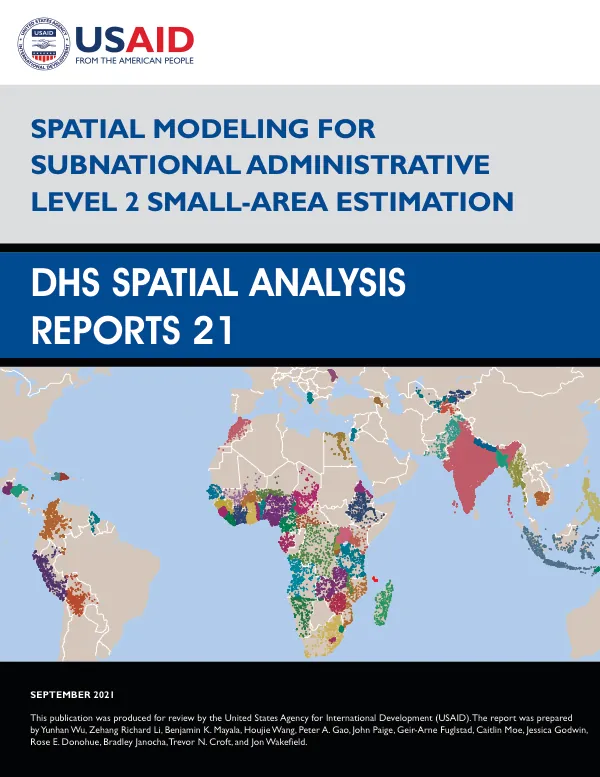
Spatial Modeling for Subnational Administrative Level 2 Small-Area Estimation
Open record 2019
2019USAID DEC