UNDP
Women’s Empowerment: Gender, Governance, and Land in Afar, Ethiopia
The Afar region in Ethiopia is characterized by high poverty rates and a harsh climate.
2018 · 14 pages
Sign in to readA free account is required to download.
Abstract
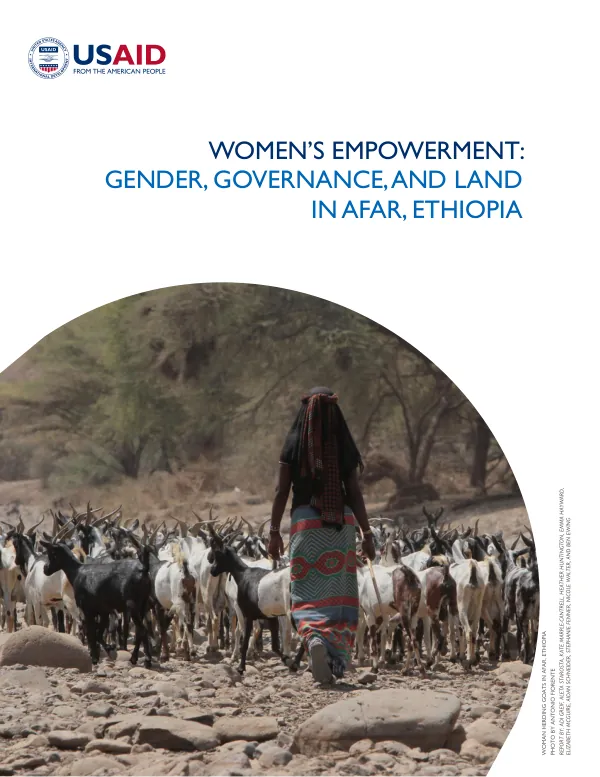
Historically, the region has been populated by pastoralist communities that herd goats, cattle, and camels, with around 30% of the region's total 1.4 million livestock depending on the rainy seasons that flood perennial and seasonal rivers and create large expanses of flooded basins and pastures. These seasonally flooded riverine areas are of interest to government and private investors for their irrigation potential, leading to the conversion of several thousand hectares of riverine grazing lands to irrigated agriculture. Land use varies distinctly by season, with clan members and their herds living on riverine lands with clear clan-based boundaries during the dry season. Households (burras) graze together with their lineage groups or extended families (dahla) and these are in turn aggregated into multiple clans (kedo) in cooperative settlements called gantas. The composition of the ganta changes during the wet season, when grazing patterns do not depend on clan and there is more mixing with other clans or gantas for security purposes and to reach water points. Afar's custom, known as Adda, prescribes strong gender norms for men and women. Men are the default head of household, and they both own most property and make most of the family's economic decisions. Women are responsible for domestic chores, milking, producing butter, and looking after small stock such as goats. Women also gather materials for and maintain mobile mat houses. Ethiopia's government has made progress revising laws to improve gender equality through a new constitution in 1995 and a new family law in 2000. These laws guarantee an equal ability to own land and to inherit, and prohibit child marriage under 18. However, customary laws often take precedence over formal laws, and wives do not have equal inheritance rights by customary law. Women access land through their husbands and may not be allowed to sell livestock without consulting their husbands. Research has shown that there is a positive relationship between wives' satisfaction with local leaders and a host of empowerment outcomes in both nomadic and settled woredas. Wives and household heads are generally positive toward local leaders, with around 40% each agreeing that leaders are fair, transparent, and working to protect land and water rights. This suggests that customary governance and women's empowerment can improve together. In terms of tenure security, there was a positive relationship between tenure security and a host of attendance and participation outcomes for community meetings on land resource use in settled woredas. However, in nomadic woredas, more tenure security increases wives' decision-making power over grazing, but decreases their meeting participation. This discrepancy between decision making and participation indicates that the distinction between a woman's private and public choices needs more attention. Wives are more likely than household heads to believe that encroachment will occur on water points from regional and national governments. Wives are also less likely than all household heads to agree that leaders' allocation of farmland is fair. In situations of high poverty, dividing farmland may make the land too small to support a family, providing a strong incentive for male household heads to restrict the division of farmland by giving it to fewer (and likely male) heirs. Female empowerment is linked to education and age at marriage. Afar girls complete, on average, less than one year of education, and girls are often married at a young age, with 16 being the minimum age allowed with dispensation. This early marriage can limit women's opportunities for education and economic empowerment.