RTI INTERNATIONAL
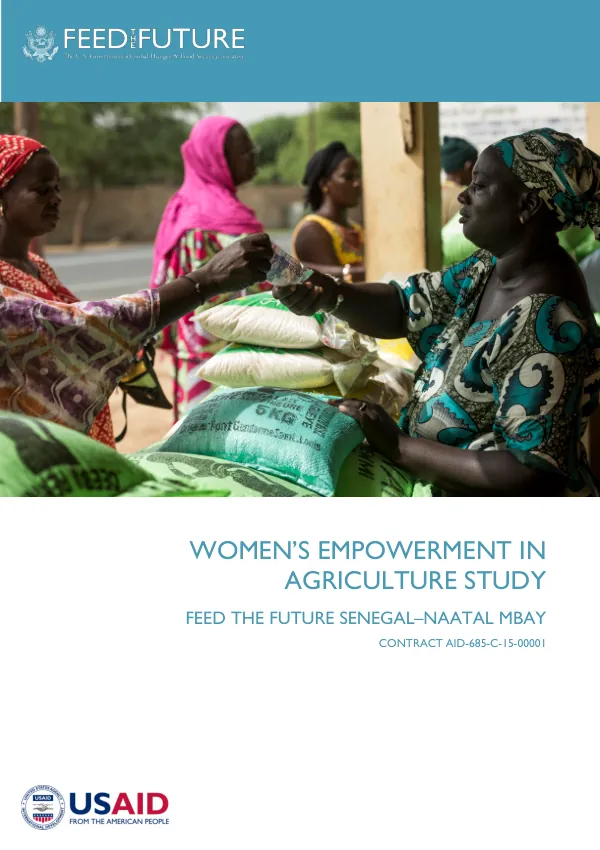
Women’s Empowerment in Agriculture Study
The Women's Empowerment in Agriculture Study in Senegal-Naatal Mbay was conducted in June 2018.
2018 · 127 pages
Sign in to readA free account is required to download.
Abstract
The study aimed to assess the level of women's empowerment in agriculture and identify factors that contribute to their empowerment. The study was conducted in the Naatal Mbay region of Senegal, which is one of the poorest regions in the country. The study used a mixed-methods approach, combining both quantitative and qualitative data collection methods. The quantitative study involved a survey of 1,200 individuals, while the qualitative study consisted of in-depth interviews and focus group discussions with 120 participants. The study team also conducted a separate analysis of the data using the Agency-Wide Empowerment in Agriculture Index (A-WEAI). The study found that women in the Naatal Mbay region face significant challenges in accessing productive resources, participating in economic activities, and making decisions within their households. The study also found that women's empowerment is closely linked to their access to education, credit, and market information. Women who have higher levels of education and access to credit are more likely to participate in economic activities and make decisions within their households. The study used the A-WEAI to assess women's empowerment in five domains: economic, social, political, educational, and health. The results showed that women in the Naatal Mbay region scored low on all five domains, indicating a high level of disempowerment. The study also found that women's empowerment varies significantly across different zones and regions within the Naatal Mbay area. The study's qualitative findings highlighted the importance of women's participation in economic activities and decision-making within their households. Women who participate in economic activities, such as farming and trading, are more likely to have higher levels of empowerment. The study also found that women's access to credit and market information is critical in enabling them to participate in economic activities and make decisions within their households. The study's conclusion emphasizes the need for policies and programs that address the root causes of women's disempowerment in agriculture. The study recommends that policymakers and program implementers prioritize women's access to education, credit, and market information, as well as their participation in economic activities and decision-making within their households. The study also highlights the importance of involving women in the design and implementation of policies and programs that aim to promote their empowerment. The study's findings have significant implications for policymakers and program implementers in Senegal and other countries in the region. The study's recommendations provide a framework for designing and implementing policies and programs that promote women's empowerment in agriculture and address the root causes of their disempowerment.