THE CLOUDBURST GROUP
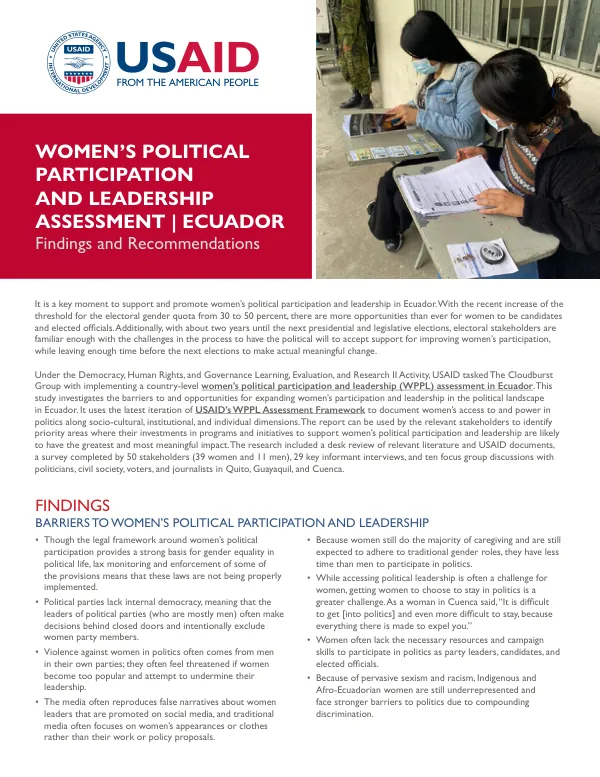
Women’s Political Participation and Leadership Assessment | Ecuador
Women's political participation and leadership in Ecuador is a critical area of focus, particularly with the recent increase in the electoral gender quota threshold from 30 to 50 percent.
2024 · 2 pages
Sign in to readA free account is required to download.
Abstract
This shift presents opportunities for women to become candidates and elected officials. Electoral stakeholders are now familiar with the challenges in the electoral process and have the political will to support improvements in women's participation, leaving enough time before the next elections to make meaningful change. The Democracy, Human Rights, and Governance Learning, Evaluation, and Research II Activity, implemented by USAID through The Cloudburst Group, conducted a country-level women's political participation and leadership assessment in Ecuador. This study investigated the barriers to and opportunities for expanding women's participation and leadership in the political landscape. The assessment used the latest iteration of USAID's Women's Political Participation and Leadership Assessment Framework to document women's access to and power in politics along socio-cultural, institutional, and individual dimensions. The assessment identified several barriers to women's political participation and leadership in Ecuador. The legal framework around women's political participation provides a strong basis for gender equality, but lax monitoring and enforcement of some provisions means that these laws are not being properly implemented. Political parties lack internal democracy, often making decisions behind closed doors and excluding women party members. Violence against women in politics often comes from men within their own parties, and the media often reproduces false narratives about women leaders. Despite these challenges, there are opportunities for women's political participation and leadership in Ecuador. The legal framework is relatively progressive, providing women with more access to formal political opportunities than ever before. The law on political violence has been used to prosecute and sanction individuals who have committed violence against women in politics, although violence remains underreported and perpetrators often go unpunished. Women's civil society is strong and has successfully advocated for important gains for women's rights. The assessment also highlighted the importance of engaging men as allies and promoting a school curriculum that challenges harmful gender stereotypes and typical gender roles. Implementing awareness campaigns to address the influence and impact of misogyny and political violence on gender equality and women's political rights is also crucial. Additionally, funding grassroots women's rights organizations and promoting the participation of the private sector in fundraising for women's electoral campaigns can help support women's participation in politics. Providing sustained training for women on campaign skills, resilience, strategic communications, conflict mitigation, and negotiation is essential. Supporting existing networks of women in politics and facilitating regional or global meetings for women to share challenges and best practices can also help women stay in politics. Programs that support women's access to and control over financial resources are also necessary to address the barriers faced by women in politics.