LOCAL CIVIL SOCIETY ORGANIZATIONS
Women's Political Participation and Leadership Assessment in Côte d'Ivoire
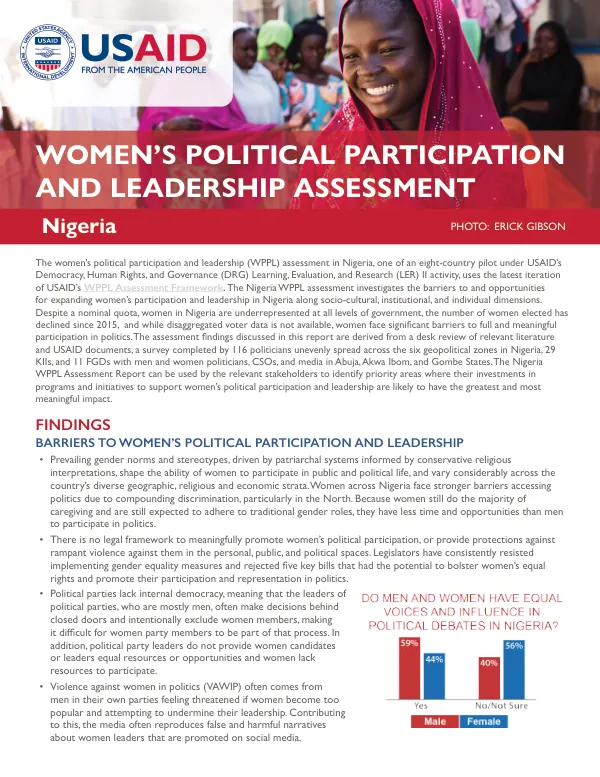
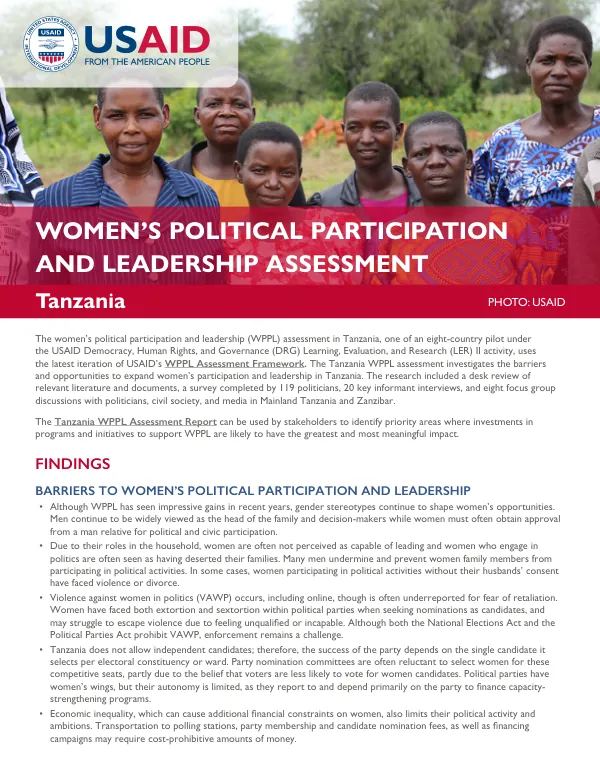
Women's political participation and leadership in Côte d'Ivoire have significant barriers and opportunities.
2024 · 2 pages
Sign in to readA free account is required to download.
Abstract
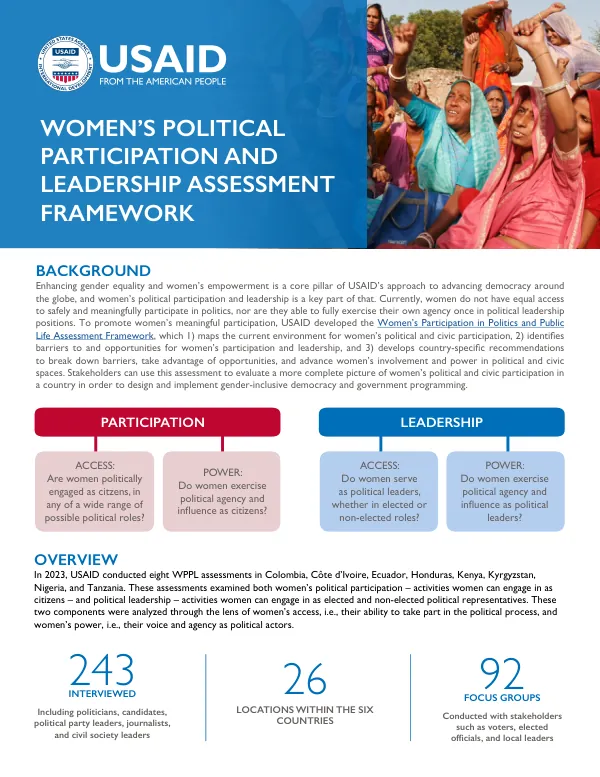
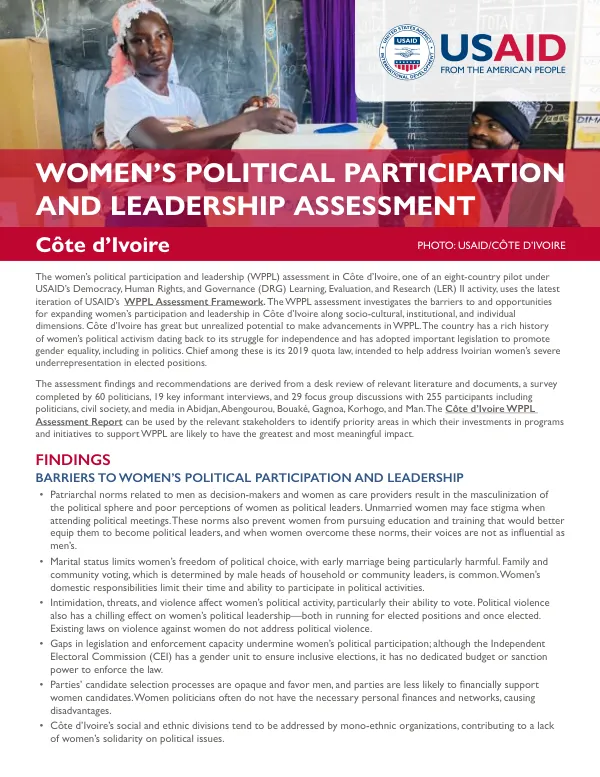
Patriarchal norms related to men as decision-makers and women as care providers result in the masculinization of the political sphere and poor perceptions of women as political leaders. Unmarried women may face stigma when attending political meetings, and these norms prevent women from pursuing education and training that would better equip them to become political leaders. Marital status limits women's freedom of political choice, with early marriage being particularly harmful. Family and community voting, which is determined by male heads of household or community leaders, is common. Women's domestic responsibilities limit their time and ability to participate in political activities. Intimidation, threats, and violence affect women's political activity, particularly their ability to vote. Political violence also has a chilling effect on women's political leadership, both in running for elected positions and once elected. Côte d'Ivoire's 2019 quota law requires political parties to nominate 30 percent women candidates for parliamentary and local elections. Although the law's delayed implementation has not yet manifested in gender parity in political representation, it is a promising step. Low levels of confidence and political awareness affect women's rates of political participation; however, surveys indicate women's willingness to participate and efforts to encourage women's political participation and leadership are viewed positively. Men politicians overestimate their party's efforts to advance women's political participation and leadership, but politicians of both genders support measures to increase women's leadership. The assessment findings and recommendations are derived from a desk review of relevant literature and documents, a survey completed by 60 politicians, 19 key informant interviews, and 29 focus group discussions with 255 participants including politicians, civil society, and media in Abidjan, Abengourou, Bouaké, Gagnoa, Korhogo, and Man. The Côte d'Ivoire WPPL Assessment Report can be used by relevant stakeholders to identify priority areas in which their investments in programs and initiatives to support WPPL are likely to have the greatest and most meaningful impact. Selected recommendations include developing culturally informed educational materials on civic education and women's political participation to bolster women's knowledge of and confidence to participate in civic and political life. Donors and partners should mobilize nationally influential men and women athletes, actors, musicians, media personalities, and customary and religious leaders as champions to transform gender norms and women's role in political life. The government should strengthen the Independent Electoral Commission's independence and authority, including via monetary support, to solidify recent progress in enforcing the 2019 quota law.