USAID
Women's Political Participation and Leadership Assessment
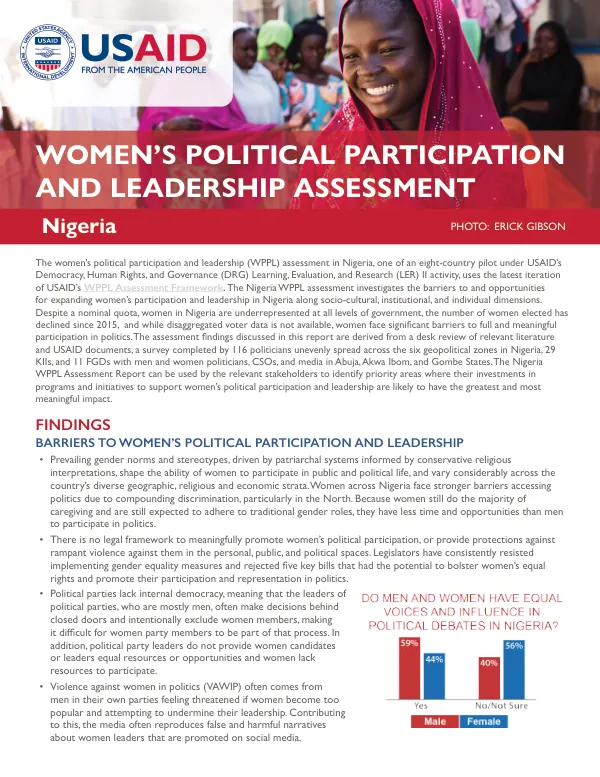
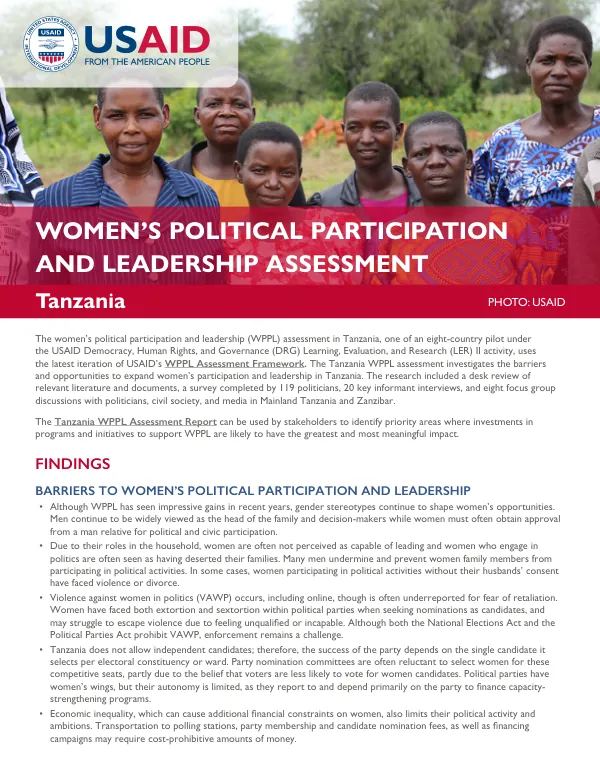
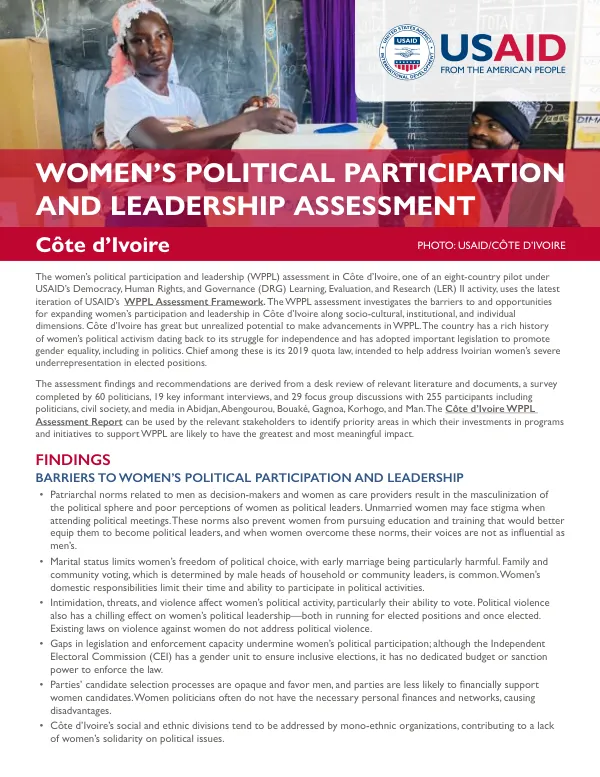
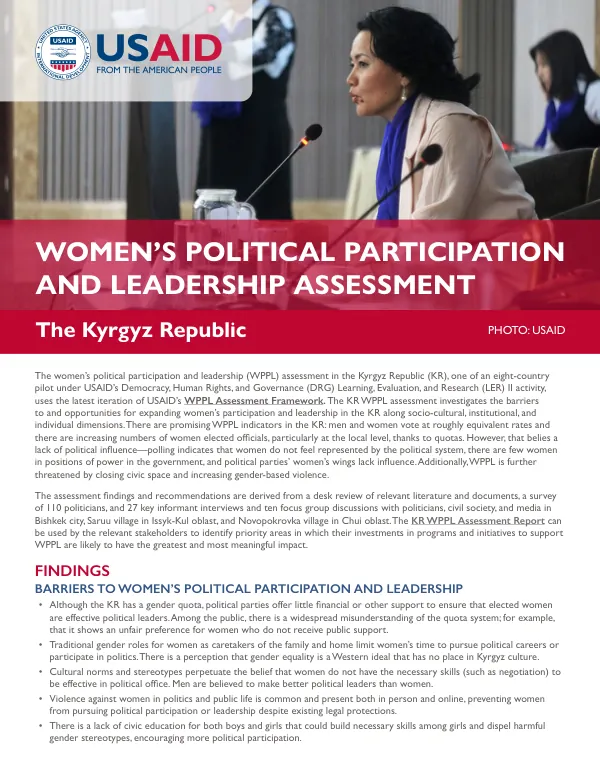
The Kyrgyz Republic's women's political participation and leadership (WPPL) assessment investigates the barriers to and opportunities for expanding women's participation and leadership in the country along socio-cultural, institutional, and individual dimensions.
2024 · 2 pages
Sign in to readA free account is required to download.
Abstract
The assessment uses the latest iteration of USAID's WPPL Assessment Framework and is part of an eight-country pilot under USAID's Democracy, Human Rights, and Governance (DRG) Learning, Evaluation, and Research (LER) II activity. Promising WPPL indicators in the Kyrgyz Republic include men and women voting at roughly equivalent rates and increasing numbers of women elected officials, particularly at the local level, thanks to quotas. However, this belies a lack of political influence, with women not feeling represented by the political system, few women in positions of power in the government, and political parties' women's wings lacking influence. Additionally, WPPL is threatened by closing civic space and increasing gender-based violence. The assessment findings and recommendations are derived from a desk review of relevant literature and documents, a survey of 110 politicians, and 27 key informant interviews and ten focus group discussions with politicians, civil society, and media in Bishkek city, Saruu village in Issyk-Kul oblast, and Novopokrovka village in Chui oblast. The assessment identifies several barriers to women's political participation and leadership, including a lack of financial and other support from political parties, traditional gender roles limiting women's time to pursue political careers, cultural norms and stereotypes perpetuating the belief that women do not have the necessary skills to be effective in political office, and violence against women in politics and public life. Despite these barriers, the assessment identifies several opportunities for women's political participation and leadership, including the updated framework for supporting WPPL in the long-term National Gender Strategy on Achieving Gender Equality, adopted in 2022, and the requirement for 30 percent of seated members of parliament to be women. The assessment also highlights the potential for donor programming to build on the election of women candidates to encourage women's political participation and expand their voices in government. The assessment recommends several actions to address the barriers to women's political participation and leadership, including working with civil society organizations to train journalists and other media professionals in gender sensitivity, engaging men gatekeepers to educate them on the pernicious effects of harmful gender stereotypes, and making the National Gender Strategy a priority and achieving the Kyrgyz Republic's gender empowerment goals. The assessment also recommends strengthening opportunities for women politicians to network and caucus with one another, supporting civic education programs designed to improve democratic and political literacy in society, and developing programming that trains women politicians to effectively use the media.