USAID DEC
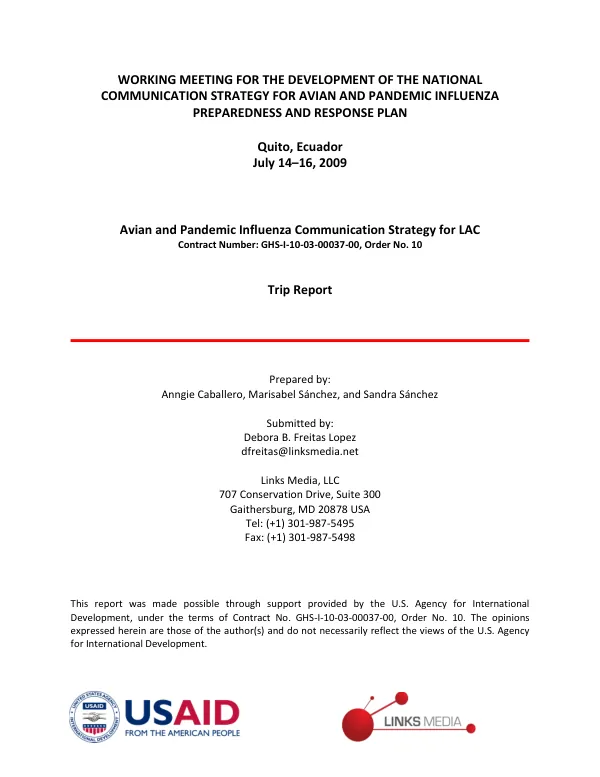
Working Meeting for the Development of the National Communication Strategy for Avian and Pandemic Influenza Preparedness and Response Plan
Sign inLINKS MEDIA, LLC
Working Meeting for the Development of the National Communication Strategy for Avian and Pandemic Influenza Preparedness and Response Plan
The working meeting for the development of the national communication strategy for avian and pandemic influenza preparedness and response plan was held in Quito, Ecuador, from July 14-16, 2009.
2009 · 25 pages
Sign in to readA free account is required to download.
Abstract
The meeting was facilitated by Marisabel Sánchez, Anngie Caballero, and Sandra Sánchez of Links Media, a full-service communications company that provides expert consultation services to the United States Agency for International Development (USAID) in support of the development and implementation of avian and pandemic influenza communication strategy and collateral material development for the Latin American and Caribbean region. The purpose of the trip was to facilitate a workshop for the development of a national communication strategy for avian and pandemic influenza preparedness and response plan. The workshop aimed to bring together key stakeholders from the Ecuadorian government, including the Ministry of Health, the Ministry of Agriculture, and the National Association of Poultry Farmers, to discuss and develop a comprehensive communication strategy for increasing awareness among key target audiences of high-risk behaviors for contracting avian influenza, practical preventive measures, and how to recognize, respond to, and treat avian influenza. The scope of work for the trip included facilitating the workshop, providing technical assistance and training on how to make the strategic plan operational at different levels, and observing procedures and outcomes. The workshop was attended by representatives from various government agencies, including the Ecuador National Inter-institutional Committee of Communication, and international organizations, such as the Pan American Health Organization (PAHO). Key findings from the workshop included the need for a comprehensive communication strategy that addresses the specific needs and concerns of different target audiences, including backyard farmers, consumers of poultry, healthcare and veterinary staff, municipality officials, and families. The strategy should provide practical preventive measures, such as vaccination and biosecurity practices, and tools to support the implementation and monitoring of the proposed communication interventions. The conclusions from the workshop emphasized the importance of a coordinated and multi-sectoral approach to communication and preparedness for avian and pandemic influenza. The recommendations included the development of a comprehensive communication strategy that addresses the specific needs and concerns of different target audiences, the provision of technical assistance and training to support the implementation of the strategy, and the establishment of a monitoring and evaluation system to track progress and outcomes. The working meeting was a success, and the participants expressed their appreciation for the opportunity to discuss and develop a comprehensive communication strategy for avian and pandemic influenza preparedness and response plan. The strategy will provide a conceptual framework and sound operating principles for increasing awareness among key target audiences of high-risk behaviors for contracting avian influenza, practical preventive measures, and how to recognize, respond to, and treat avian influenza. The development of the national communication strategy for avian and pandemic influenza preparedness and response plan is a critical step in preparing for a potential influenza pandemic in the Latin American and Caribbean region. The strategy will provide a framework for coordinated and multi-sectoral communication and preparedness efforts, and will help to strengthen capacities to rapidly detect and respond to the current avian influenza problem in animals and humans, and to prepare for a possible human influenza pandemic.