USAID
Workshop on the Flagship Learning Program for the Next Decade
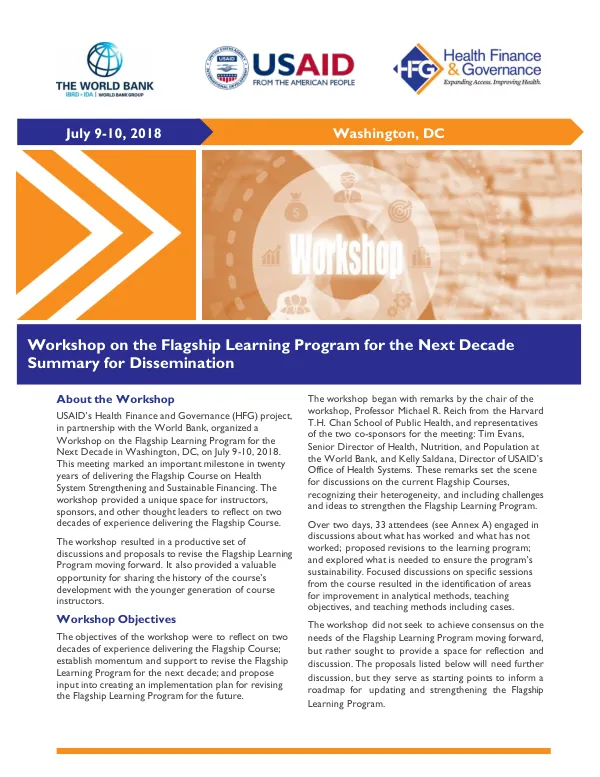
The Flagship Learning Program for the Next Decade was the focus of a workshop organized by USAID's Health Finance and Governance (HFG) project in partnership with the World Bank.
2018 · 4 pages
Sign in to readA free account is required to download.
Abstract
The workshop took place in Washington, DC, on July 9-10, 2018, and brought together 33 attendees, including instructors, sponsors, and thought leaders. The meeting marked a significant milestone in the program's 20-year history, which has delivered the Flagship Course on Health System Strengthening and Sustainable Financing to over 20,000 participants worldwide. The workshop aimed to reflect on two decades of experience delivering the Flagship Course, establish momentum and support for revising the program, and propose input into creating an implementation plan for the future. The discussions centered on the current Flagship Courses, recognizing their heterogeneity, and identifying areas for improvement in analytical methods, teaching objectives, and teaching methods, including cases. Attendees agreed that the Flagship Learning Program has continued to be a valuable capacity-building and knowledge-transfer mechanism for health system actors. The program has been highly demanded by national governments and donor agencies, and its materials have been continually revised and adapted at the country and regional levels. Workshop attendees recommended additional efforts to create an easily accessible library of course materials, enhance coordination among instructors and sponsoring agencies, and develop methods for adapting the global course to regional and national contexts. The Flagship Learning Program's language needs to be updated to reflect current terminology and thinking about health systems strengthening. Attendees agreed that the analytical framework and the flagship approach remain largely valid, and that the orientation of the control knobs towards action is a strong element of the approach. They expressed the need for thinking about how to bring the different control knobs together as policy variables connected to produce certain desired outcomes and how to facilitate the translation of ideas into action by mapping the control knobs to organizational structures within countries. A key insight from the workshop was that the Flagship Learning Program has created a global Flagship community. Attendees emphasized the value of having a community that cares deeply about advancing the health systems field and carrying forward the Flagship Learning Program. Course founders shared stories about the history of the course's development and the theoretical underpinnings of the framework with the younger generation of instructors, creating a unique opportunity to support the generational transition of the course faculty. Workshop attendees discussed the need to integrate an emphasis on equity in health system performance throughout the curriculum and adapt the Flagship Learning Program to serve the needs of countries in transition and countries in crisis. They recognized the importance of adapting the program to a country's stage of development and addressing the challenges of implementation in strengthening health systems. The attendees also discussed the challenges of getting the right people to attend the course and the advantages and disadvantages of mixed audiences. The workshop attendees exchanged ideas about how to engage with course participants after the course, discussed establishing an alumni network, and identified a need for sharing information about follow-up courses with course participants. They highlighted the opportunity that technology offers to improve the delivery of the content, including the use of e-learning to make more efficient use of in-class time. Attendees also discussed the need to strengthen the pedagogic guidance for faculty of the Flagship Course and develop more teaching cases. There was broad agreement among workshop attendees that updating the Flagship Learning Program will require time, resources, and multiple stakeholders, and that this workshop was just the first phase of a longer-term consultative process. Attendees emphasized the need for better coordination among different institutions affiliated with the Flagship Course and noted that future efforts to revise the Flagship curriculum should consider input from past course participants.