USAID DEC
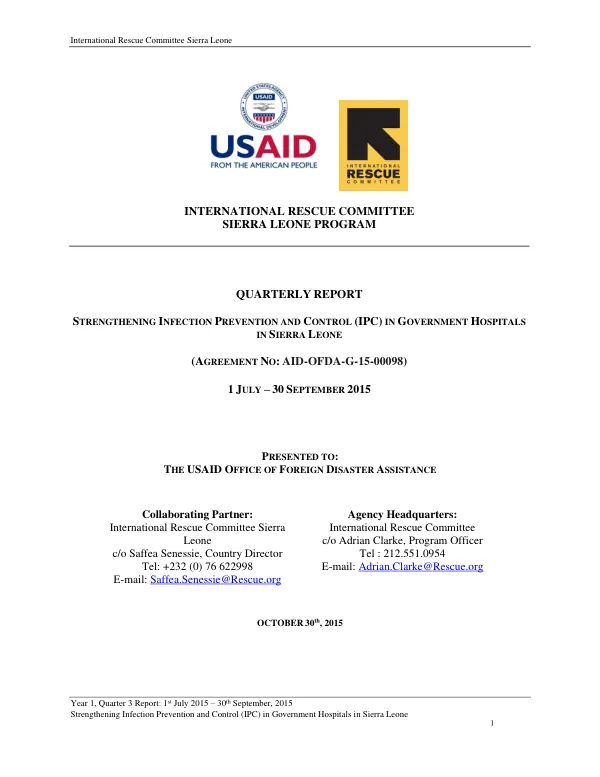
Year 1, Quarter 3 Report: 1st July 2015 – 30th September, 2015 Strengthening Infection Prevention and Control (IPC) in Government Hospitals in Sierra Leone
Sign inCONCERN WORLDWIDE INTERNATIONAL
Year 1, Quarter 3 Report: 1st July 2015 – 30th September, 2015 Strengthening Infection Prevention and Control (IPC) in Government Hospitals in Sierra Leone
Strengthening Infection Prevention and Control (IPC) in Government Hospitals in Sierra Leone began in response to the Ebola Virus Disease (EVD) outbreak.
2015 · 11 pages
Sign in to readA free account is required to download.
Abstract
The program aimed to improve IPC knowledge, practices, and infrastructure in 19 government hospitals. The goal was to protect healthcare workers and patients from nosocomial infections by educating staff, implementing standard operating procedures, and monitoring adherence to the standard operating procedure (SOP) for "Safe Provision of Hospital Services during an Ebola/Viral Hemorrhagic Fever (VHF) Outbreak." The program targeted 4,890 health workers and 5,687,150 individuals in 12 districts of Sierra Leone. The duration of the program was 12 months, with the first quarter of the program spanning from July 1st to September 30th, 2015. The program was supported by funding from the United States Agency for International Development (USAID) Office of Foreign Disaster Assistance (OFDA). During the reporting period, the number of confirmed EVD cases decreased from 121 cases between April and June to 36 cases between July and September. However, the cases that occurred during the previous quarter highlighted the ongoing risks that the region will continue to face over the coming months, including the risk of imported cases and late detection. Protecting health workers and patients at all health facilities was a key strategy within the EVD response. Patients with EVD still presented to non-EVD facilities, posing a risk of transmission to healthcare workers, facility staff, other patients, and visitors. Since the start of the outbreak, there had been 307 EVD cases and 221 deaths of healthcare workers in Sierra Leone, leading to fear among healthcare workers and patients, resulting in reduced availability and utilization of routine essential health services. The program provided support to Sierra Leone's Ministry of Health and Sanitation (MoHS) to implement a comprehensive program to support IPC trainings and intensive supervision in 19 government hospitals. The program included the placement of NGO Infection Prevention and Control Mentors in each of the 19 supported hospitals. The mentors worked with the IPC Focal Person to improve and sustain IPC implementation through on-the-job training, IPC supervision, and strengthening hospital IPC systems. Healthcare worker training was also a key component of the program. Between July 1st and September 30th, seven out of the remaining nine hospitals completed the IPC training for clinical and support staff. In total, 1,632 clinical and support staff received IPC training during this reporting period. The training was followed by continuous on-the-job training to consolidate IPC adherence. The program also focused on building the capacity of the IPC Focal Persons to play an increasingly central role in coordinating IPC activities in the hospitals. The skills imparted to IPC Focal Persons through mentorship during the quarter included mentoring the IPC Focal person to facilitate both formal and on-the-job trainings, IT skills, chairing meetings, and conducting systematic IPC supervisions. By September 30th, all staff in 17 out of the 19 targeted hospitals had received the initial comprehensive training on IPC, as well as refresher trainings as needed. The program will continue to work with the MoHS and support them to ensure health workers feel confident to continue to safely provide healthcare to their communities and will be able to take necessary steps to immediately correct any mistakes as they are identified.