USAID DEC
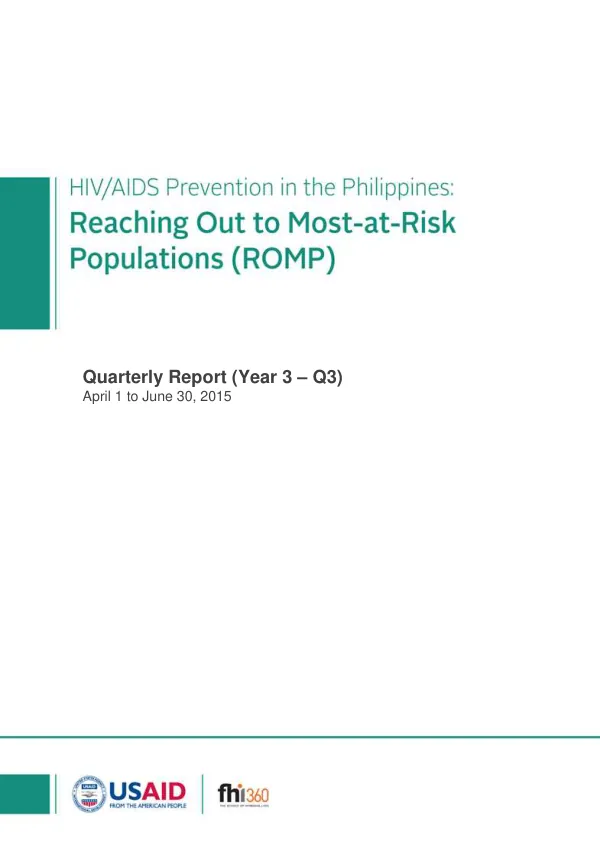
Year 2 Report: HIV/AIDS Prevention in the Philippines: Reaching Out to Most-at-Risk Populations (ROMP) Project
Sign inFHI 360
Year 2 Report: HIV/AIDS Prevention in the Philippines: Reaching Out to Most-at-Risk Populations (ROMP) Project
The HIV/AIDS Prevention in the Philippines: Reaching Out to Most-at-Risk Populations (ROMP) Project is a comprehensive initiative aimed at addressing the challenges in HIV programming for men who have sex with men (MSM) and people who inject drugs (PWID).
2014 · 49 pages
Sign in to readA free account is required to download.
Abstract
The project is implemented by FHI 360 Philippines Office, in partnership with the Philippine Department of Health (DOH), with funding support from the United States Agency for International Development (USAID). The project's primary objective is to develop and test comprehensive package of services (CPS) models for MSM and PWID that can be adopted and recommended by the national AIDS program to other local government units (LGUs) for implementation. The CPS models aim to increase the effectiveness of peer education activities and address the loss-to-follow-up of clients along the HIV services cascade. During the third quarter of Year 3 (Y2Q3), the MSM component of the project reached 229 MSMs with motivational interviewing, HIV testing, and counseling. This brings the cumulative total to 1,014 MSMs reached, tested, and aware of their test results since recruitment started, exceeding the target of 800 by 27 percentage points. The HIV positivity rate among MSMs tested during this quarter was 13%, which is higher than the 2013 HIV prevalence for MSM in Quezon City, which was around 7%. For the PWID component, the project focused on providing comprehensive services, including prevention and education, diagnosis of HIV, STIs, and TB, case management, care and support, and strengthening behavioral change communication (BCC) programming. The project also conducted a midterm evaluation, which revealed a 27% increase in household income among program participants compared to the control group. The project's implementation issues were discussed during the Case Management Team (CMT) and Service Delivery Network (SDN) meetings, as well as during monitoring visits. The issues related to the delivery of HIV cascade of services were identified, and the project is working to address these challenges. The project's outputs were disseminated through various channels, including the DOH-CHD 7 Regional HIV/AIDS Summit 2015 AIDS Candlelight Memorial Commemoration. The project's financial reports were also submitted, providing an overview of the project's financial performance during the reporting period. The project's success in reaching MSMs and PWID with comprehensive services is a significant achievement, and the project's outputs and lessons learned will be valuable in informing future HIV programming in the Philippines. The project's focus on addressing the loss-to-follow-up of clients along the HIV services cascade and increasing the effectiveness of peer education activities is critical in reducing the spread of HIV among high-risk populations.