USAID DEC
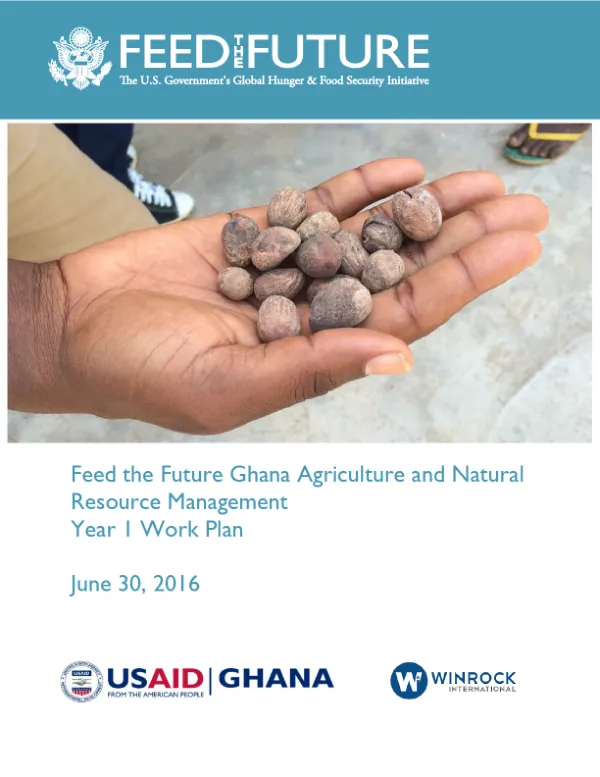
Year I Work Plan – Original submission: June 30, 2016, Final submission: July 20, 2016
Sign inTECHNOSERVE, INC.
Year I Work Plan – Original submission: June 30, 2016, Final submission: July 20, 2016
The USAID Feed the Future (FtF) Ghana Agriculture and Natural Resource Management Project (AgNRM) is a five-year, $24,900,000 program that will run from May 2, 2016, to April 30, 2021.
2016 · 30 pages
Sign in to readA free account is required to download.
Abstract
The project is implemented by Winrock International in partnership with TechnoServe, Nature Conservation Research Centre, and Center for Conflict Transformation and Peace Studies. The project's main goal is to address environmental and natural resource management issues in Northern Ghana. The project is divided into four outcomes: 1) Increased Incomes from Natural Resource Products; 2) Improved Food and Nutritional Security; 3) Increased Farmer and Community Security/Access to Land and Natural Resources; and 4) Strengthened Environmental Stewardship. The project will be implemented under the USAID/Ghana FtF strategy, which aims to address issues of environment and natural resource management in Northern Ghana. The project's approach is integrated and landscape-based, aligning development and conservation and responding to the interdependencies of ecosystems and livelihoods. The project will support USAID/Ghana's Development Objective 2 and the Ghana FtF Multi-Year Strategy. Winrock's AgNRM approach builds on USAID's resilience strategy and its investments in the FtF Zone of Influence. The project's conceptual model adds health as a fourth dimension to the Nature, Wealth and Power framework, ensuring integration of food security and water systems and highlighting the importance of these factors to nutrition and resilience. The project interventions are expected to result in transformative change, including adoption of improved practices, technologies, and behaviors; better functioning value chains and governance structures; more equitable access to land and resources; and increased capacity of organizations to improve natural resource management. Year 1 of the AgNRM project is a short, five-month implementation year to align the project with USAID's standard reporting cycle. During this timeframe, the majority of Year 1 will be devoted to rapid mobilization and start-up activities. Start-up tasks include mobilizing key personnel and recruiting local project staff; identifying and setting up project offices and procuring vehicles, office furniture, and other equipment and supplies. Cross-cutting activities will focus on establishing a firm foundation on which all project activities will be built. The project will be implemented in Northern Ghana, with a focus on the Feed the Future Zone of Influence. The project's geographic targeting will be based on the project's outcomes and the needs of the target communities. The project's technical approach will be integrated and landscape-based, aligning development and conservation and responding to the interdependencies of ecosystems and livelihoods. The project's monitoring and evaluation plan will be based on the project's outcomes and the needs of the target communities. The project will use a range of indicators to measure progress towards the project's outcomes, including income levels, food security, and environmental stewardship. The project will also conduct regular monitoring and evaluation to ensure that the project is on track to meet its outcomes. The project's budget for Year 1 is $4,900,000, which will be used to support start-up activities, cross-cutting activities, and project implementation. The project will also receive support from USAID/Ghana and other partners to implement the project's activities. The project's implementation schedule is outlined in Annex A, which presents a detailed Gantt Chart summarizing the implementation schedule for activities during Year 1.