U.S. DEPARTMENT OF STATE/OES
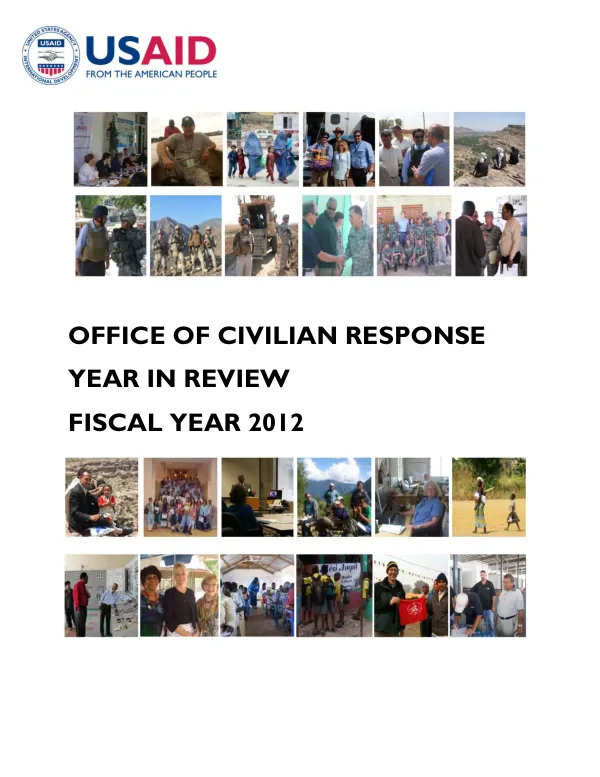
Year in Review: Office of Civilian Response Fiscal Year 2012
The Office of Civilian Response continued to evolve in Fiscal Year 2012, with significant changes in funding and deployment policies.
2012 · 9 pages
Sign in to readA free account is required to download.
Abstract
For the first time, all funding for the Civilian Response Corps (CRC) was provided by Congress to the State Department for reallocation to participating agencies, and USAID did not receive any funding. As a result, the State Department planned to significantly reduce the number of CRC members, necessitating changes in how USAID managed its CRC, including requiring USAID Missions to fund the travel costs and in some cases the full costs of CRC deployed. Despite the change in funding, the number of deployments remained constant, with 65 deployments for 9,332 days of support, and the number of requests actually increased from 2011 to 82 total requests. USAID deployments continued to constitute the majority of the utilization of USAID's CRC. The introduction of client satisfaction surveys for all USAID deployments helped provide additional feedback and rigor to improving OCR's surge staffing support within the Agency. The initial results were very positive, with 91% noting "high" or "very high" satisfaction post-deployment. The USAID CRC staff is designed to represent the full array of USAID development expertise and currently includes subject matter experts in Democracy, Rights, and Governance, Program Analysts, Administrative Officers, Engineers, Contracting Officers, General Business Specialists, and an expert in Public Health. The USAID Civilian Response Corps (CRC) at its maximum was a 42-person cadre, but due to hiring freezes and attrition, the USAID CRC size was reduced to 28 by the end of FY 2012. In FY 2012, OCR undertook 65 deployments to 19 countries, with nearly half of the requests for CRC staff coming from the Middle East and Africa region (48%). The types of environments or responses to which USAID CRC were deployed included prevention of crisis, post-conflict, economic growth, infrastructure development, and governance. The majority of CRC work within USAID was focused on deployments to USAID Missions or work based in Washington providing individual support (92%). In comparison, CRC work with the interagency was mostly in team situations (59%). Out of the 44 USAID overseas deployments undertaken by CRC, 33 (75 percent) could be categorized as filling a vital staffing requirement in the USAID Mission. The average length of deployment was 101 days, and the total number of work days for CRC deployed to USAID missions and bureaus was 7,992. Eighteen percent of deployments were extended, and 54 out of 65 deployments were in response to requests from USAID Missions or Bureaus, or about 83 percent of all CRC deployments. Washington-based deployments totaled 1,340 days of USAID-based work, with nine assignments, and an average length of 146 days. Sixteen different Missions and two non-presence countries had the highest number of overseas deployments, with Afghanistan, Haiti, Libya, South Sudan, and Tunisia having the most deployments. The Office of Civilian Response has three main operating principles that guide its day-to-day tasks and strategic goals: strengthening USAID's and the USG's prevention of, preparation for, and response to crisis or transition situations; providing short to medium-term assistance in crises, generally lasting two to ten months; and planning, programming, and managing OCR deployments directly supporting USAID requirements and objectives.