ABT ASSOCIATES
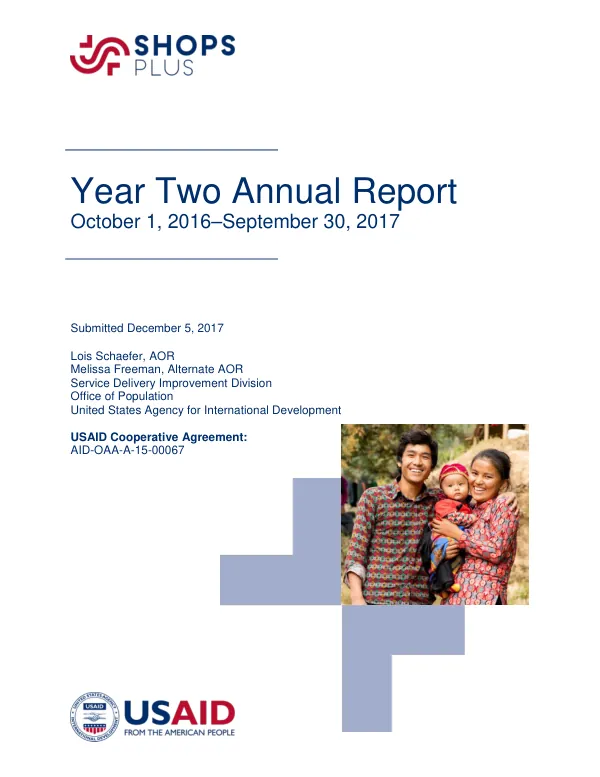
Year Two Annual Report
The SHOPS Plus project is a flagship initiative of the United States Agency for International Development (USAID) aimed at harnessing the potential of the private sector to improve health outcomes in family planning, HIV/AIDS, maternal and child health, and other health areas.
2017 · 130 pages
Sign in to readA free account is required to download.
Abstract
The project seeks to catalyze public-private engagement and improve the equity and quality of the total health system, accelerating progress toward universal health coverage. The project's results framework is centered around four key results: an improved enabling environment for the private health sector, expanded utilization of private sector information, products, and services at the community and health facility levels, increased effective public-private engagement to improve health outcomes, and innovative, emerging, and tested private sector models surfaced, disseminated, and applied. These results are critical to achieving the US government's priorities, including ending preventable child and maternal deaths, an AIDS-free generation, and FP2020. In Year Two, the project focused on several key priorities, including improving the enabling environment for the private health sector, expanding the utilization of private sector information, products, and services, and increasing effective public-private engagement. The project also worked to surface, disseminate, and apply innovative, emerging, and tested private sector models. The project's activities were implemented across multiple countries, including Afghanistan, Haiti, India, Madagascar, Nepal, Nigeria, Pakistan, Senegal, Tanzania, and the Middle East Region. In these countries, the project worked with a range of partners, including private sector providers, nongovernmental organizations, and government agencies, to improve health outcomes and accelerate progress toward universal health coverage. One of the key highlights of the project's Year Two activities was the expansion of the utilization of private sector information, products, and services. This was achieved through a range of activities, including the establishment of demonstration plots, the provision of training and technical assistance to private sector providers, and the development of innovative products and services. The project also made significant progress in improving the enabling environment for the private health sector. This was achieved through a range of activities, including the development of policies and regulations that support the growth of the private sector, the provision of training and technical assistance to private sector providers, and the establishment of partnerships between the public and private sectors. In addition to these highlights, the project also faced several challenges during Year Two. These challenges included difficulties in working with private sector providers, limited access to funding, and the need to balance the project's focus on short-term results with its long-term goals. Overall, the SHOPS Plus project made significant progress in Year Two, expanding the utilization of private sector information, products, and services, improving the enabling environment for the private health sector, and increasing effective public-private engagement. The project's activities were implemented across multiple countries, and the project worked with a range of partners to improve health outcomes and accelerate progress toward universal health coverage.