INTERNATIONAL COMMITTEE FOR THE RED CROSS
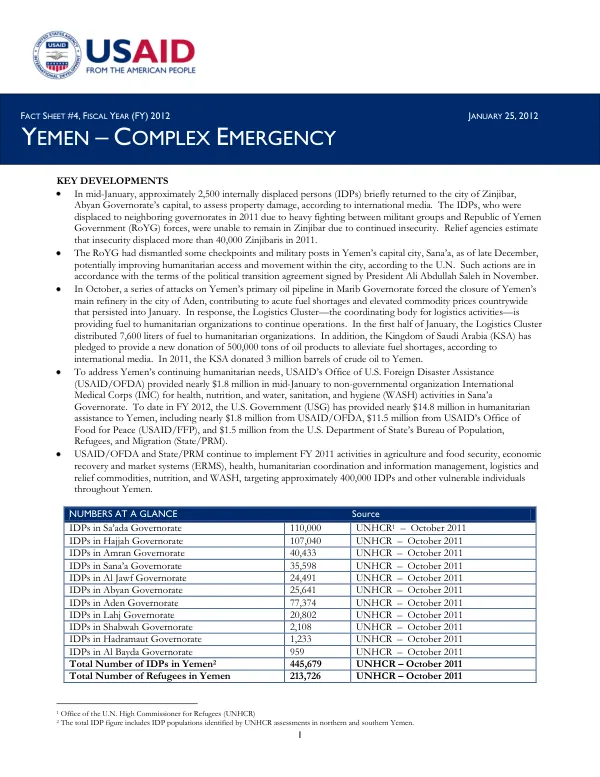
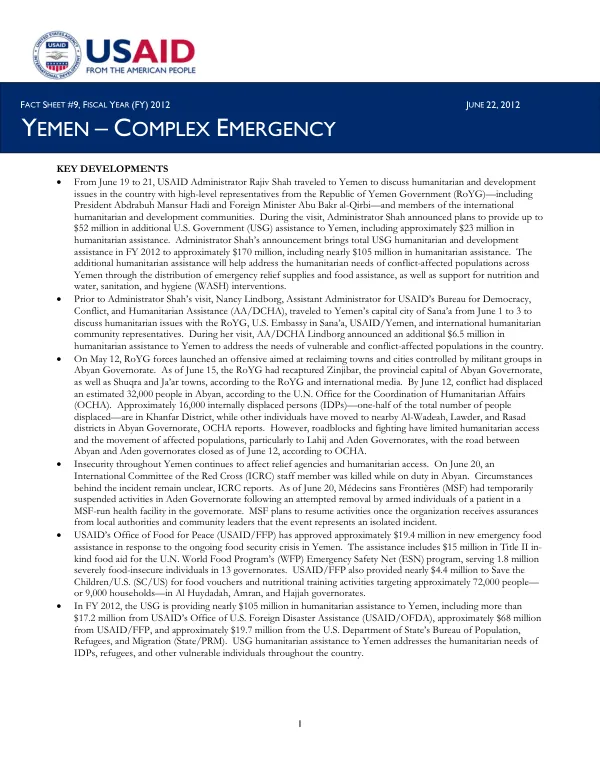
Yemen – Complex Emergency
Yemen's complex emergency has been ongoing since 2004, with conflict between the Republic of Yemen Government (RoYG) and al-Houthi opposition forces affecting over 1 million people and repeatedly displacing populations in northern Yemen.
2012 · 5 pages
Sign in to readA free account is required to download.
Abstract
The fragile February 2010 ceasefire collapsed in April 2011, resulting in sporadic clashes and isolated violent incidents that have hindered large-scale population returns to Sa'dah and Al Jawf governorates, as well as northern areas of 'Amran Governorate. In September 2011, al-Houthi leadership announced new conditions under which all humanitarian organizations are required to operate in Sa'dah, further restricting relief activities in the area. Humanitarian organizations continue to negotiate with al-Houthi leadership to gain increased access to vulnerable populations in Sa'dah. Between February and November 2011, anti-government protests throughout Yemen resulted in clashes between RoYG security forces, pro-government demonstrators, and opposition demonstrators, limiting the RoYG's capacity to provide basic services and contributing to increased humanitarian needs among vulnerable populations. The USG-designated terrorist group Al-Qaeda in the Arabian Peninsula (AQAP) increased its attacks against the RoYG in the southern governorate of Abyan and occupied several towns, displacing people, disrupting basic services, and hindering humanitarian access. Conflicts in northern and southern Yemen and an economic slowdown attributed to the ongoing political instability have exacerbated a nationwide malnutrition crisis. Aside from internally displaced persons (IDPs), Yemen hosts a significant number of refugees and migrants, the majority from the Horn of Africa, who are also in need of humanitarian assistance. As of January and March 2012, the total number of IDPs in Yemen was 559,678, with the majority residing in Sa'dah, Hajjah, 'Amran, San'a', Al Jawf, Abyan, Aden, Lahij, Shabwah, Hadramawt, and Al Bayda' governorates. The total number of refugees in Yemen was 217,677, with the majority from Somalia. In 2011, over 100,000 migrants and asylum seekers from the Horn of Africa arrived in Yemen, despite increasing conflict and worsening food security. In the first five months of 2012, there were approximately 51,400 new arrivals, with the majority from Ethiopia. The USG has provided significant humanitarian assistance to Yemen in FY 2012, with a total of $104.8 million in funding. USAID's Office of U.S. Foreign Disaster Assistance (USAID/OFDA) provided $17.2 million, USAID's Office of Food for Peace (USAID/FFP) provided $67.9 million, and the U.S. Department of State's Bureau of Population, Refugees, and Migration (State/PRM) provided $19.7 million. This assistance addresses the humanitarian needs of IDPs, refugees, and other vulnerable individuals throughout the country. On June 19-21, USAID Administrator Rajiv Shah traveled to Yemen to discuss humanitarian and development issues with high-level representatives from the RoYG and members of the international humanitarian and development communities. Administrator Shah announced plans to provide up to $52 million in additional U.S. Government assistance to Yemen, including approximately $23 million in humanitarian assistance. This announcement brings total USG humanitarian and development assistance in FY 2012 to approximately $170 million, including nearly $105 million in humanitarian assistance. Prior to Administrator Shah's visit, Nancy Lindborg, Assistant Administrator for USAID's Bureau for Democracy, Conflict, and Humanitarian Assistance (AA/DCHA), traveled to Yemen's capital city of Sana'a from June 1 to 3 to discuss humanitarian issues with the RoYG, U.S. Embassy in Sana'a, USAID/Yemen, and international humanitarian community representatives. During her visit, AA/DCHA Lindborg announced an additional $6.5 million in humanitarian assistance to Yemen to address the needs of vulnerable and conflict-affected populations in the country. On May 12, RoYG forces launched an offensive aimed at reclaiming towns and cities controlled by militant groups in Abyan Governorate. As of June 15, the RoYG had recaptured Zinjibar, the provincial capital of Abyan Governorate, as well as Shuqra and Ja'ar towns, according to the RoYG and international media. By June 12, conflict had displaced an estimated 32,000 people in Abyan, according to the U.N. Office for the Coordination of Humanitarian Affairs (OCHA).