MERCY CORPS INTERNATIONAL
Yemen Emergency Food Assistance (YEFA) II Final Report FY 2018
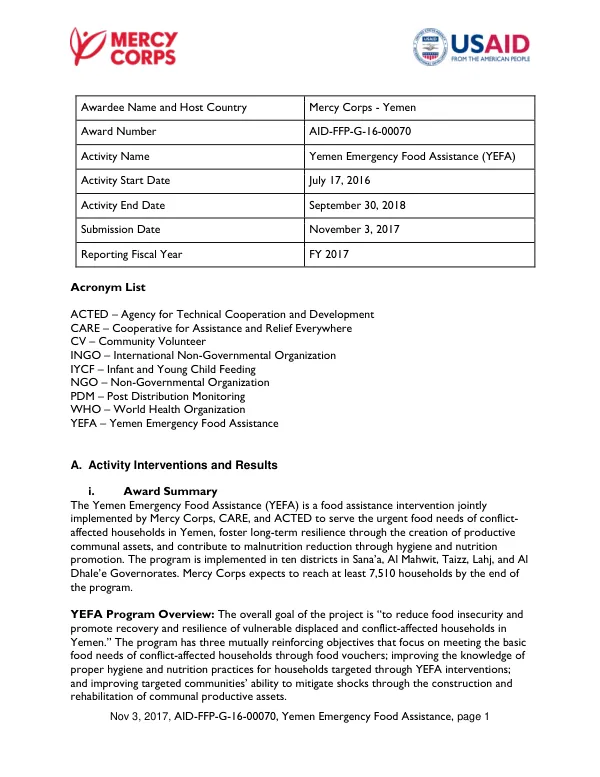
The Yemen Emergency Food Assistance (YEFA) II program, implemented by Mercy Corps, aimed to provide emergency food assistance to vulnerable households in Yemen.
2018 · 20 pages
Sign in to readA free account is required to download.
Abstract
The program began in earnest despite active conflict in Sana'a, which resulted in the killing of the former president of Yemen and the leader of the Houthis. The country experienced a prolonged blockade, rendering 90% of the Yemeni population food insecure. Implementation of the program involved close collaboration with local authorities, MOPIC, and NAMCHA at the national and district levels. Partners conducted joint planning and kick-off meetings to discuss objectives, outcomes, standards, and harmonized programs and MEL tools. Community meetings and consultations were held in all ten districts to select beneficiaries and conduct baseline surveys. The program also developed market assessment tools and conducted market commodities assessments in major markets on a monthly basis. Mercy Corps and partners worked together with community committees and community leaders to distribute food vouchers to registered beneficiaries and conduct community trainings on hygiene, nutrition, and sanitation. The consortium supported rehabilitation and construction of communal assets projects in selected districts. Partners participated in FSAC cluster activities and meetings at the national and district levels, including district-level vulnerability assessments and data collection for districts under YEFA II programming. The program achieved several key milestones, including the completion of baseline surveys, awareness-raising sessions, community committee establishment, beneficiary selection and registration, assessments, vendor training, food voucher printing and distribution, community health volunteer training, and community communal assets construction. The program supported 7,510 beneficiary households with access to basic food items through the provision of food vouchers. Awareness-raising of the YEFA II program was conducted at all levels of the government leadership structure, including the Ministry of Planning and International Cooperation (MOPIC) officials and the Minister of Interior. Community-level program kick-off meetings and awareness sessions were held in Sana'a and Al Mahwit governorates, explaining program objectives, modalities, and activities, as well as providing an orientation on Mercy Corps' vision and humanitarian principles. The program's programming performance was evaluated through the creation of awareness on program activities, particularly criteria for food commodity voucher eligibility, including conditionality. The program's results included the provision of food vouchers to 7,510 beneficiary households, awareness-raising of the YEFA II program at all levels of the government leadership structure, and the completion of baseline surveys and assessments. Mercy Corps and partners conducted joint planning and kick-off meetings to discuss objectives, outcomes, standards, and harmonized programs and MEL tools. The program also developed market assessment tools and conducted market commodities assessments in major markets on a monthly basis. The consortium supported rehabilitation and construction of communal assets projects in selected districts, and partners participated in FSAC cluster activities and meetings at the national and district levels. The program's geographic focus was on Yemen, with a specific emphasis on the ten districts where the program was implemented. The program's timeframes were from October to September, with quarterly progress reports submitted to the donor. The program's recommendations included the continuation of emergency food assistance to vulnerable households, the expansion of the program to reach more beneficiaries, and the strengthening of community committees and community leaders to ensure effective program implementation.