INTERNATIONAL MEDICAL CORPS
Yemen Humanitarian Response Plan
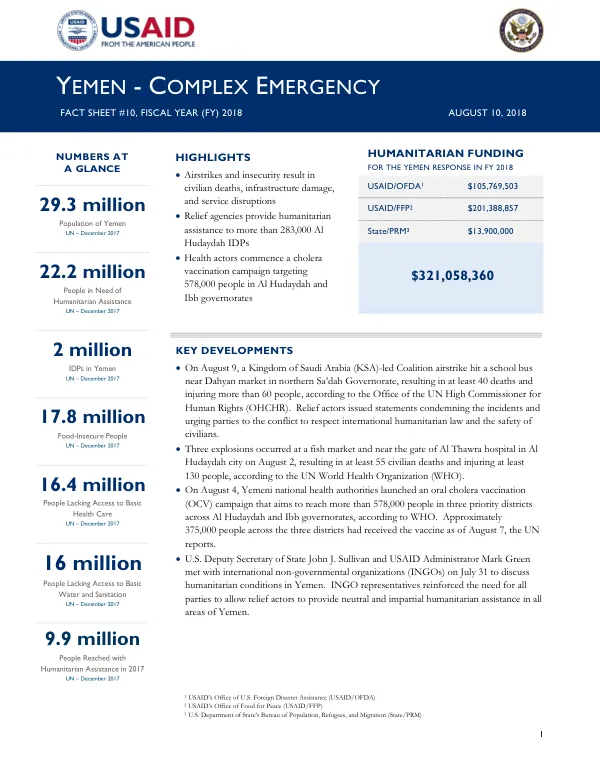
The Yemen Humanitarian Response Plan (YHRP) was updated on July 23 to address humanitarian needs in Yemen.
2012 · 4 pages
Sign in to readA free account is required to download.
Abstract
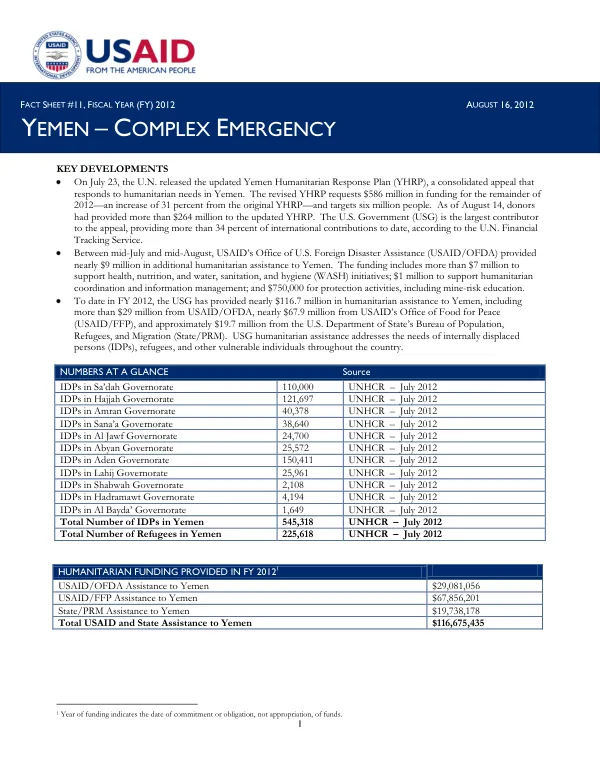
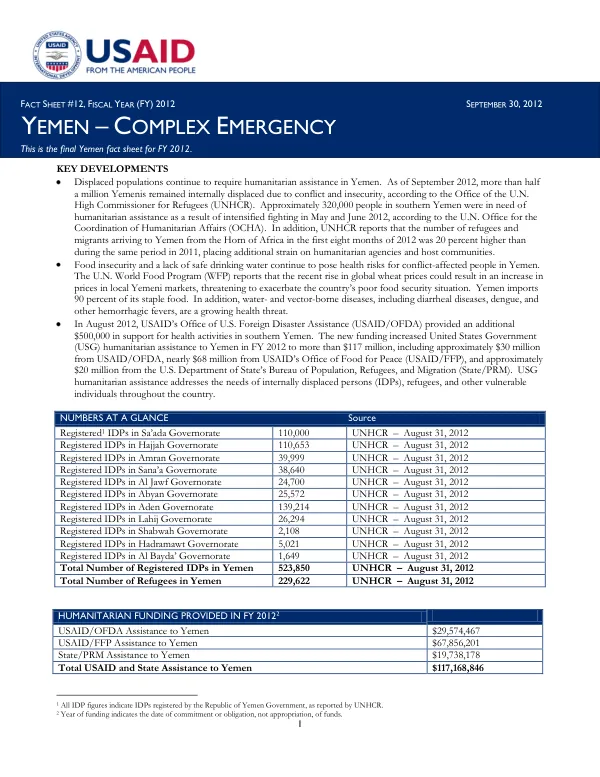
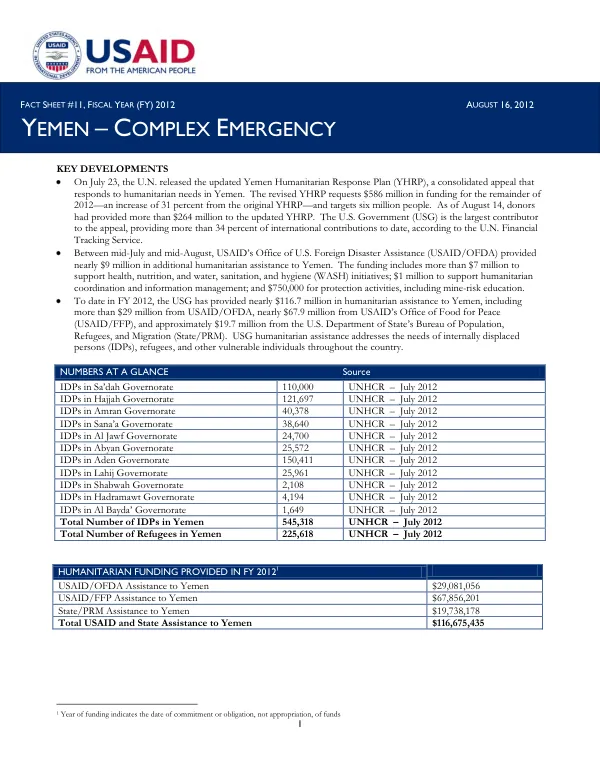
The revised plan requests $586 million in funding for the remainder of 2012, a 31 percent increase from the original YHRP. The plan targets six million people, with the U.N. Financial Tracking Service reporting that donors had provided more than $264 million as of August 14. The U.S. Government is the largest contributor to the appeal, providing more than 34 percent of international contributions to date. The Office of U.S. Foreign Disaster Assistance (USAID/OFDA) provided nearly $9 million in additional humanitarian assistance to Yemen between mid-July and mid-August. The funding includes more than $7 million to support health, nutrition, and water, sanitation, and hygiene (WASH) initiatives, $1 million to support humanitarian coordination and information management, and $750,000 for protection activities, including mine-risk education. To date in FY 2012, the U.S. Government has provided nearly $116.7 million in humanitarian assistance to Yemen, including more than $29 million from USAID/OFDA, nearly $67.9 million from USAID's Office of Food for Peace (USAID/FFP), and approximately $19.7 million from the U.S. Department of State's Bureau of Population, Refugees, and Migration (State/PRM). The humanitarian situation in Yemen is complex, with conflict between the Republic of Yemen Government (RoYG) and al-Houthi opposition forces affecting more than 1 million people since 2004. Sporadic clashes and isolated violent incidents continue to result in insecurity and limited humanitarian access, hindering large-scale population returns to Sa'dah and Al Jawf governorates, as well as northern areas of Amran Governorate. The RoYG regained effective control of Abyan Governorate in mid-June, but conflict displaced more than 45,000 households from Abyan since May 2011. The humanitarian response in Yemen focuses on addressing the needs of internally displaced persons (IDPs), refugees, and other vulnerable individuals throughout the country. The Office of the U.N. High Commissioner for Refugees (UNHCR) reports a limited number of IDPs have returned to Abyan Governorate, and returns may increase in the coming months despite ongoing concerns, such as landmines and unexploded ordnance, extensive damage to infrastructure, and lack of security, basic services, and employment opportunities. USAID/OFDA provided $700,000 to UNICEF to provide mine-risk education to inform conflict-affected people and IDPs about the threats posed by landmines and explosive remnants of war. Populations in southern Yemen's Lahij Governorate are experiencing global acute malnutrition (GAM) levels of approximately 23 percent, exceeding the U.N. World Health Organization (WHO) emergency threshold level of 15 percent, according to a recent U.N. Children's Fund (UNICEF) survey. UNICEF also found severe acute malnutrition (SAM) levels of 4.5 percent in Lahij. To date in FY 2012, USAID/FFP has provided nearly $68 million in food vouchers and more than 58,000 metric tons (MT) of emergency food assistance to affected populations across Yemen. In addition, USAID/OFDA has provided nearly $5.6 million to International Medical Corps (IMC), International Rescue Committee (IRC), Save the Children/U.S. (SC/US), and UNICEF to support nutrition activities. Heavy fighting in Abyan Governorate in May and June led to a significant influx of displaced people in Aden Governorate, increasing the need for expanded health services and WASH activities. More than 150,000 IDPs reside in Aden, according to UNHCR. Civil unrest in 2011 in Ta'izz Governorate—the most populous governorate in Yemen—damaged health and WASH infrastructure. Access to water and sanitation services remains limited throughout Ta'izz and cases of acute watery diarrhea, acute respiratory infection, and fever are increasing according to humanitarian organizations.