USAID DEC
Yombal mboj: Enhancing Competitiveness of the Pearl Millet Value Chain in Senegal
The USAID/Yombal mbojj project aims to enhance the competitiveness of the pearl millet value chain in Senegal.
2021 · 28 pages
Sign in to readA free account is required to download.
Abstract
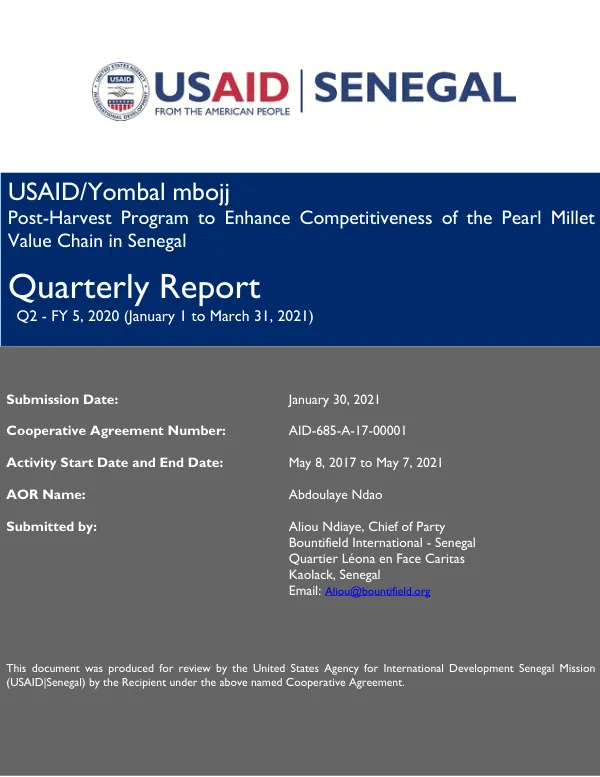
The project, implemented by Bountifield International, focuses on increasing the availability of high-quality grains on the local market. To achieve this goal, the project addresses the gap in technologies available for smallholder pearl millet producers, particularly women, by introducing affordable postharvest processing tools. The project has prioritized the strengthening of private sector capacity to develop and distribute affordable tools addressing the unique needs of women smallholders. Using a facilitation approach, the project has joined forces with partners to develop a "business in a box model" for smallholder farmers to make a profit from their harvest. This model includes a grinder, which is a key component of the project's efforts to improve postharvest processing. During the second quarter of FY5, the project continued working with partners and clients amid the COVID-19 pandemic. The project team worked with OMEGA to provide repair and maintenance services for hand-operated threshers and with the Chamber of Commerce to assess and implement a capacity building program for women's groups on the "business in the box" package with the grinder. The project also increased promotional activities with agrodealers and the Chamber of Commerce, exhausting and deploying all the grinders that were in stock. The main activities planned for this quarter included monitoring the use of the hand-operated thresher and implementation of repair and maintenance services, finalizing tests of the imported "NANS No.14 Multi-Crop Thresher" in the field, implementing a training program for women's groups on the "business in a box" package, and supporting agrodealers to promote and market the grinder "business in a box" package to potential clients. The project has made significant progress in enhancing the competitiveness of the pearl millet value chain in Senegal. The availability of high-quality grains on the local market has increased, and the project has addressed the gap in technologies available for smallholder pearl millet producers, particularly women. The project's efforts to improve postharvest processing have also led to increased incomes for smallholders. The project's implementation challenges include the COVID-19 pandemic, which has affected the project's activities and operations. However, the project team has continued to work with partners and clients to ensure the project's objectives are met. The project's closeout plan has been approved, and the project will prepare the final report, close all contracts with partners, dispose of the inventory, and close out staff contracts. The project's geographic coverage includes the regions of Fatick, Kaffrine, Kaolack, Kolda, Sedhiou, and Tambacounda. The project's implementation status is ongoing, with the project team working to ensure the project's objectives are met. The project's cross-cutting activities include gender integration, environmental mitigation and monitoring, and communication. The project's monitoring, evaluation, and learning activities are also ongoing, with the project team working to ensure the project's objectives are met.
Related documents