ICF
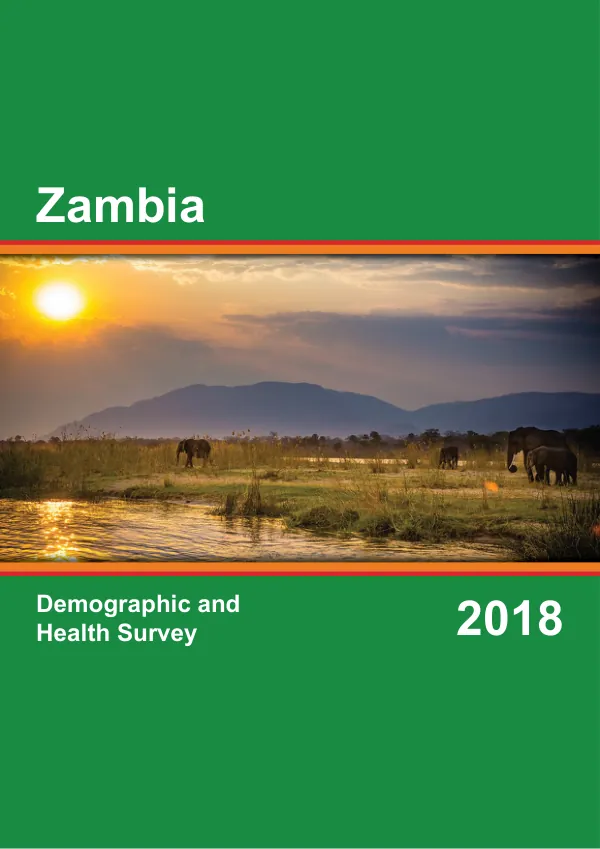
Zambia Demographic and Health Survey 2018
The 2018 Zambia Demographic and Health Survey (ZDHS) was implemented by the Zambia Statistics Agency in partnership with the Ministry of Health, the University Teaching Hospital Virology Laboratory, and the Department of Population Studies at the University of Zambia under the overall guidance of the National Steering Committee.
2019 · 581 pages
Sign in to readA free account is required to download.
Abstract
Data collection lasted from July 2018 to January 2019. Funding for the 2018 ZDHS was provided by the United States Agency for International Development (USAID), the Global Fund, the Department for International Development (DFID), and the United Nations Population Fund (UNFPA). ICF provided technical assistance through The DHS Program, a USAID-funded project providing support and technical assistance in the implementation of population and health surveys in countries worldwide. The survey objectives were to provide data on fertility, family planning, maternal and child health, and HIV/AIDS. The sample design involved a two-stage sampling process, with the first stage selecting clusters and the second stage selecting households within those clusters. Questionnaires were administered to women aged 15-49 and men aged 15-59, and anthropometry, anaemia testing, and HIV testing were conducted on a subsample of women. The survey collected data on housing characteristics, including drinking water sources and treatment, sanitation, exposure to smoke inside the home, and household wealth. Household population and composition, children's living arrangements and parental survival, birth registration, and education were also assessed. The survey found that 44% of households had access to improved drinking water sources, while 22% of households had access to improved sanitation facilities. The survey also collected data on the characteristics of respondents, including education and literacy, mass media exposure, employment, occupation, health insurance coverage, tobacco use, and surgery. The survey found that 64% of women aged 15-49 had no education, while 22% of men aged 15-59 had some secondary education. The survey also found that 15% of women aged 15-49 had ever used tobacco. The survey collected data on marriage and sexual activity, including marital status, polygyny, age at first marriage, age at first sexual intercourse, and recent sexual activity. The survey found that 44% of women aged 15-49 were married, while 21% of women aged 15-49 had never been married. The survey also found that 12% of women aged 15-49 had their first sexual intercourse before age 15. The survey collected data on fertility, including current fertility, children ever born and living, birth intervals, insusceptibility to pregnancy, menopause, age at first birth, teenage childbearing, and sexual and reproductive behaviors before age 15. The survey found that 44% of women aged 15-49 had given birth to at least one child, while 15% of women aged 15-49 had given birth to five or more children. The survey also found that 12% of women aged 15-49 had their first birth before age 18. The survey collected data on fertility preferences, including desire for another child and ideal family size. The survey found that 44% of women aged 15-49 desired another child, while 22% of women aged 15-49 desired no more children. The survey also found that 64% of women aged 15-49 had an ideal family size of three or more children.