AFRICARE, INC.
1st Quarterly report August-December 2012: Niger Development Food Aid Program
The Niger Development Food Aid Program, also known as the "Sawki" program, is a comprehensive initiative aimed at reducing food insecurity and malnutrition among vulnerable populations in Niger.
2012 · 6 pages
Sign in to readA free account is required to download.
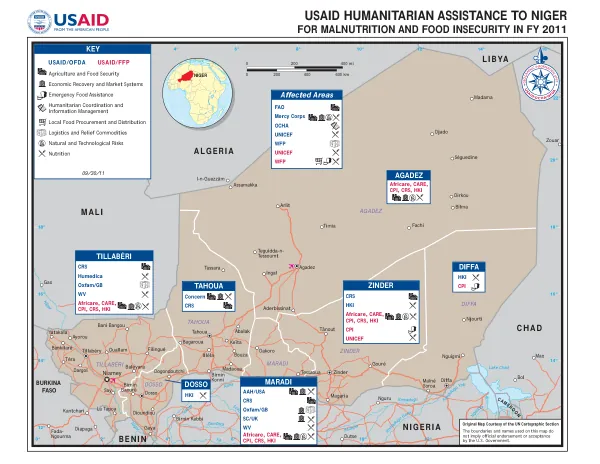
Abstract
The program is implemented by a consortium of Mercy Corps, Africare, and Helen Keller International, with funding from the United States Agency for International Development (USAID) through the Food for Peace (FFP) program. The program targets 81 villages in Maradi and Zinder, two of the most food-insecure regions of Niger, with a focus on empowering women and adolescent girls. The two strategic objectives of the program are to reduce chronic malnutrition among pregnant and lactating women and children under five, with an emphasis on children under two, and to increase the local availability of and households' access to nutritious food by diversifying agricultural productivity, rural households' income, and increasing resilience to shocks. The program's implementation began in August 2012, and the first and second quarters focused on startup and preliminary activities. The program has successfully accomplished or is on track to complete all objectives established for the period. Key activities included staff recruitment, office and warehouse setup, development of monitoring and evaluation tools, and participation in a baseline workshop led by FANTA and ICF Macro. Staff recruitment was a critical issue due to high competition among development and emergency projects in Niger and Mali. However, most key positions had been identified and hired by the end of the reporting period, including the Chief of Party, Agricultural Livelihoods Specialist, M&E Specialist, and Gender Specialist. Hellen Keller International is in the process of recruiting the SO1 team leader for nutrition. The program has also made significant progress in developing monitoring and evaluation tools, including the Results Framework, IPTT, PMP, and DIP, which were finalized and submitted to FFP in November 2012. The program worked with the Global Environmental Management Support (GEMS) of the BEO to strengthen the environmental M&E components, resulting in the revision of the IPTT by redefining a few indicators and including new ones. A baseline preparation workshop for Niger Title II DFAP programs was conducted by ICF Macro on December 11-14, 2012, attended by representatives of the Mercy Corps consortium, Africare, and HKI. The workshop addressed the review and adaptation of baseline quantitative and qualitative tools, improvements to the methodology, and harmonization of indicators among the three DFAP holders. The program has also completed the selection of villages through a participatory process with key stakeholders, including local government, government extension services, municipalities, and communities. The criteria for village eligibility included size, natural resource potential, local authorities' commitment, accessibility, security, and contiguity to other villages. As a result, the overall number of villages for the program implementation increased from 75 to 81. The program has developed protocols with the Government of Niger ministries and other partners, which will be finalized at a workshop scheduled for February/March 2013. The program's overall goal is to reduce food insecurity and malnutrition among vulnerable populations in Niger, with a special emphasis on empowering women and adolescent girls.