HELLEN KELLER INTERNATIONAL
MC Niger Sawki Quarterly Report FY 15 Q1
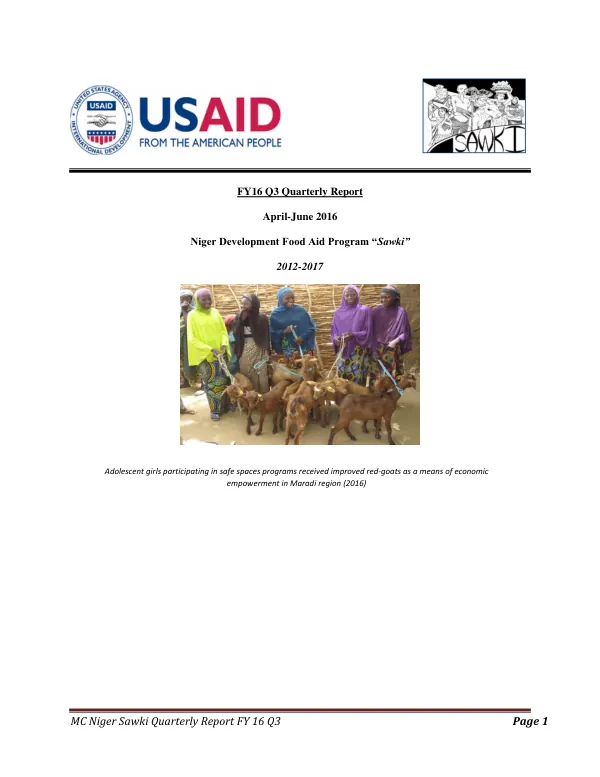
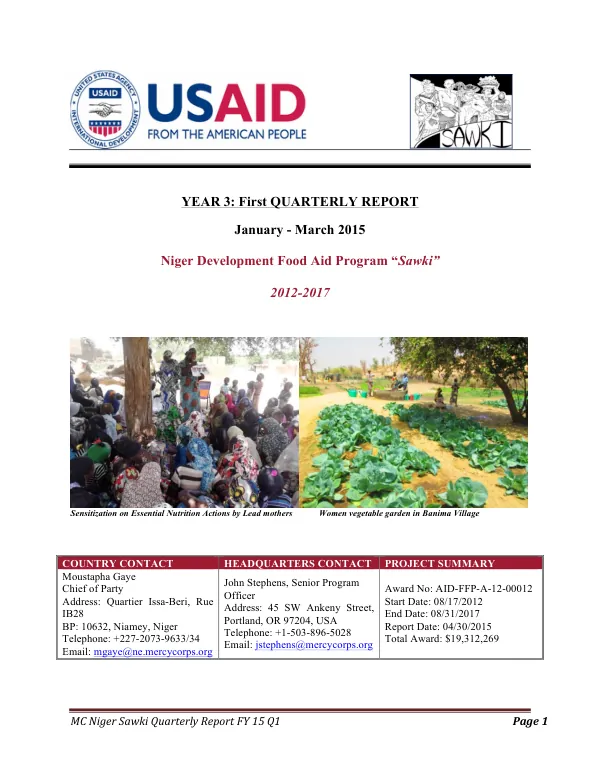
The Niger Development Food Aid Program "Sawki" is a comprehensive package of activities designed to respond to the food security needs of more than 92,092 beneficiaries in Maradi and Zinder, two of the most food insecure regions of Niger.
2015 · 18 pages
Sign in to readA free account is required to download.
Abstract
The program is implemented by Mercy Corps and Helen Keller International, in partnership with the Government of Niger, local NGOs, the National Institute of Agronomy Research (INRAN), and the private sector. The program's overall goal is to reduce food insecurity and malnutrition among vulnerable populations in Niger, with a special emphasis on empowering women and adolescent girls. The two strategic objectives (SO) are: SO1, to reduce chronic malnutrition among pregnant and lactating women and children under five with an emphasis on children under two, and SO2, to increase the local availability of and households' access to, nutritious food by diversifying agricultural productivity, rural households' income, and increasing resilience to shocks. During the first quarter of 2015, the program accomplished several activities, including sensitization sessions on essential nutrition actions, community granary committees, triggering of Community-Led Total Sanitation (CLTS) in 20 villages, cooking demonstrations, home visits, and delivery of equipment such as grain milling machines and threshers. The program also trained 44 milling machine operators for equipment management and maintenance, and community mobilization of a stock of 70 tons of millet for the establishment of a seed bank in 15 villages. The program's progress against targets for the first quarter of 2015 includes the following: 1,917 sensitization sessions were conducted, reaching 39,958 participants, including 34,799 women and 5,159 men; 15 community granary committees were set up in pilot villages; 2,452 cooking demonstration sessions were held, with 11,401 participants attending; 5,766 home visits were conducted, reaching 17,505 participants; and 1,040 pregnant women, 1,903 lactating women, and 7,284 children under two received their supplemental rations of CSB+. The program also made progress in training and capacity building, including the training of 44 milling machine operators, 36 literacy trainers, and 32 water management committee members. Additionally, the program conducted advocacy with Anima Sutura for the sale of Aquatab, and installed hygiene kits in each village in the Zinder Region.