CATHOLIC RELIEF SERVICES ORGANIZATION
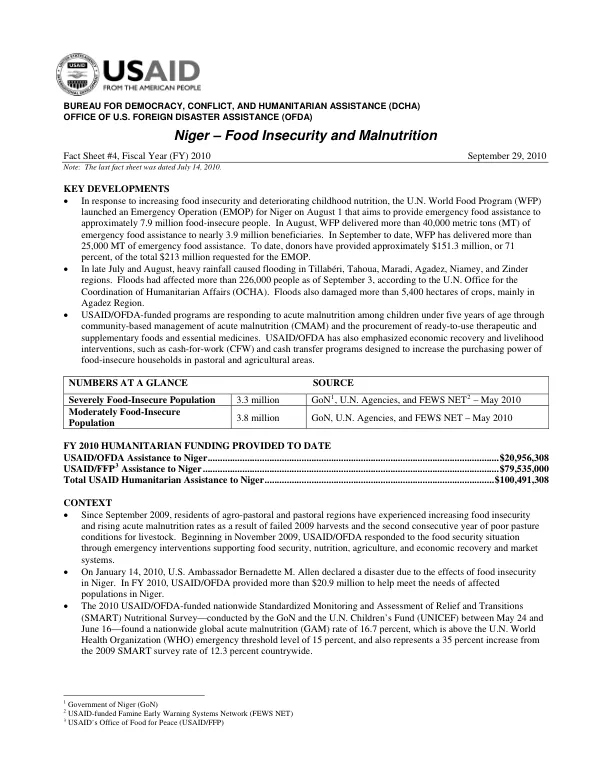
Niger Malnutrition and Food Insecurity – September 29, 2010
The Niger food insecurity and malnutrition situation has been a pressing concern since September 2009.
2010 · 4 pages
Sign in to readA free account is required to download.
Abstract
Residents of agro-pastoral and pastoral regions have experienced increasing food insecurity and rising acute malnutrition rates due to failed 2009 harvests and poor pasture conditions for livestock. In response, the U.N. World Food Program (WFP) launched an Emergency Operation (EMOP) on August 1, 2010, to provide emergency food assistance to approximately 7.9 million food-insecure people. The WFP has delivered over 65,000 metric tons of emergency food assistance to nearly 5.4 million beneficiaries as of September 2010. Donors have provided approximately $151.3 million, or 71 percent, of the total $213 million requested for the EMOP. Heavy rainfall in late July and August caused flooding in several regions, affecting over 226,000 people and damaging more than 5,400 hectares of crops. USAID/OFDA-funded programs are addressing acute malnutrition among children under five years of age through community-based management of acute malnutrition (CMAM) and the procurement of ready-to-use therapeutic and supplementary foods and essential medicines. The programs also emphasize economic recovery and livelihood interventions, such as cash-for-work (CFW) and cash transfer programs, to increase the purchasing power of food-insecure households in pastoral and agricultural areas. According to the U.N. Food and Agricultural Organization (FAO), the start of the harvest season in neighboring coastal countries and favorable Niger crop prospects have led to a stabilization in cereal prices as of early September. However, prices remain high, and poorer households continue to suffer from insufficient food access due to high food prices and limited income. Many households have incurred debts that must be repaid following the October harvest, with some reports claiming that farmers will have to pay off as much as 3 months' worth of harvest immediately. The number of malaria cases in Niger continues to increase in 2010 compared to the 2009 caseload. As of August 28, the World Health Organization (WHO) reported approximately 1.4 million cases of malaria, compared to approximately 880,000 reported cases by the same date in 2009. USAID/OFDA-funded programs are assisting Niger's most vulnerable populations through targeted nutrition interventions, including CMAM activities and the procurement of essential medicines. In response to food insecurity in Niger during FY 2010, USAID/FFP provided more than 47,000 metric tons of emergency food assistance, valued at approximately $52.7 million, to benefit affected populations throughout Niger. In addition, USAID/FFP provided approximately $26.8 million in Emergency Food Security Program (EFSP) grants for the local procurement of food, as well as a food voucher program, in affected areas. These contributions were in addition to the USAID/FFP annual non-emergency food security program implemented through USAID/FFP grantees, valued at approximately $15 million. Food insecurity in pastoral areas remains a concern due to the deterioration in the principal means of subsistence for pastoralists, mainly raising livestock and the sale of livestock products. Poor livestock conditions and water shortages continue to hinder sufficient income generation for pastoralists. Many poorer households are adopting negative coping strategies, including selling breeding animals or working as shepherds away from their own livestock, in order to provide sufficient amounts of food to their families. In addition, many households have lost entire herds. According to FEWS NET, at least 20 percent of Niger's pastoral population had lost approximately 80 to 100 percent of its livestock as of September 21. The Government of Niger reports that losses have been concentrated among particularly vulnerable pastoral households. FEWS NET attributes the large losses to the sale of livestock at poor terms of trade in order to supplement household food needs, food deficits for livestock leading to starvation, and heavy rains that killed livestock during July and August.
Related documents