FHI 360
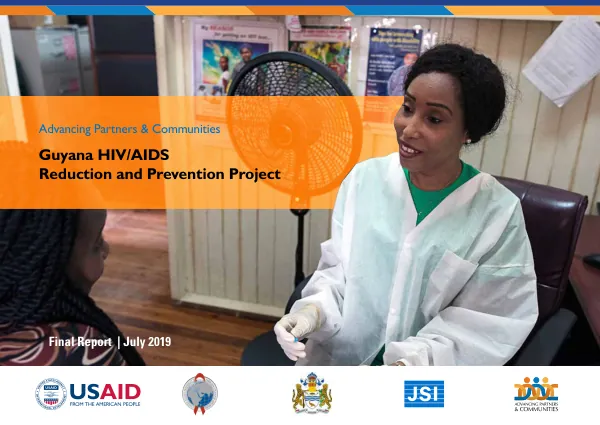
Guyana HIV/AIDS Reduction and Prevention Project: Final Report
The Guyana HIV/AIDS Reduction and Prevention Project was implemented by JSI Research & Training Institute, Inc.
2019 · 32 pages
Sign in to readA free account is required to download.
Abstract
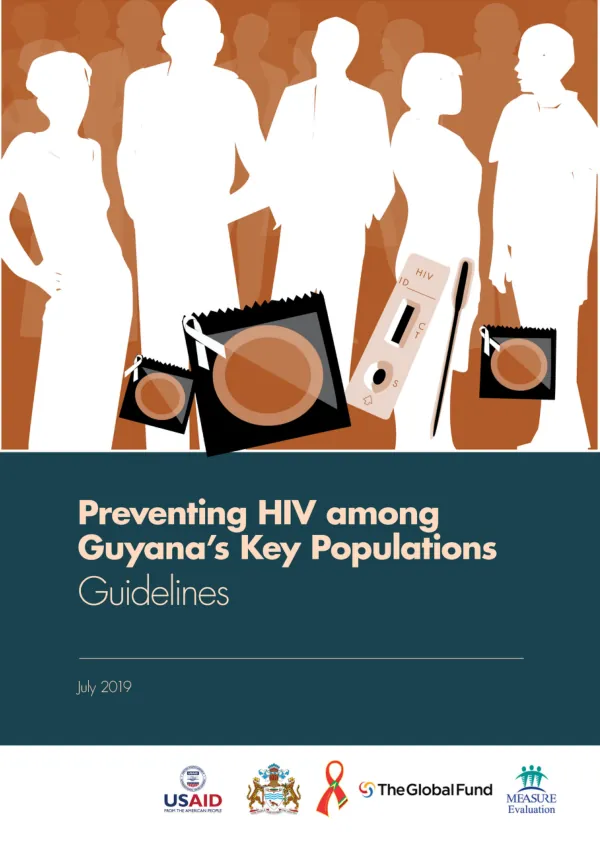
(JSI) from September 2013 to September 2019, with funding from the U.S. Agency for International Development (USAID) under the Advancing Partners & Communities (APC) cooperative agreement. The project focused on reducing the spread of HIV/AIDS in Guyana, particularly among key populations such as men who have sex with men (MSM), female sex workers (FSWs), and transgender individuals. Guyana has a population of approximately 747,884 people, with a landmass of 215,000 square km extending along the north-eastern coast of South America. The country has a generalized HIV epidemic, with an adult HIV prevalence of 1.7 percent, according to UNAIDS 2017 estimates. The epidemic has been progressive, with a sharp decrease in HIV prevalence among FSWs, from 26.6 percent in 2005 to 5.5 percent in 2014, and among MSM, from 21.2 percent in 2005 to 4.9 percent in 2014. The project design included a combination of evidence-based, biomedical, behavioral, and structural interventions, including testing and linkage to care, and efforts to reduce policy and human rights barriers. The project used the social-ecological model, which provides a framework for examining the multi-level domains of HIV infection risk and its relationship to individuals' HIV risk within the network, community, and public policy contexts. The project objectives were to improve the operational framework for local nongovernmental organizations (NGOs) to reach key populations and provide services, improve efficiency of service delivery to reduce unit costs, strengthen the partnership between NGOs and the government to expand services with the same amount of investment, and explore initiatives to ensure sustainability of NGO programming based on best practices. The project supported 12 grantees that are part of Guyana's national HIV and AIDS response, initially covering eight of Guyana's 10 administrative regions. In 2016, the project shifted its focus to work exclusively in Region 4, targeting the key populations that are most at risk of contracting HIV. The project also introduced innovative, evidence-based, and cost-effective solutions, tailored to meet the needs of populations at risk of HIV in Guyana. The project timeline from 2014 to 2019 included various program areas, such as HIV prevention, HIV testing and counseling, stigma and discrimination, and gender-based violence. The project also introduced client advocates to support key populations in accessing services and reducing stigma and discrimination. The project completed in September 2019, with a focus on ensuring sustainability of NGO programming and expanding services with the same amount of investment. The project's impact was significant, with a sharp decrease in HIV prevalence among key populations, improved efficiency of service delivery, and strengthened partnership between NGOs and the government. The project's combination approach to HIV prevention, including testing and linkage to care, and efforts to reduce policy and human rights barriers, was effective in reducing the spread of HIV/AIDS in Guyana.
Related documents