USAID DEC
9th Quarterly Report: Education Consortium for the Advancement of STEM in Egypt (ECASE)
Sign inWORLD LEARNING
9th Quarterly Report: Education Consortium for the Advancement of STEM in Egypt (ECASE)
The Education Consortium for the Advancement of STEM in Egypt (ECASE) Program, funded by the United States Agency for International Development (USAID), has been working to advance science, technology, engineering, and math (STEM) education in Egypt.
2014 · 164 pages
Sign in to readA free account is required to download.
Abstract
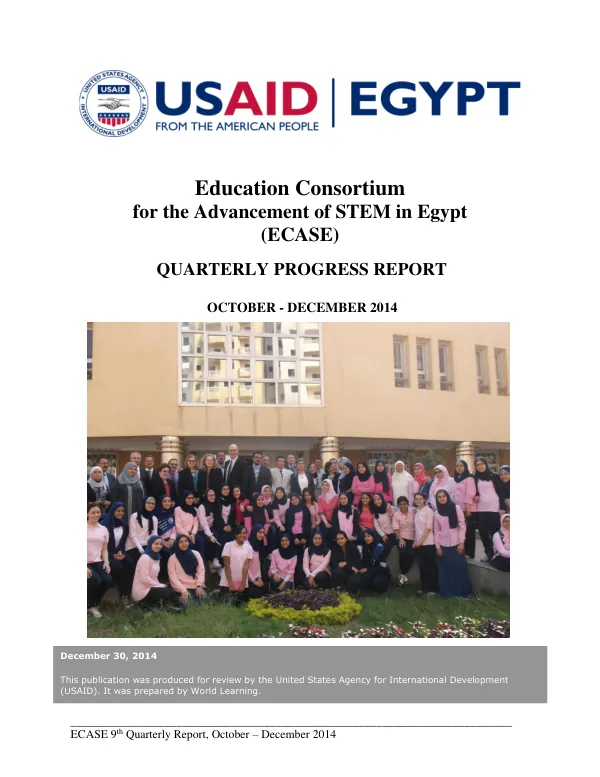
The program is implemented by World Learning in collaboration with consortium partners 21PSTEM, TIES, and TFI. During the October-December 2014 quarter, ECASE conducted several activities to achieve its program objectives. A visit to the Ma'adi STEM School for Girls was made by USAID officials, including Assistant Administrator Mark Feierstein, Charge d'Affaires Mark Sievers, and USAID Mission Director Dr. Mary C. Ott. The visit aimed to witness the achievements of the ECASE project and meet with students and teachers. The students showcased their Capstone projects and demonstrated their proficiency in using the equipment available in the Fab Lab. Another visit was made to the 6th of October STEM School for Boys, where USAID Mission Director Dr. Mary C. Ott met with students and saw their projects. She discussed capstone project ideas with the students and learned about their experience in the school. The students led a tour of the physics, biology, chemistry labs, and the Fab Lab, demonstrating their knowledge and understanding of the STEM curriculum. ECASE also conducted Fab Lab training at both Ma'adi and 6th of October schools. The training plan focused on ensuring that every student has access to Fab Lab training and that foundational training is delivered by professional trainers. The training was divided into three tiers, from basic to advanced, and was conducted by Fab Lab Managers and a Fab Guru from Fab Lab Barcelona. Eight members of the Ministry of Education's Technology Development Center (TDC) also joined the training, which aimed to upgrade their capacity and help transfer ownership of the Fab Labs to the Ministry. Weekly STEM Unit meetings were held, with associated Task Force meetings regularly taking place. The ECASE team plans to work with the STEM Unit to approve and formalize content for replication to other STEM Schools in Egypt through Local STEM Units. Training on the Design Blueprint was provided to STEM Unit members, who were engaged in creating Design Features, Success Indicators, and Action Items. The ECASE project also focused on the development, administration, scoring, and feedback sessions for the midterm examinations for Grade 1 and 2 students. The project aims to advance STEM education in Egypt and improve the quality of education in the country. The ECASE program has made significant progress in advancing STEM education in Egypt. The program's activities have focused on improving the quality of education, increasing access to STEM education, and developing the capacity of educators and students. The program's achievements have been recognized by USAID officials, who have visited the schools and seen the impact of the program firsthand. The ECASE program has also made efforts to sustain the Fab Labs and transfer ownership to the Ministry of Education. The program has provided training to TDC members, who will be responsible for maintaining and upgrading the Fab Labs after the program ends. This will ensure that the benefits of the program are sustained and that the Fab Labs continue to be used by students and educators in Egypt. Overall, the ECASE program has made significant progress in advancing STEM education in Egypt. The program's activities have focused on improving the quality of education, increasing access to STEM education, and developing the capacity of educators and students. The program's achievements have been recognized by USAID officials, and efforts are being made to sustain the program's benefits and transfer ownership of the Fab Labs to the Ministry of Education.
Related documents