WORLD LEARNING
ECASE 5th Quarterly Report, October - December 2013
The Education Consortium for the Advancement of STEM in Egypt (ECASE) Program is a USAID-funded initiative aimed at promoting science, technology, engineering, and mathematics (STEM) education in Egypt.
2013 · 36 pages
Sign in to readA free account is required to download.
Abstract
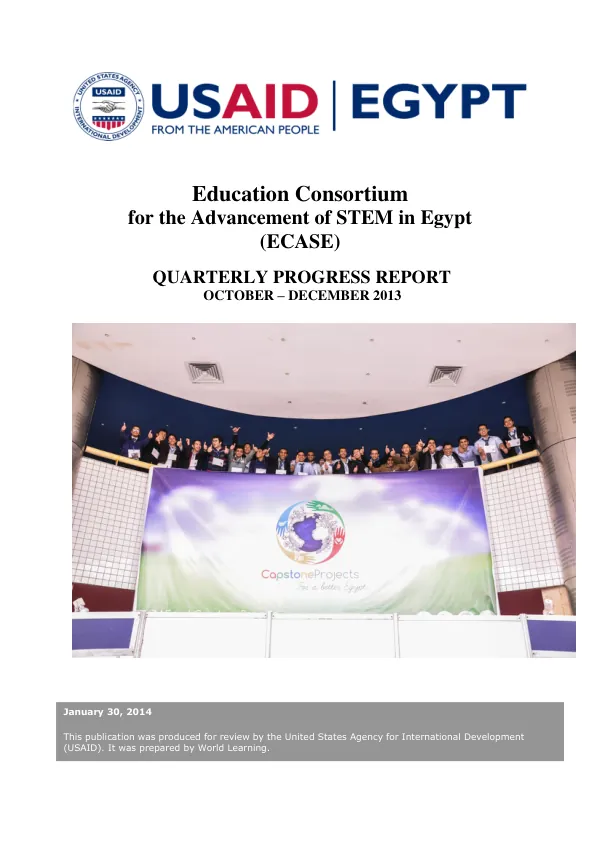
The program is implemented by World Learning in collaboration with consortium partners, including the 21st Century Partnership for STEM Education (21PSTEM), the Teaching Institute for Excellence in STEM (TIES), and The Franklin Institute (TFI). ECASE has completed the first year of a four-year implementation plan and has started its second year, with a modified wind-up plan in place due to a USAID request to wind up activities. The modified plan focuses on completing a sustainable educational model and concentrating on two existing schools in the greater Cairo area to reduce the time needed to complete this model. The program has received approval for the Wind Up Plan by the end of the first quarter of year two. During the quarter, ECASE supported a visit by USAID Deputy Mission Director Dr. Anne Patterson to the October STEM School. Dr. Patterson met with students, teachers, and the principal to learn about the school's progress and was impressed with the students' ideas and models. The visit provided an opportunity for the students and teachers to interact directly with a senior USAID official. ECASE also initiated a college guidance process to provide support to Grade 3 students at the 6th of October School. The process involved one-on-one support to 27 students interested in international college opportunities, as well as generating usable student transcripts for use by international universities. The ECASE team formalized a plan to utilize the ACT as a college readiness exam and to create tests of concepts and final exams for STEM coursework. The program also supported a capstone exhibition for Semester 1 student work, which resulted in a showcase of prototypes and posters highlighting ongoing project work over the past semester. The capstones offered students connectivity to Egyptian Grand Challenges while integrating with the STEM curriculum in hands-on projects. Highlights of this activity included prototype exhibitions at the 6th of October School and the Ma'adi School, as well as poster presentations at the Educational City main building. ECASE worked on an overarching plan for professional development and accomplished the additional task of delivering one week of pedagogical professional development support and training. The program provided a key STEM curriculum expert on the ground for 9.5 weeks, who provided ongoing expertise and guidance to the schools through curriculum professional development, one-on-one coaching, and evaluation of the Curriculum 1.0 through over 35 classroom observations. The information obtained from these sessions will be used to revise the curriculum for the next semester and to make enhancements for a Curriculum 2.0 release for the STEM schools. The project curriculum team continued their work to develop and refine the STEM curriculum, with a focus on creating a sustainable educational model that can be replicated in other schools. The program's efforts are aimed at improving STEM education in Egypt and providing students with the skills and knowledge needed to succeed in the 21st century.