WORLD LEARNING
ECASE 6th Quarterly Report, January – March 2014
The Education Consortium for the Advancement of STEM in Egypt (ECASE) Program, funded by the United States Agency for International Development (USAID), has made significant progress in implementing its activities from January 1, 2014 to March 31, 2014.
2014 · 91 pages
Sign in to readA free account is required to download.
Abstract
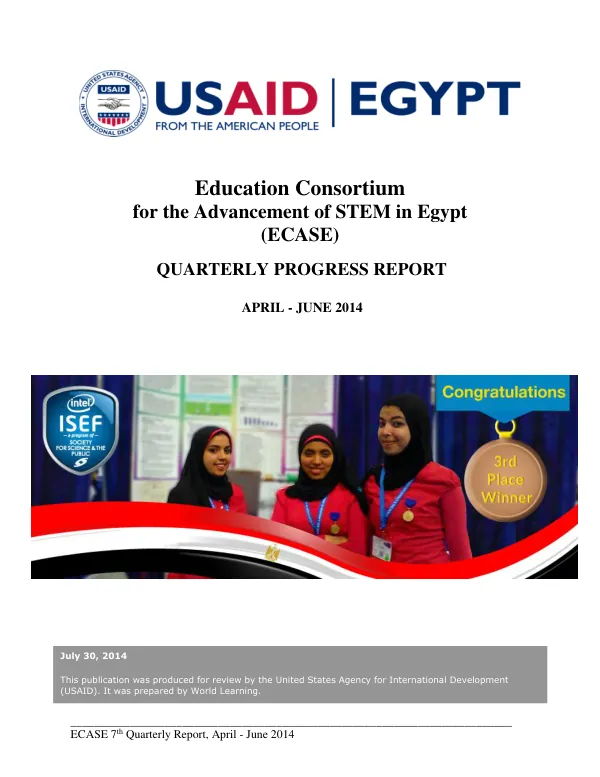
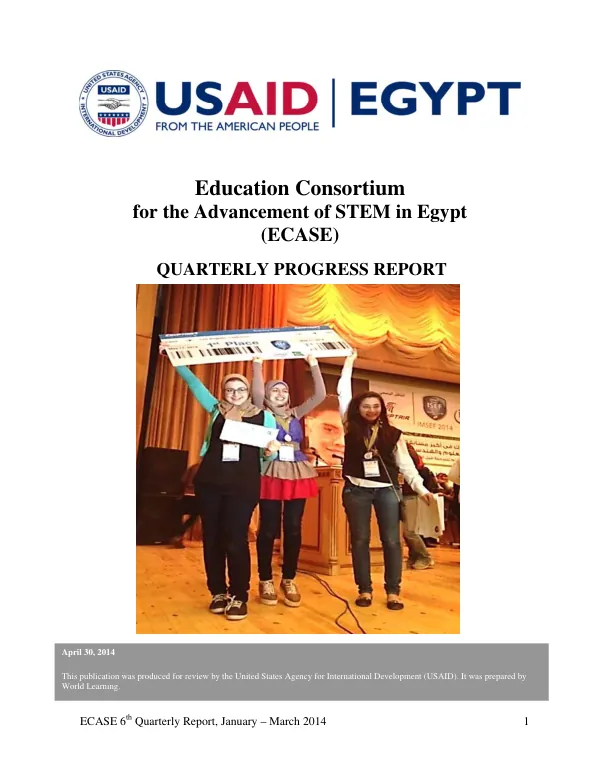
The program's main objective is to advance science, technology, engineering, and mathematics (STEM) education in Egypt. Professional Development (PD) was a key focus area during this quarter. An 18-member team from partner organizations, including 21PSTEM, TIES, and TFI, conducted intensive training of new teachers in STEM pedagogy, the integrated curriculum, and assessment approaches. The training sessions were held in Cairo and supported by ECASE, which worked with new teachers on pedagogy and supported humanities teachers in their curriculum development. The training also included preparation for the exhibition and grading of Semester 2 capstones. The Intel International Science & Engineering Fair (ISEF) was another significant activity during this quarter. STEM students from both schools submitted a total of 49 projects to the Intel-ISEF Egypt Competition, resulting in 25 projects that made it to the ISEF Egypt Final Evaluation. A group of students from the Maadi STEM School won the First Place Prize at the final competition in Cairo for their project 'Water Desalination Using Nano-Technology', and another group from the Maadi STEM School made it to the Second Place Prize at the final competition in Alexandria for their project 'Water Purification'. In addition, 20 students from both schools won 12 different individual and honorable prizes from a total of 20 prizes provided. Extra-curricular activities were also launched during this quarter. The EiPIC program was launched at both STEM schools in March 2014, with the aim of engaging Egyptian youth in methods to capture intellectual property and bring innovative ideas to fruition. The launch was well received, and several applications have been submitted as of the time of this report. ECASE also worked on codifying the STEM model through a STEM School Design Blueprint. The Blueprint is tied to the Egyptian STEM School Design Principles and the partner work in the annual implementation plan (AIP). Codification of the STEM model through the Design Blueprint will enable a sustainable model and protocols for use by the MOE STEM Unit, existing schools, and new STEM schools. To ensure sustainability, ECASE has had collaborative engagements with the newly established MOE STEM Unit to enable the transfer of knowledge and local ownership of the STEM model. ECASE has provided trainings to the members of the Unit on the overall STEM design system and integration of the curriculum, including the role of capstones. The team has also been working with the Curriculum Sub-Group of the MOE STEM Unit to transfer knowledge and to enable localization and contextualization of the STEM curriculum in preparation for v 2.0. Professional development sessions were also implemented for new teachers at both 6th of October and Ma'adi schools. The MOE STEM Unit held regular workshop sessions every Wednesday to build local capacity. A total of 147 participants (103 males and 44 females) attended the training sessions during this quarter.
Related documents