USAID DEC
A 10-year cohort analysis of routine paediatric ART data in a rural South African setting
Sign inANOVA HEALTH INSTITUTE
A 10-year cohort analysis of routine paediatric ART data in a rural South African setting
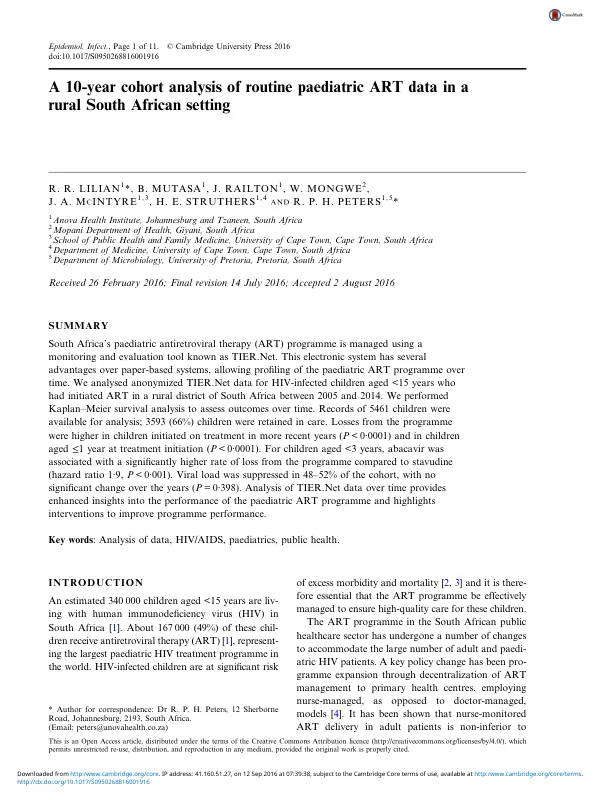
South Africa's paediatric antiretroviral therapy (ART) programme is managed using a monitoring and evaluation tool known as TIER.Net.
2016 · 11 pages
Sign in to readA free account is required to download.
Abstract
This electronic system has several advantages over paper-based systems, allowing profiling of the paediatric ART programme over time. The programme is designed to provide high-quality care for HIV-infected children, who are at significant risk of excess morbidity and mortality. The ART programme in the South African public healthcare sector has undergone a number of changes to accommodate the large number of adult and paediatric HIV patients. A key policy change has been programme expansion through decentralization of ART management to primary health centres, employing nurse-managed models. Task-shifting of ART initiation and management to non-physicians for paediatric patients has also been shown to provide comparable clinical and programme outcomes. Expansion of the ART programme has necessitated an efficient monitoring and evaluation (M&E) system to manage the increasing number of children on ART. In December 2010, the South African National Department of Health adopted an ART M&E tool known as TIER.Net, which was developed by the University of Cape Town's Centre for Infectious Disease Epidemiology and Research. TIER.Net is a three-phase system, progressing from paper registers to stand-alone electronic registers and finally to networked electronic medical records. The study analysed routinely available, anonymized TIER.Net data for children initiating ART in Mopani district of Limpopo Province, South Africa, between January 2005 and December 2014. The data were extracted from TIER.Net in February 2015, and 5461 records were available for analysis. The study found that losses from the programme were higher in children initiated on treatment in more recent years and in children aged ≤1 year at treatment initiation. For children aged <3 years, abacavir was associated with a significantly higher rate of loss from the programme compared to stavudine. Viral load was suppressed in 48-52% of the cohort, with no significant change over the years. The study highlights the importance of the availability of such data and provides insights into the performance of the paediatric ART programme. The analysis demonstrates associations between programme expansion and patient outcomes, and provides opportunities for comparing cohorts over time and between time periods. These insights are essential to improve the long-term effectiveness of the ART programme and are particularly important as the programme is expanded to achieve 90-90-90 targets. The study used Kaplan-Meier survival analysis to assess outcomes over time and found that children who initiated ART in more recent years had higher losses from the programme. The study also found that children aged ≤1 year at treatment initiation had higher losses from the programme. The analysis of TIER.Net data over time provides enhanced insights into the performance of the paediatric ART programme and highlights interventions to improve programme performance. The study demonstrates the value of electronic data in monitoring and evaluating the paediatric ART programme and provides a valuable opportunity to assess programme performance over time.
Related documents