JHPIEGO
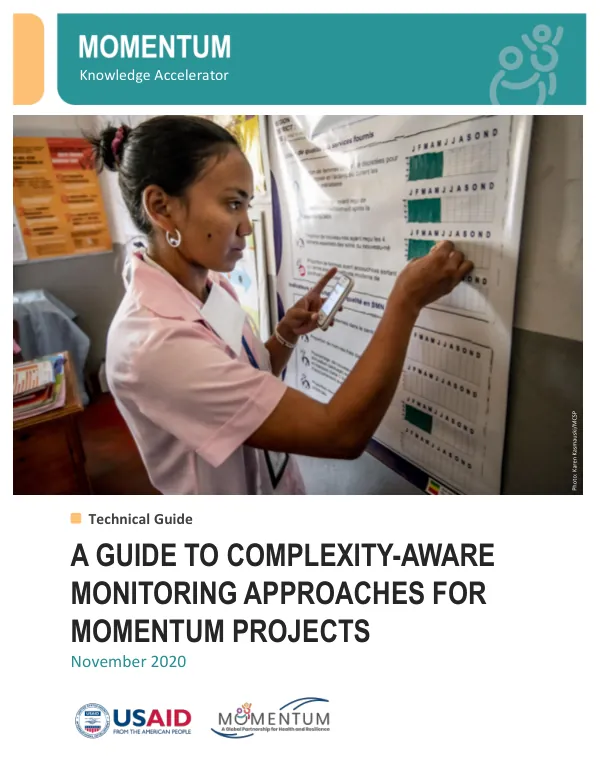
A GUIDE TO COMPLEXITY-AWARE MONITORING APPROACHES FOR MOMENTUM PROJECTS
Complexity-aware monitoring approaches are designed to address the inherently unpredictable and uncertain nature of complex situations.
2020 · 34 pages
Sign in to readA free account is required to download.
Abstract
These approaches recognize that traditional monitoring and evaluation (M&E) methods may not be sufficient to capture the dynamic and adaptive nature of complex systems. In complex situations, there is often a lack of strong expertise and agreement on what needs to be done, making it challenging to design and implement effective interventions. Complexity-aware monitoring approaches focus on outcome-level changes, which are beyond the direct control of the project but within the project's realm of influence. These approaches aim to capture the changes that occur as a result of the project's interventions, rather than just tracking outputs or activities. By focusing on outcomes, complexity-aware monitoring approaches can provide a more nuanced understanding of the project's impact and effectiveness. There are several complexity-aware monitoring approaches that can be used in MOMENTUM projects. These include Social Network Analysis, Causal Link Monitoring, Outcome Mapping, Sentinel Indicators, Pause and Reflect, Outcome Harvesting, Most Significant Change, Ripple Effects Mapping, and Contribution Analysis. Each of these approaches has its own strengths and limitations, and can be used in different contexts to suit the needs of the project. Social Network Analysis, for example, is a method that examines the relationships and interactions between individuals and groups within a system. This approach can help to identify key influencers, networks, and relationships that can inform project design and implementation. Causal Link Monitoring, on the other hand, is a method that examines the causal relationships between different variables and outcomes. This approach can help to identify the underlying drivers of change and inform project interventions. Outcome Mapping is a method that focuses on identifying and tracking outcomes at the individual, community, and system levels. This approach can help to provide a more nuanced understanding of the project's impact and effectiveness. Sentinel Indicators, Pause and Reflect, Outcome Harvesting, Most Significant Change, Ripple Effects Mapping, and Contribution Analysis are other complexity-aware monitoring approaches that can be used in MOMENTUM projects. These approaches can be used in different contexts to suit the needs of the project. For example, Social Network Analysis may be used in a project that aims to improve maternal health outcomes in a rural community, while Causal Link Monitoring may be used in a project that aims to improve access to family planning services in a urban setting. The MOMENTUM Complexity-Aware Monitoring Methods Technical Guide provides a comprehensive overview of these approaches and their applications in MOMENTUM projects. The guide is designed to support project staff and stakeholders in selecting and implementing complexity-aware monitoring approaches that are tailored to the needs of their project. The guide is the result of a collaborative effort between the MOMENTUM Knowledge Accelerator and various partners, including the U.S. Agency for International Development (USAID) and the Population Reference Bureau (PRB). The guide is intended to provide a practical resource for project staff and stakeholders who are seeking to improve the effectiveness and impact of their projects. The guide is organized into several sections, including an overview of complexity-aware monitoring approaches, a description of the different approaches, and a discussion of the applications and limitations of each approach. The guide also includes a glossary of terms and abbreviations, as well as a list of cross-cutting references and resources.