USAID DEC
Access to and use gaps of insecticide-treated nets among communities in Jimma Zone, southwestern Ethiopia: baseline results from malaria interventions
Sign inLINCOLN UNIVERSITY
Access to and use gaps of insecticide-treated nets among communities in Jimma Zone, southwestern Ethiopia: baseline results from malaria interventions
The study aimed to determine access to and use gaps of long-lasting insecticidal nets (LLINs) in malaria endemic settings in southwestern Ethiopia.
2015 · 11 pages
Sign in to readA free account is required to download.
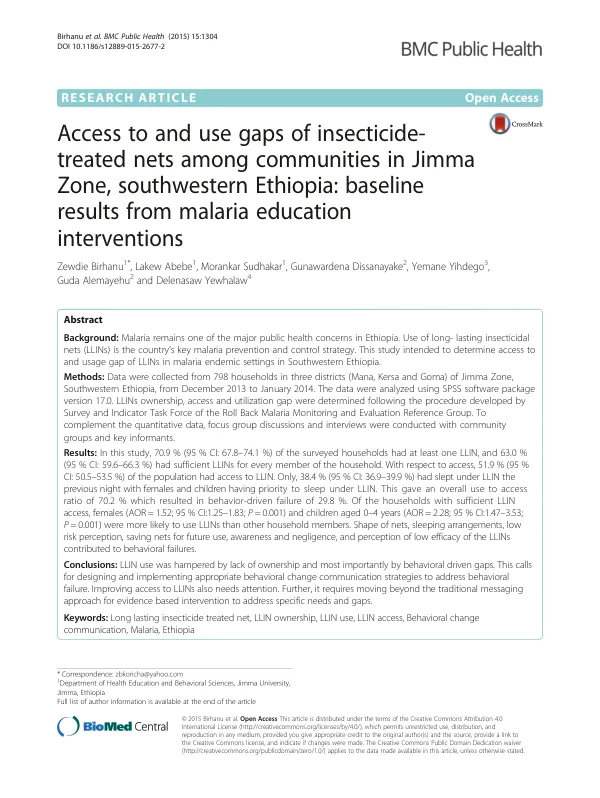
Abstract
Data were collected from 798 households in three districts (Mana, Kersa, and Goma) of Jimma Zone, Southwestern Ethiopia, from December 2013 to January 2014. The study found that 70.9% of the surveyed households had at least one LLIN, and 63.0% had sufficient LLINs for every member of the household. However, only 38.4% of the population had access to LLINs, and 29.8% of households with sufficient LLINs did not use them. The study also found that females and children under 5 years old were more likely to use LLINs than other household members. The main reasons for non-use of LLINs were lack of ownership and behavioral-driven failure, including low risk perception, low risk perception, and negligence. The study recommended designing and implementing appropriate behavioral change communication strategies to address behavioral failure and improving access to LLINs. The study area is located in Jimma Zone, Southwestern Ethiopia, and has a total population of 213,023. The district is situated at an altitude that ranges from 1380 to 1680 m, and about 20.1% of the landmass is swampy. The population of the district is predominantly Oromo, and the majority of inhabitants are Muslim. Malaria transmission is seasonal, with peak transmission occurring between September and December. The study used two main indicators to measure LLIN use: the proportion of households with at least one LLIN and the proportion of the population with access to an LLIN within the household. The study also used focus group discussions and key informant interviews to complement the quantitative data. The study found that the proportion of households with at least one LLIN was 70.9%, and the proportion of the population with access to an LLIN within the household was 51.7%. The study recommended that the government and malaria partners should focus on improving access to LLINs and designing and implementing appropriate behavioral change communication strategies to address behavioral failure. The study also recommended that the government should update its plan to achieve universal access and use of LLINs by 2015 and eventually eliminate malaria by 2040-2050. The study's findings have implications for malaria control and prevention efforts in Ethiopia. The study's recommendations highlight the need for a comprehensive approach to malaria control and prevention that addresses both access and use gaps of LLINs. The study's findings also emphasize the importance of behavioral change communication strategies in addressing behavioral-driven failure. The study's methodology involved collecting data from 798 households in three districts of Jimma Zone, Southwestern Ethiopia. The data were collected using a community-based cross-sectional study design. The study used two main indicators to measure LLIN use: the proportion of households with at least one LLIN and the proportion of the population with access to an LLIN within the household. The study also used focus group discussions and key informant interviews to complement the quantitative data.