USAID DEC
ACIP Mid-term Impact Evaluation – Annexes
The ACIP Mid-term Impact Evaluation was conducted to assess the program's contributions to significant and sustainable change in the socioeconomic and political inclusion of indigenous and Afro-Colombian populations in targeted geographic areas.
2016 · 179 pages
Sign in to readA free account is required to download.
Abstract
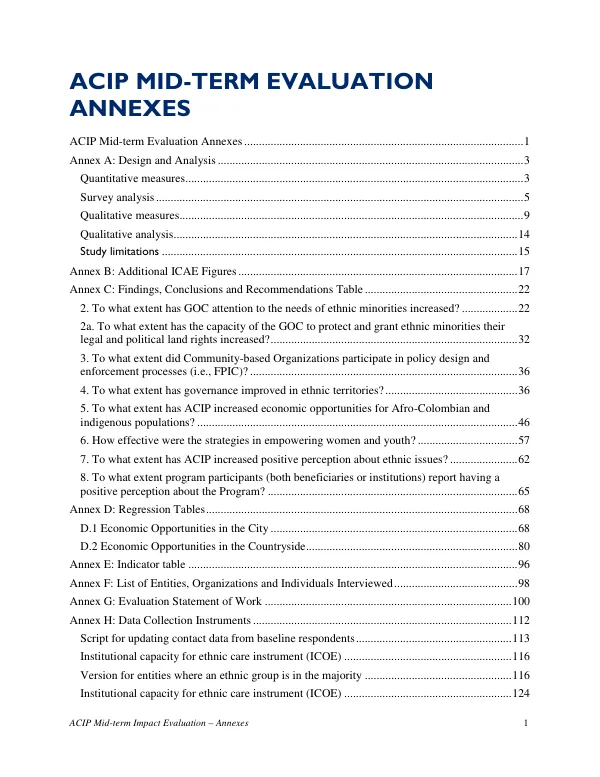
A mixed methods approach was used, combining qualitative and quantitative measures to examine a set of indicators for each result pursued by the program. The evaluation sought to understand changes in policies, practices, attitudes, and decision-making among community-based organizations and partner institutions with respect to ethnic populations. The survey design, instruments, and samples established at baseline were continued in this mid-term measure to conserve comparability. A control sample interviewed at baseline was re-interviewed, allowing detection of program impact over time. The evaluation also replicated the baseline data on attitudes and perceptions of ethnic groups to measure the influence ACIP may have had through cultural activities and promoting ethnic heritage in the media. Structured interviews were conducted with institutions and organizations involved with ACIP, using the same instruments as at baseline to capture change over time on indices of key practices related to ethnic care, institutionality, and community representation. The survey instruments were structured as a traditional household survey, differentiated for rural and urban participants. They included modules on contact and demographic data, housing, media consumption and perceptions of ethnic groups, participation and community activities, perceptions of the ACIP program, household income and transfers, household expenditures and food security, characterization of land ownership, sale, and use for productive projects, and savings and debts. The evaluation surveyed 2,368 participants in economic opportunity programming, with a total of 958 participants in the urban area and 676 participants in the rural area. The survey design used a quasi-experimental method called Covariate Balance Propensity Score (CBPS) to choose control groups for both the urban and rural components of Result 3. This method balances treatments and control groups across a wide range of individual and household-level characteristics, making them comparable. However, some characteristics remain unbalanced, and empirical analysis should control for relevant characteristics. The evaluation team also conducted structured interviews with institutions and organizations involved with ACIP, using the same instruments as at baseline to capture change over time on indices of key practices related to ethnic care, institutionality, and community representation. The evaluation team used regression tables to analyze the data, with separate tables for economic opportunities in the city and the countryside. The tables show the results of the analysis, including the impact of the program on economic opportunities, household income, and food security. The evaluation also used an indicator table to summarize the results of the analysis, showing the impact of the program on various indicators, including economic opportunities, household income, and food security. The evaluation team conducted structured interviews with institutions and organizations involved with ACIP, using the same instruments as at baseline to capture change over time on indices of key practices related to ethnic care, institutionality, and community representation. The interviews were conducted with a total of 120 institutions and organizations, including community-based organizations, partner institutions, and government agencies. The evaluation team also conducted focus group discussions with community members and leaders, using a guide to facilitate the discussion and ensure that all relevant topics were covered. The evaluation team used a mixed methods approach to analyze the data, combining qualitative and quantitative measures to examine a set of indicators for each result pursued by the program. The evaluation sought to understand changes in policies, practices, attitudes, and decision-making among community-based organizations and partner institutions with respect to ethnic populations. The evaluation team used regression tables to analyze the data, with separate tables for economic opportunities in the city and the countryside. The tables show the results of the analysis, including the impact of the program on economic opportunities, household income, and food security.