DEMOCRACY INTERNATIONAL, INC.
Buenaventura: Memory as a mechanism for reconciliation
Buenaventura, a city in Colombia, is characterized by a lack of trust in the state, uncertain rights to life and security, and limited opportunities for access to social rights such as education, health, employment, and housing.
2020 · 4 pages
Sign in to readA free account is required to download.
Abstract
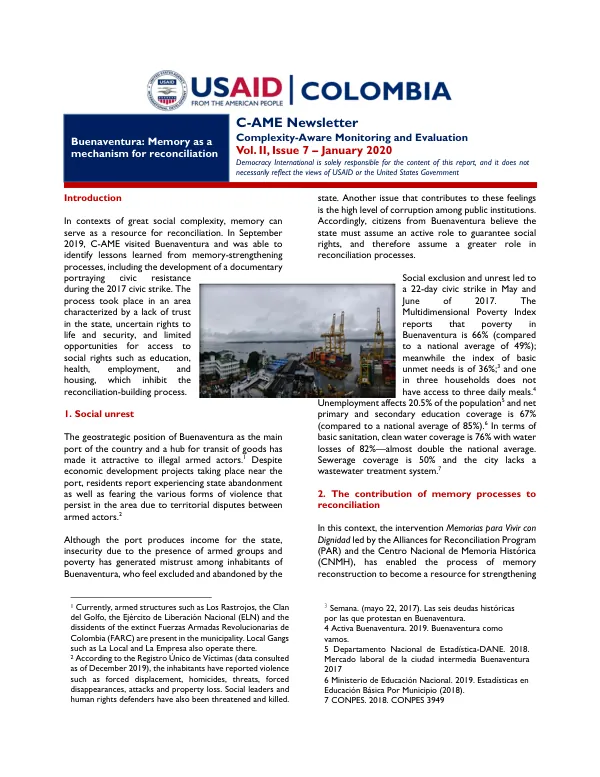
This context has led to social unrest, with residents experiencing state abandonment and fearing various forms of violence due to territorial disputes between armed actors. The city's geostrategic position as the main port of the country and a hub for transit of goods has made it attractive to illegal armed actors. The presence of armed groups and poverty has generated mistrust among inhabitants of Buenaventura, who feel excluded and abandoned by the state. Another issue contributing to these feelings is the high level of corruption among public institutions. Citizens from Buenaventura believe the state must assume an active role to guarantee social rights and therefore assume a greater role in reconciliation processes. Social exclusion and unrest led to a 22-day civic strike in May and June of 2017. The Multidimensional Poverty Index reports that poverty in Buenaventura is 66% (compared to a national average of 49%), while the index of basic unmet needs is 36%. One in three households does not have access to three daily meals. Unemployment affects 20.5% of the population, and net primary and secondary education coverage is 67% (compared to a national average of 85%). In terms of basic sanitation, clean water coverage is 76% with water losses of 82%—almost double the national average. Sewerage coverage is 50%, and the city lacks a wastewater treatment system. In this context, the intervention Memorias para Vivir con Dignidad led by the Alliances for Reconciliation Program (PAR) and the Centro Nacional de Memoria Histórica (CNMH) has enabled the process of memory reconstruction to become a resource for strengthening reconciliation. The Memorias initiative achieved this by producing a documentary depicting the resistance that took place during the civic strike of 2017. The process helped to increase empowerment and strengthen collective action mechanisms. The documentary film recognized the actors and social movements that came together to protest socio-economic inequality and insecurity. The CNMH intervention, with support from PAR, improved the capacity of the actors linked to the strike committee to influence public agendas through meetings and dialogue between these actors. Additionally, this process contributed to improving the participants' self-trust by allowing them to identify convergent narratives and common causes and objectives with other social actors. The project fostered spaces for dialogue among community members that resulted in the identification of security risks affecting social leaders and human rights defenders in the beneficiary communities. The workshops for the production of the documentary led to meetings between people from neighborhoods separated by invisible borders created by territorial disputes between illegal armed actors. These meetings resulted in greater community cohesion and recognition of the skills communities use to manage situations of insecurity. Despite the obstacles associated with the insecurity of social leaders and human rights defenders, the beneficiary organization (Sueños Reales) continued to work towards achieving the project's objectives. As part of this process, the meetings for the production of the documentary brought together actors who face security risks in different parts of the city where invisible borders limit their free movement. These meetings contributed to the construction of communication networks that aim to generate mechanisms for confronting risks that affect community leaders in contexts of high insecurity. Memorias para Vivir con Dignidad drew on and strengthened local reconciliation narratives. The project highlighted these narratives by creating spaces to discuss the demands of the actors who participated in the civic strike. According to C-AME's interviews with beneficiaries and actors, reconciliation involves continuous dialogue between civil society and the state in order to guarantee social and economic rights. The memory processes carried out during implementation made it possible to raise awareness of the relevance of these social demands. This also led participants to reflect on their role as agents of change in their communities. The learning processes associated with this type of initiative account for the variety of ideas about reconciliation that exist in the areas in which PAR operates. It is therefore necessary to update methodologies to promote dialogue between PAR's definition of reconciliation and local definitions. This dialogue would create feedback that may be useful for strengthening the operational definition of reconciliation for PAR's use in its implementation processes.