USAID
Co-Creation Fact Sheet
Co-creation is a collaborative approach to development that brings together diverse stakeholders to design and create solutions to complex problems.
2016 · 2 pages
Sign in to readA free account is required to download.
Abstract
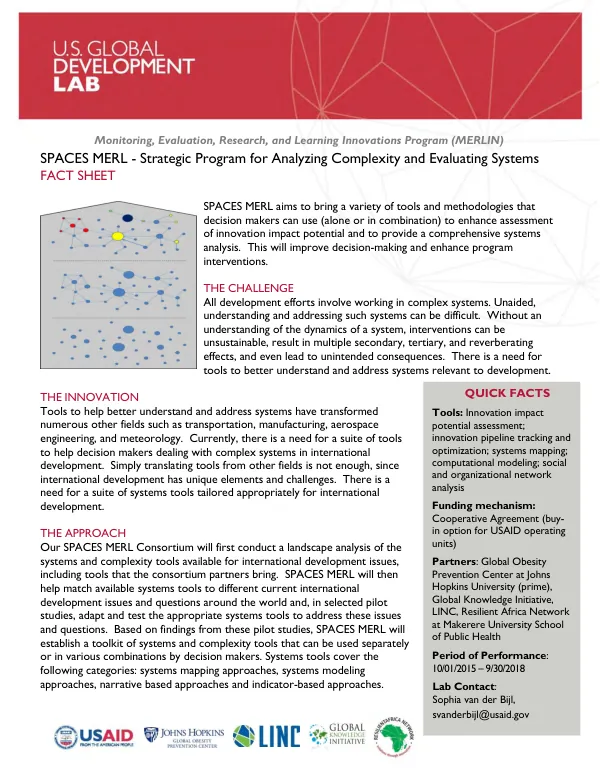
This process involves shared power, decision-making, and value between participants, allowing for a holistic understanding of challenges and the generation of innovative solutions. Co-creation can take many forms, including one-on-one collaborations, small group work, or large-scale stakeholder engagements focused on specific challenges. The benefits of co-creation include the incorporation of diverse perspectives and skill sets, leading to outputs that reflect a broad range of views and foster broad buy-in. This approach enables the testing of assumptions, building of consensus, and refinement of ideas and concepts. Co-creation is flexible and can be applied at various stages of a project cycle, from strategic planning to project closedown. USAID's MERLIN program is an example of co-creation in action. This initiative brings together experts to identify, design, and test ways to measure the impact of development activities. A consortium of over 30 partners has contributed to the design of 10 MERL concepts, including four unique concepts being rolled out as pilots. These pilots aim to support different types of USAID projects during various phases, including planning, startup, implementation, and closedown. Another example of co-creation is the Family Care First Cambodia (FCFC) program. This initiative seeks to prevent the unnecessary separation of children from their families in Cambodia. In 2015, FCFC brought together 42 practitioners, academics, and donors to work toward promoting family-based care for vulnerable children. Today, two interconnected system-based solutions from the workshop are being implemented in Cambodia with support from entire communities. The Haiti Financial Inclusion Initiative is another example of co-creation in practice. This work aims to make financial services available to all Haitians. From 2009 to 2015, the Haiti Integrated Finance for Value Chains and Enterprises (HIFIVE) project and 60 financial institutions in Haiti developed over 120 financial products to support the agricultural sector. At the close of HIFIVE, USAID/Haiti released a Broad Agency Announcement to develop the next phase of programming, partnering with new companies and local organizations to discover, test, and accelerate potential solutions in payments, savings, credit, and insurance in support of the Haitian government's national financial inclusion strategy. Co-creation is a key component of the U.S. Global Development Lab's approach to innovation. The Lab seeks to advance a culture of innovation for better outcomes by supporting the Agency and its partners to incentivize more people to innovate and solve development challenges.
Related documents