JSI RESEARCH & TRAINING INSTITUTE, INC
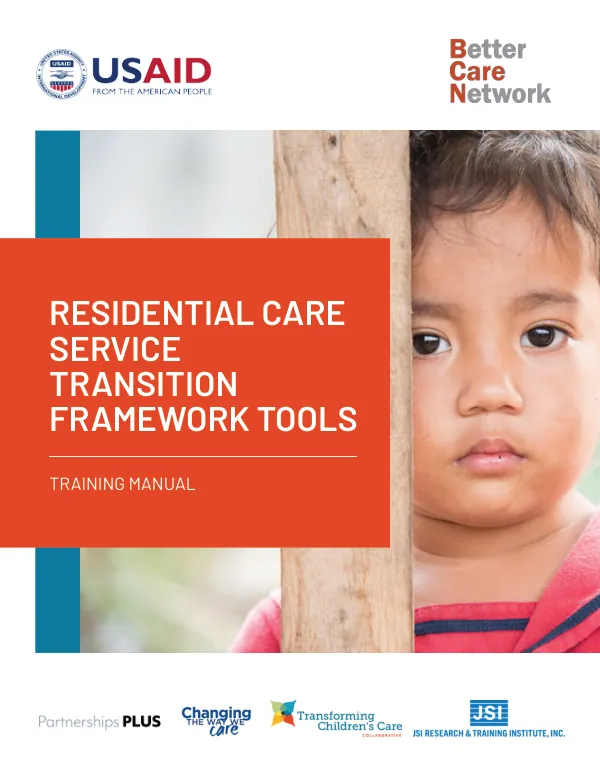
Residential Care Service Transition Framework Tools Training Manual
The Residential Care Services Transition Framework Tools Training Manual was developed as part of the Global Transition Working Group's efforts to build capacity at the national level to accelerate the transition of residential care services.
161 pages
Sign in to readA free account is required to download.
Abstract
The training is designed to be delivered as a face-to-face workshop for social workers and practitioners involved in the provision of technical support to residential care services undergoing transition. The objective of the training is to build the capacity of social workers and practitioners to integrate three consensus-based technical tools that comprise the transition framework into their practice. These tools include the Phases of Transition Interactive Diagram, the Transitioning Residential Models of Care Assessment Tool, and the Transitioning Residential Care Cost Estimation Tool. The training is divided into four parts and comprises 13 interactive sessions designed to be delivered over a minimum of 3 days. In addition to sessions focused on the three technical tools, the training includes a session that links the transition of residential care services to wider care reforms and a session on managing risks, focusing on detecting and responding to trafficking and exploitation in residential care settings. The training draws heavily on content developed and included in other resources developed by BCN and partners, including the Transitioning Models of Care Manual and training videos, the Transition Capacity Building Roadmap, and the About Orphanage Trafficking: Indicators and Descriptions resources. The training manual includes guidance for trainers and is accompanied by a set of training slides and links to other resources that can be used in the delivery of the training. These resources and links can be found in the annex section of the manual. Trainers for the Transition Framework Tools Training are expected to have the following skills, knowledge, and experience. They should be able to facilitate learning, have knowledge of key resources, and be able to handle difficult situations, such as topics they may not agree with or that the group may not have consensus on. The training process involves four steps: knowing who, why, and how; planning the training; delivering the training; and evaluating and supporting. The first step is to understand who will be attending the training and collecting their contact details, as well as understanding why training is being requested and ensuring that this training meets the needs of the participants and the capacity gap the requested training aims to address. The ideal participant size is no more than 20 people, and the time that participants have to dedicate to the training is also an important consideration. The training manual provides guidance on how to adapt the training and materials to context, general guidance on effective facilitating and training, and tips for preparing for and running the training.