USAID
Advocacy for the Promotion of Women’s Entrepreneurship in Nepal
Women's entrepreneurship in Nepal has been gaining momentum, with an increasing number of women-led businesses contributing to the national economy.
2019 · 2 pages
Sign in to readA free account is required to download.
Abstract
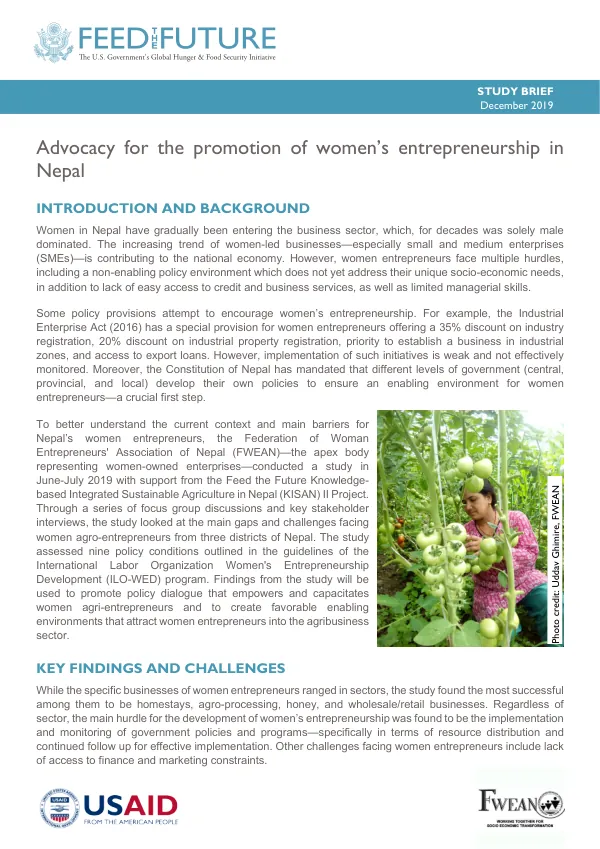
However, women entrepreneurs face significant challenges, including a non-enabling policy environment, limited access to credit and business services, and lack of managerial skills. The Industrial Enterprise Act of 2016 offers provisions to encourage women's entrepreneurship, such as discounted industry registration and priority to establish a business in industrial zones. Despite these initiatives, implementation is weak, and the Constitution of Nepal mandates that different levels of government develop policies to ensure an enabling environment for women entrepreneurs. A study conducted by the Federation of Woman Entrepreneurs' Association of Nepal (FWEAN) in June-July 2019 aimed to better understand the current context and main barriers for Nepal's women entrepreneurs. The study assessed nine policy conditions outlined in the guidelines of the International Labor Organization's Women's Entrepreneurship Development program. The study found that the most successful women entrepreneurs were engaged in homestays, agro-processing, honey, and wholesale/retail businesses. However, the main hurdle for the development of women's entrepreneurship was found to be the implementation and monitoring of government policies and programs, particularly in terms of resource distribution and continued follow-up for effective implementation. In the agriculture sector, women business-owners face challenges related to timely availability of raw materials, quality assurance, and price realization. The supply chain for agricultural commodities is not organized, and many small-scale businesses operated by women entrepreneurs are not profitable due to high costs of purchasing raw inputs and difficulty competing with similar products manufactured by big industries. Women entrepreneurs lack access to quality food processing technologies, packaging, and certification, as well as the skills to adequately market and brand their products. Government subsidy programs in the agriculture sector are not efficient and do not reach actual women entrepreneurs in need of such services. Despite these challenges, women entrepreneurs have found some support networks to turn to, including groups or cooperatives to obtain small loans or to network with other business owners. Existing service providers for women entrepreneurs include the Department of Cottage and Small Industries, Micro Enterprise Development for Poverty Alleviation, Krishi Gyan Kendra, and the Federation of Nepalese Chamber of Commerce & Industries/Agro Enterprise Centre. To improve the enabling environment for women entrepreneurs and increase their active involvement in Nepal's agribusiness sector, several recommendations have been made. These include upscaling and enhancing competitiveness through a collective business model, promoting trade fairs as an ideal platform to showcase products, and implementing policies based on research and piloting catering to various categories of industries.