USAID
Advocacy Outcomes for Victims' Rights in Colombia
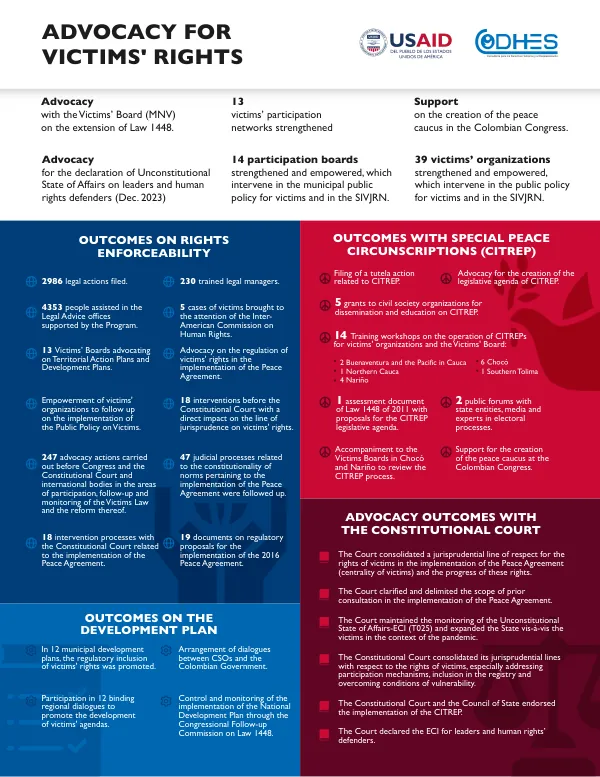
The Development Plan Advocacy for Victims' Rights began with efforts to extend Law 1448 through collaboration with the Victims' Board (MNV).
1 pages
Sign in to readA free account is required to download.
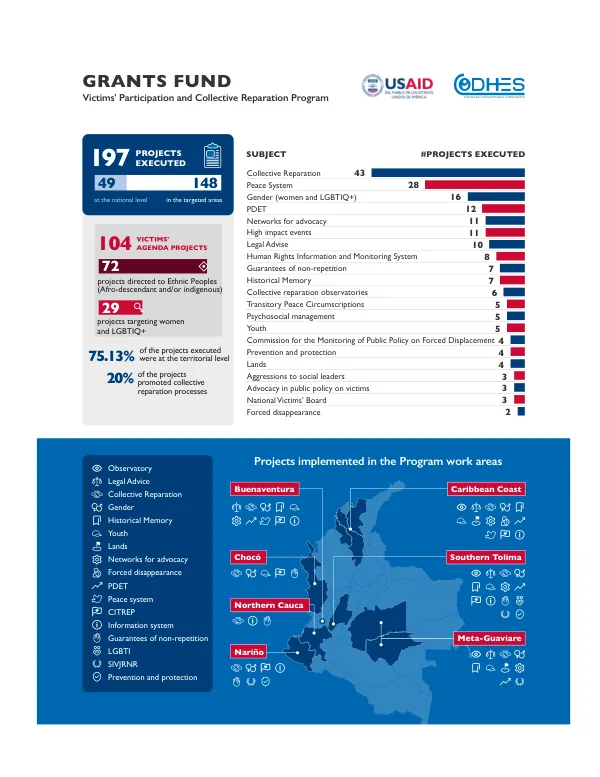
Abstract
This initiative aimed to strengthen victims' participation networks, with 13 networks enhanced to intervene in municipal public policy for victims and the SIVJRN. Additionally, 39 victims' organizations were strengthened and empowered to intervene in public policy for victims and the SIVJRN. The Program also focused on enforcing victims' rights, with 2986 legal actions filed and 230 trained legal managers. The Legal Advice offices supported by the Program assisted 4353 people, and 5 cases of victims were brought to the attention of the Inter-American Commission on Human Rights. Furthermore, 13 Victims' Boards advocated on Territorial Action Plans and Development Plans, and advocacy was conducted on the regulation of victims' rights in the implementation of the Peace Agreement. Empowerment of victims' organizations was also a key aspect of the Program, with 18 interventions before the Constitutional Court having a direct impact on the line of jurisprudence on victims' rights. A total of 247 advocacy actions were carried out before Congress and the Constitutional Court and international bodies in the areas of participation, follow-up, and monitoring of the Victims Law and its reform. The Program also followed up on 47 judicial processes related to the constitutionality of norms pertaining to the implementation of the Peace Agreement. The Program also worked with Special Peace Circumscriptions (CITREP), filing a tutela action related to CITREP and advocating for the creation of the legislative agenda of CITREP. Five grants were provided to civil society organizations for dissemination and education on CITREP, and 14 training workshops were conducted on the operation of CITREPs for victims' organizations and the Victims' Board. Additionally, 2 public forums were held with state entities, media, and experts in electoral processes, and accompaniment was provided to the Victims Boards in Chocó and Nariño to review the CITREP process. The Program also had significant outcomes with the Constitutional Court, which consolidated a jurisprudential line of respect for the rights of victims in the implementation of the Peace Agreement. The Court clarified and delimited the scope of prior consultation in the implementation of the Peace Agreement and maintained the monitoring of the Unconstitutional State of Affairs-ECI (T025). The Constitutional Court also endorsed the implementation of the CITREP and declared the ECI for leaders and human rights' defenders. Furthermore, the Court promoted the regulatory inclusion of victims' rights in 12 municipal development plans and arranged dialogues between CSOs and the Colombian Government.