USAID DEC
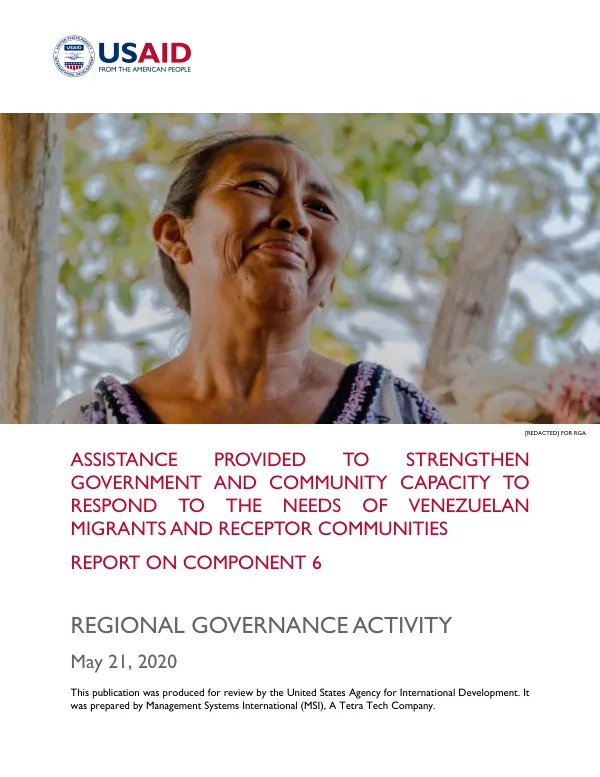
Assistance Provided to Strengthen Government and Community Capacity to Respond to the Needs of Venezuelan Migrants and Receptor Communities: Report on Component 6
Sign inMANAGEMENT SYSTEMS INTERNATIONAL
Assistance Provided to Strengthen Government and Community Capacity to Respond to the Needs of Venezuelan Migrants and Receptor Communities: Report on Component 6
The Regional Governance Activity (RGA) in Colombia began on June 22, 2015, with an initial period of performance of four and a half years.
2020 · 90 pages
Sign in to readA free account is required to download.
Abstract
The original objective was to improve governance in 40 Colombian municipalities affected by the nation's armed conflict through five program components: decentralization, public financial management, tertiary roads, citizen participation, and electoral reform. On April 23, 2019, RGA was awarded a six-month cost extension to June 21, 2020. The amendment added a sixth component and adjusted RGA's territorial focus to concentrate on 10 subnational governments (SNGs) in three border departments - Arauca, La Guajira, and Norte de Santander - to help them cope with the challenges created by the influx of Venezuelan migrants and Colombian returnees in host communities. RGA's Component 6 aimed to strengthen government and community capacity to respond to the needs of Venezuelan migrants and receptor communities. The activity focused on supporting local governments in target regions for health and education services, as well as strengthening civil society organization (CSO) capacities. RGA worked closely with the Government of Colombia (GOC) to provide a coordinated response to the migrant crisis, strengthen local government capacities in resource management and local planning, and build institutional capacity to improve access to public services for migrant, returnee, and host populations. RGA's support to local governments included providing technical assistance and training to improve their capacity to manage resources and plan for local development. The activity also focused on building institutional capacity to improve access to public services, including health and education services, for migrant, returnee, and host populations. RGA worked with CSOs to strengthen their capacities to improve public service provision for migrant and returnee populations, as well as to promote coexistence and citizen oversight. The activity also focused on empowering women and youth, who are disproportionately affected by the migrant crisis. RGA worked with local governments and CSOs to develop and implement programs that promote women's and youth's participation in decision-making processes and provide them with access to education and economic opportunities. RGA's work under Component 6 was guided by a number of key principles, including a commitment to supporting the GOC's efforts to respond to the migrant crisis and promoting a coordinated response to the crisis. The activity also prioritized the needs of vulnerable populations, including women, children, and youth, and sought to promote inclusive and equitable development in the target regions. Throughout the activity, RGA worked closely with a range of stakeholders, including local governments, CSOs, and international organizations. The activity also engaged with a number of key partners, including the GOC, the United Nations High Commissioner for Refugees (UNHCR), and the World Food Program (WFP). The activity's results were significant, with RGA supporting the development of a number of key initiatives, including the creation of a national registry for Venezuelan migrants and the development of a roadmap for Colombian returnees' access to services. RGA also supported the implementation of a number of projects aimed at improving access to health and education services for migrant, returnee, and host populations. Overall, RGA's work under Component 6 was critical to supporting the GOC's efforts to respond to the migrant crisis and promoting a coordinated response to the crisis. The activity's results demonstrate the importance of supporting local governments and CSOs in their efforts to respond to the crisis and promote inclusive and equitable development in the target regions.