USAID
Victims' Participation and Collective Reparation Program
The Victims' Participation and Collective Reparation Program is an initiative of CODHES and USAID that aimed to promote victims' rights to truth, justice, comprehensive reparation, and non-repetition within the current legal framework.
2024 · 2 pages
Sign in to readA free account is required to download.
Abstract
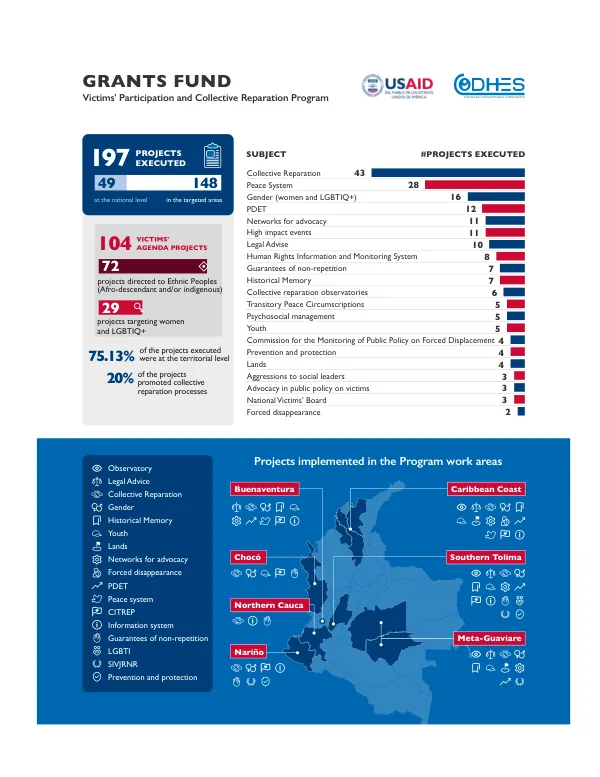
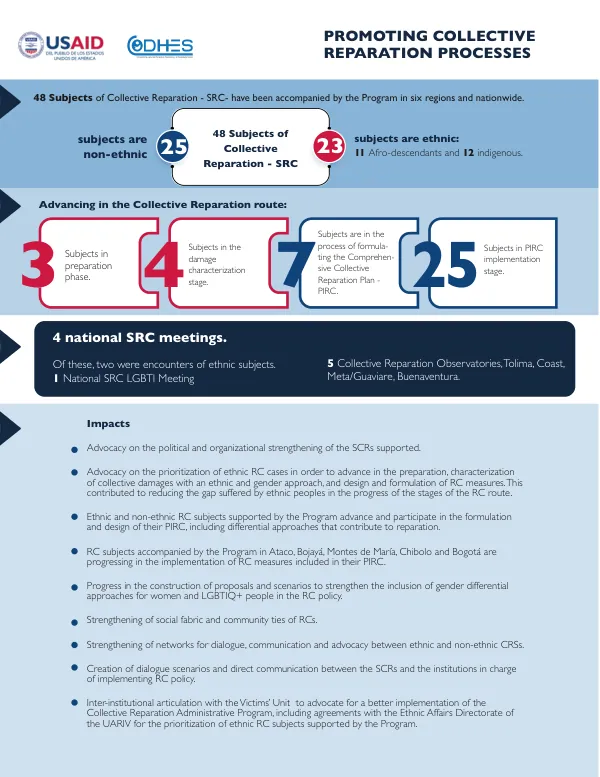
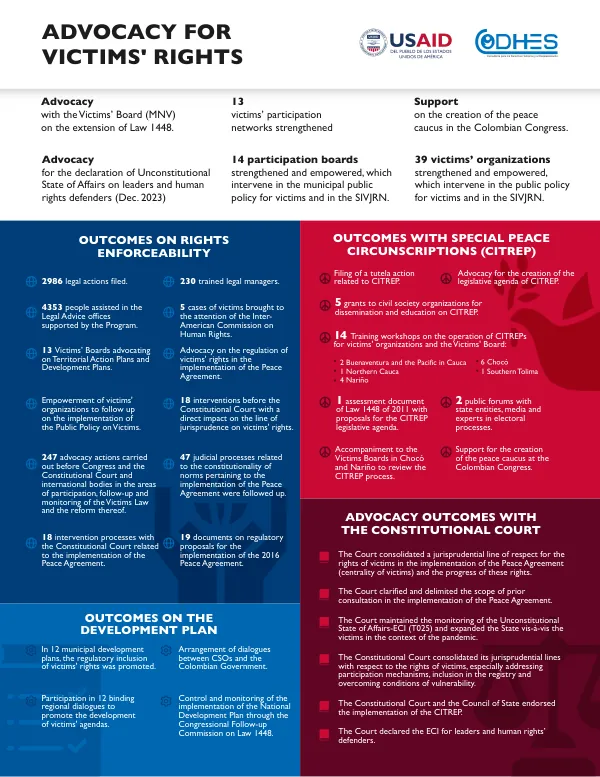
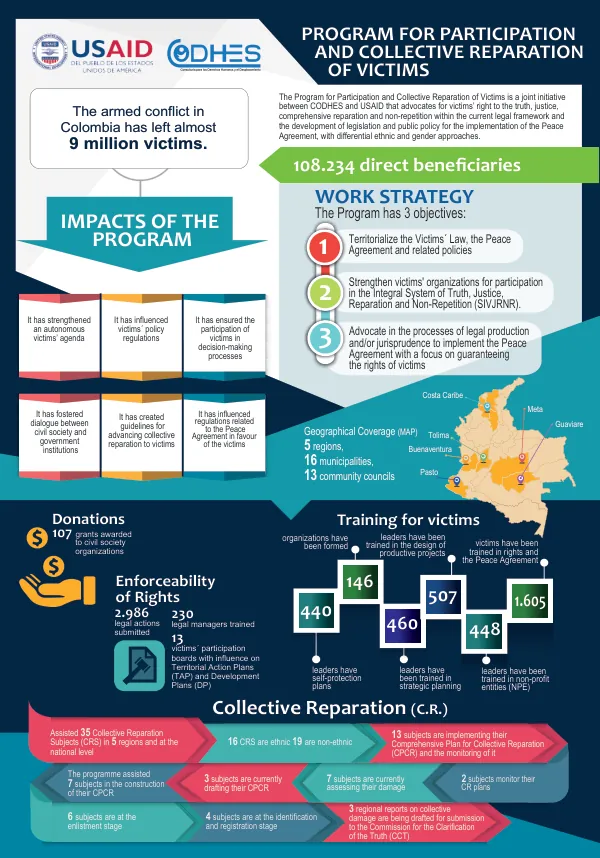
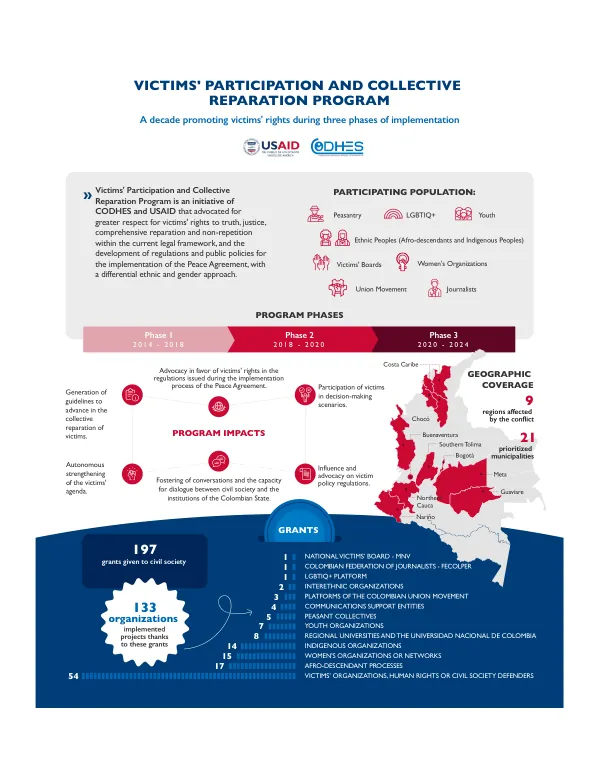
The program focused on developing regulations and public policies for the implementation of the Peace Agreement, with a differential ethnic and gender approach. The program operated in nine regions affected by the conflict, with 21 prioritized municipalities receiving support. A total of 197 grants were given to civil society organizations, with 133 organizations implementing projects thanks to these grants. The program's geographic coverage included Costa Caribe, Southern Tolima, Meta, Bogotá, Chocó, Buenaventura, Northern Cauca, Nariño, and Guaviare. The program's impacts included influencing and advocating for victim policy regulations, participation of victims in decision-making scenarios, autonomous strengthening of the victims' agenda, and generation of guidelines to advance in the collective reparation of victims. The program also provided training to victims and advocacy, with a focus on collective reparation, organizational training, and project design. A total of 507 leaders were trained in strategic planning, 460 in ESAL, and 448 in civil society organizations and victims' organizations. Additionally, 146 organizations were trained in communication ICTs, and 66 in socio-political and advocacy training in areas such as prevention and protection, participation, advocacy, citizen oversight, public victims' policy, peace agreement, transitional justice, territorial development, clarification of truth, collective reparation, and non-repetition. The program supported 48 subjects of collective reparation, with 25 non-ethnic and 23 ethnic subjects receiving support in six regions and nationwide. The program also worked with various institutions, including the Constitutional Court, Congress, National Planning Department, Territorial Entities, Victims' Unit, Ministry of the Interior, Public Ministry Offices, Peace System, and Inter-American System of Human Rights. The program operated in three phases: Phase 1 (2014-2018), Phase 2 (2018-2020), and Phase 3 (2020-2024). During this time, the program provided training to victims and advocacy, collective reparation, organizational training, and project design, ultimately promoting victims' rights and contributing to the implementation of the Peace Agreement.