AGA KHAN FOUNDATION
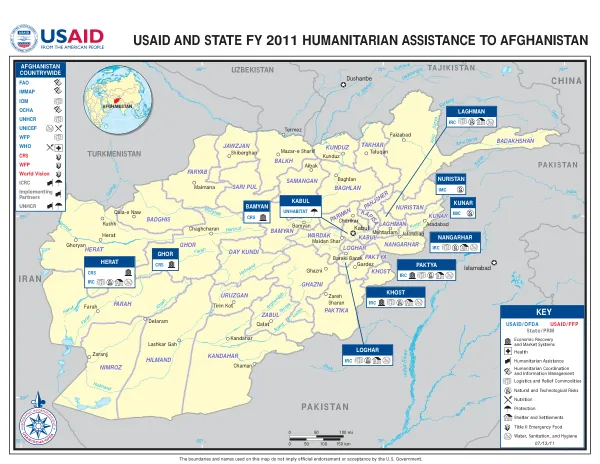
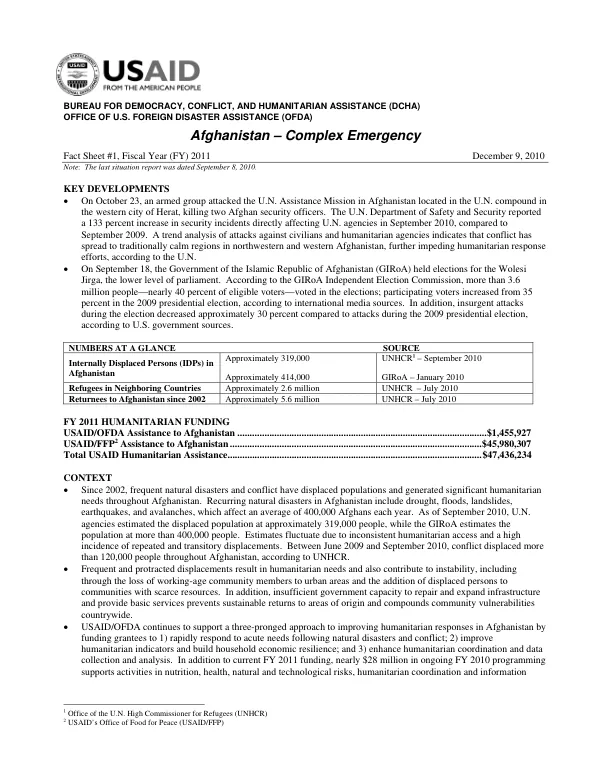
Afghanistan Complex Emergency Fact Sheet #1
The complex emergency in Afghanistan has been ongoing since 2002, with frequent natural disasters and conflict displacing populations and generating significant humanitarian needs throughout the country.
2011 · 3 pages
Sign in to readA free account is required to download.
Abstract
Recurring natural disasters, including drought, floods, landslides, earthquakes, and avalanches, affect an average of 400,000 Afghans each year. As of September 2010, U.N. agencies estimated the displaced population at approximately 319,000 people, while the Government of the Islamic Republic of Afghanistan (GIRoA) estimates the population at more than 400,000 people. The conflict has spread to traditionally calm regions in northwestern and western Afghanistan, further impeding humanitarian response efforts. A trend analysis of attacks against civilians and humanitarian agencies indicates that conflict has increased significantly, with a 133 percent increase in security incidents directly affecting U.N. agencies in September 2010 compared to September 2009. The U.N. Department of Safety and Security reported a 133 percent increase in security incidents directly affecting U.N. agencies in September 2010, compared to September 2009. In September 2010, the GIRoA held elections for the Wolesi Jirga, the lower level of parliament. According to the GIRoA Independent Election Commission, more than 3.6 million people—nearly 40 percent of eligible voters—voted in the elections. Participating voters increased from 35 percent in the 2009 presidential election, according to international media sources. In addition, insurgent attacks during the election decreased approximately 30 percent compared to attacks during the 2009 presidential election, according to U.S. government sources. The humanitarian situation in Afghanistan is characterized by significant needs and vulnerabilities. Approximately 2.6 million refugees reside in neighboring countries, and more than 5.6 million returnees have returned to Afghanistan since 2002. The U.N. estimates that approximately 319,000 people are internally displaced, while the GIRoA estimates the population at more than 400,000 people. The conflict has resulted in significant population movements, with more than 104,000 Afghan refugees returning voluntarily to Afghanistan from Pakistan between March and November 2010. The U.S. Agency for International Development's Office of U.S. Foreign Disaster Assistance (USAID/OFDA) continues to support a three-pronged approach to improving humanitarian responses in Afghanistan. The approach focuses on rapidly responding to acute needs following natural disasters and conflict, improving humanitarian indicators and building household economic resilience, and enhancing humanitarian coordination and data collection and analysis. USAID/OFDA has provided nearly $1.4 million in funding for water, sanitation, and hygiene (WASH) activities in Afghanistan, benefiting more than 250,000 people. The funding supports the construction of sanitation facilities, hygiene education, and provision of clean water supplies. The polio virus remains a significant concern in Afghanistan, with the GIRoA Minister of Health reporting concerns that migrant populations currently residing in Pakistan and Tajikistan may contract the virus and spread it upon return to Afghanistan. In response, the Ministry of Health, the U.N. Children's Fund (UNICEF), and the U.N. World Health Organization (WHO) launched a three-day polio immunization campaign targeting 7.8 million children in all 34 provinces. However, health workers were unable to reach nearly 110,000 children in southern Afghanistan due to insecurity. The agricultural sector in Afghanistan is also facing significant challenges, with regional market disruptions resulting from a food export ban in Pakistan and decreased agricultural production in areas in Afghanistan causing wheat prices to rise 31 percent since July. Afghanistan is likely to experience a 700,000-metric ton shortage of wheat in 2011, which commercial traders will work to fill through wheat imports from Kazakhstan.
Related documents