USAID DEC
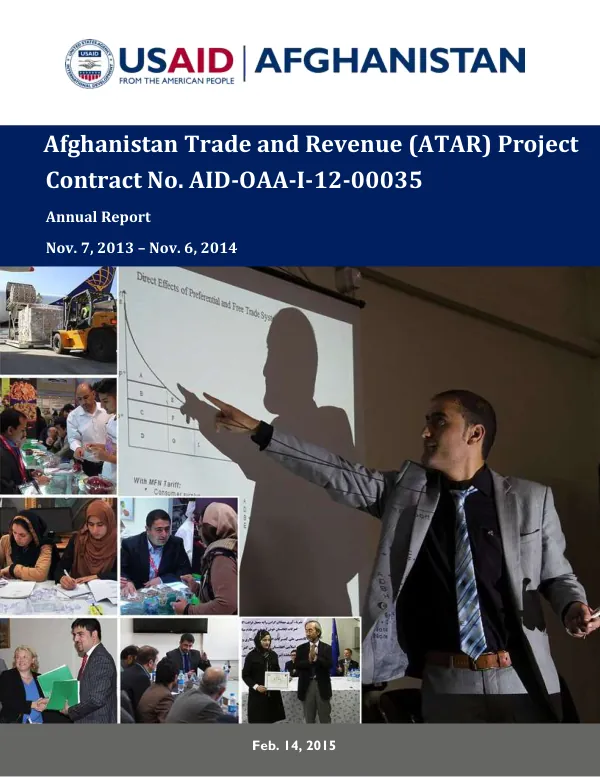
Afghanistan Trade and Revenue (ATAR) Project Nov. 7, 2013-Nov. 6, 2014 Annual Report
Sign inCHEMONICS
Afghanistan Trade and Revenue (ATAR) Project Nov. 7, 2013-Nov. 6, 2014 Annual Report
Afghanistan Trade and Revenue (ATAR) Project began on November 7, 2013, and concluded on November 6, 2014.
2015 · 80 pages
Sign in to readA free account is required to download.
Abstract
The project aimed to enhance Afghanistan's trade and revenue capacity through three main components: trade policy liberalization, facilitating enhanced access to regional markets, and improved customs administration. Trade policy liberalization was a key focus area, with the project supporting the World Trade Organization (WTO) accession process. This involved legislative reforms to ensure WTO conformity, building sustainable capacity for fulfilling key WTO commitments, and strengthening the Afghan National Standards Authority (ANSA). The project also assisted in building capacity and technical sustainability of the WTO unit, trade policy analysis unit, and central statistics office. Facilitating enhanced access to regional markets was another critical component, with the project focusing on Afghanistan's trade relationships with neighboring countries. This included cross-border transport agreements, customs risk management, and electronic data interchange. The project also supported trade and business promotion activities in Afghanistan, the Kyrgyz Republic, Tajikistan, Turkmenistan, and Uzbekistan. Improved customs administration was a third key component, with the project focusing on strengthening the Afghan Customs Department (ACD). This involved improving tax administration, customs administration, and border management. The project also supported the implementation of risk management systems, electronic payment of customs debt, and taxpayer outreach programs. Additionally, the project aimed to increase gender representation at ACD and reduce corruption. The project made significant progress in its first year, with notable achievements in trade policy liberalization, regional market access, and customs administration. The project's indicator performance showed improvements in key areas, including trade facilitation, customs clearance, and revenue collection. Lessons learned from the project highlighted the importance of building sustainable capacity, addressing corruption, and promoting gender equality in customs administration. The project's success was attributed to the collaborative efforts of the Government of Afghanistan, the United States Agency for International Development (USAID), and the project's implementing partner, Chemonics. The project's achievements contributed to the development of Afghanistan's trade and revenue capacity, positioning the country for increased economic growth and integration into regional markets.