USAID DEC
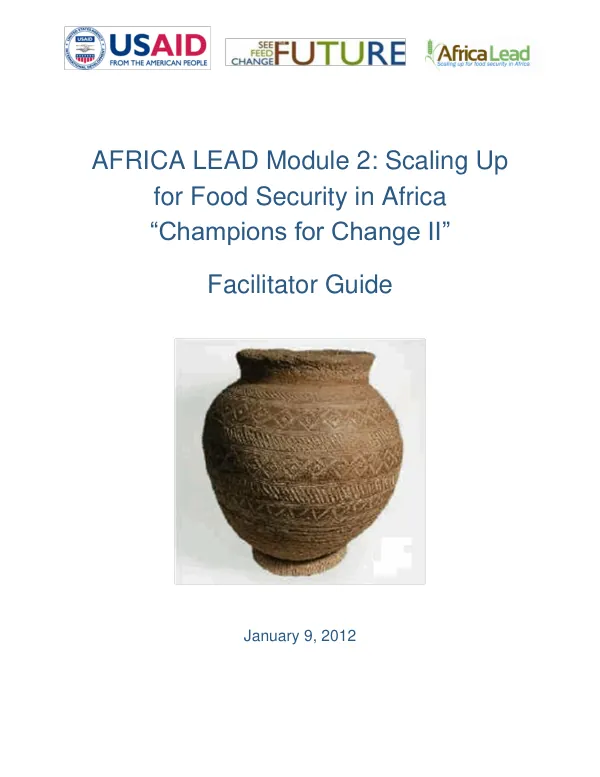
AFRICA LEAD Module 2: Scaling Up for Food Security in Africa "Champions for Change II"
Sign inUSAID DEC
AFRICA LEAD Module 2: Scaling Up for Food Security in Africa "Champions for Change II"
The purpose of the AFRICA LEAD Module 2 workshops is to ensure that country and regional teams and a select group of dynamic champions trained in Module 1 possess the requisite skills to move the NAIP/RAIP implementation process forward.
2012 · 749 pages
Sign in to readA free account is required to download.
Abstract
Module 2 provides skill development to support NAIP/RAIP implementation, strengthen involvement and broaden the inclusiveness of the teams and their supporters in order to create better program results and insure that organizational and unit action plans in support of the CAADP National Agricultural Investment Programs (NAIPs) in each country and Regional Agricultural Investment Programs (RAIPs) are followed and show tangible, positive results. The objectives of the Module 2 intervention are to enable implementation teams of champions to identify and develop strategic coordination mechanisms for CAADP and NAIPs/RAIPs, identify and agree to the most critical steps for CAADP NAIP/RAIP implementation, appreciate the necessary steps and activities in successful program and project design, integrate the project design elements into on-going NAIPs/RAIPs, apply appropriate project management, monitoring and evaluation methodologies to plans and projects, and use the Rapid Results Approach (RRA) to develop 100-day action plans. The target audience for the Module 2 intervention includes select members of country and regional NAIP teams and a select group of dynamic champions trained in Module 1, including representatives of civil society, private sector, government and research organizations that are actively implementing food security/agriculture programs that contribute to NAIP/RAIP objectives. Regional teams will be chosen through regional focal points for the value this workshop will add to their plans and projects. The AFRICA LEAD designers of the Module 2 intervention operated under the assumption that the primary target audience for participating countries and regions would be the country or regional implementation teams, which will include representatives of the CAADP Country Teams (CCTs), regional agricultural and rural development teams, selected Champions from the Module 1 training program, representatives from the ministry of agriculture and other key stakeholders. They also assumed that the most effective and efficient structure would be to focus on work in individual countries and with regional bodies, and that there exists a critical need to support follow-up of the country teams. The Module 2 intervention is designed to provide skill development to support NAIP/RAIP implementation, strengthen involvement and broaden the inclusiveness of the teams and their supporters. The intervention will focus on work in individual countries and with regional bodies, and will provide training and support to country and regional teams and a select group of dynamic champions trained in Module 1. The ultimate goal of the Module 2 intervention is to create better program results and insure that organizational and unit action plans in support of the CAADP National Agricultural Investment Programs (NAIPs) in each country and Regional Agricultural Investment Programs (RAIPs) are followed and show tangible, positive results. The Module 2 intervention will be delivered through a series of workshops and training sessions, which will provide participants with the skills and knowledge necessary to support NAIP/RAIP implementation. The workshops will focus on topics such as project design, project management, monitoring and evaluation, and the Rapid Results Approach (RRA). Participants will also have the opportunity to network with other stakeholders and share best practices. The Module 2 intervention is a critical component of the AFRICA LEAD program, as it provides the necessary skills and knowledge to support NAIP/RAIP implementation. The intervention is designed to build on the knowledge and skills gained in Module 1, and to provide participants with the tools and resources necessary to create better program results.
Related documents